Minnesota DVS permit practice test 9
25 questions written from the Minnesota Driver's Manual, covering hazards, weather and night driving, emergencies, alcohol and drugs, safe and defensive driving, licensing laws and penalties and more. Pick an answer to see straight away whether you're right and why.
-
Question 1When are deer most active?
Show answer
B: Dusk to dawn. Deer are most active from dusk to dawn. Minnesota Driver's Manual: Watch out for deer, page 84.
-
Question 2After a crash, if you don't have your insurance information with you, within how long must you provide it?
Show answer
B: 72 hours. If asked and you do not have it, provide insurance information within 72 hours. Minnesota Driver's Manual: What to do in a traffic crash, page 39.
-
Question 3Where may opened cannabis products be kept in a vehicle on a street or highway?
Show answer
B: In the trunk (or an area not normally occupied if there is no trunk). Opened cannabis or hemp products may be kept in the trunk, or an unoccupied area if no trunk, but not the glove or utility compartment. Minnesota Driver's Manual: Possession and open package law, page 96.
-
Question 4Driver distraction accounts for at least what share of Minnesota crashes each year?
Show answer
C: 25 percent. Driver distraction accounts for at least 25 percent of all crashes annually. Minnesota Driver's Manual: Distracted driving, page 78.
-
Question 5What happens under Vanessa's Law if an unlicensed teen is convicted of a crash-related moving violation?
Show answer
B: They cannot get a license, permit or provisional license until age 18. An unlicensed teen convicted of a crash-related or alcohol/drug violation cannot get a license or permit until 18. Minnesota Driver's Manual: Vanessa's Law, page 15.
-
Question 6What is lane filtering by motorcycles?
Show answer
B: Moving between stopped vehicles, no more than 15 mph faster than traffic. Lane filtering lets a motorcycle move through stopped traffic at no more than 15 mph over the speed of traffic. Minnesota Driver's Manual: Sharing the road with motorcyclists, page 50.
-
Question 7What does this warning sign mean?

Show answer
B: The road you are on ends; prepare to turn right or left (T-intersection). T-Intersection Ahead: the road ends soon; prepare to turn right or left and yield to cross traffic. Minnesota Driver's Manual: Intersection warning signs, page 61.
-
Question 8You see the reflection of deer eyes at the roadside. What should you do?
Show answer
B: Slow down, blow the horn and be ready to stop. If you see the reflection, slow down, blow the horn, be ready to stop, and watch for more than one deer. Minnesota Driver's Manual: Watch out for deer, page 84.
-
Question 9Who is most often killed in an alcohol-related crash in Minnesota?
Show answer
B: The impaired driver. The person most often killed in an alcohol-related crash is the impaired driver. Minnesota Driver's Manual: Alcohol and driving, page 91.
-
Question 10Which is a 'cognitive' distraction?
Show answer
B: Being lost in thought. Cognitive distraction is being 'lost in thought'; visual is looking away and mechanical is hands off the wheel. Minnesota Driver's Manual: Distracted driving, page 78.
-
Question 11What vision standard must Minnesota drivers meet?
Show answer
B: 20/40 and peripheral vision of at least 105 degrees. Normal or corrected vision must be at least 20/40, and peripheral vision at least 105 degrees. Minnesota Driver's Manual: The vision screening, page 10.
-
Question 12A motorcycle passes between your car and the car in the next lane at a stoplight. What should you do?
Show answer
B: Nothing; this is legal and you must not interfere. Motorcycles may share your lane in slow or stopped traffic; this is legal and you must not get in their way. Minnesota Driver's Manual: Motorcycle lane sharing, page 1.
-
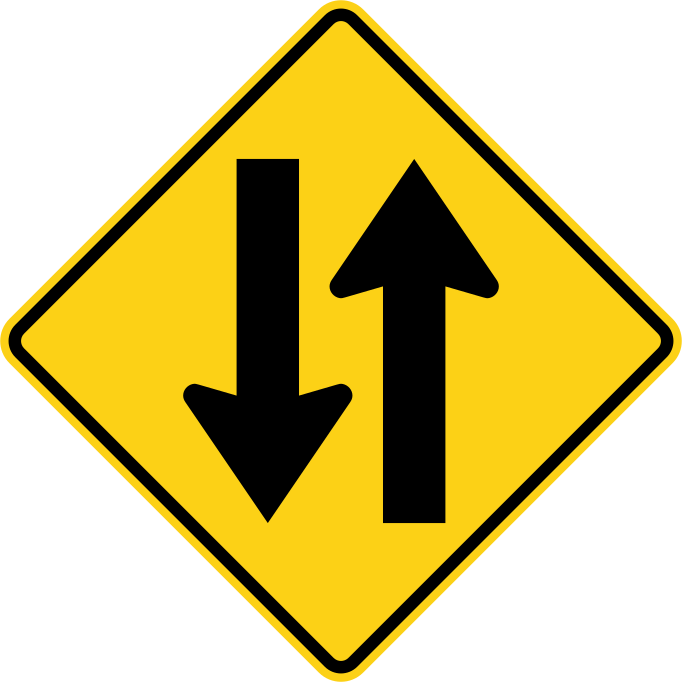
Question 13What does the Two-way Traffic Ahead sign mean?
Show answer
B: You are leaving a one-way road and entering a two-way road; stay to the right. You are leaving a one-way road and entering a two-way road; stay to the right. Minnesota Driver's Manual: Two-way Traffic Ahead, page 62.
-
Question 14What are the steps of the SIPDE system?
Show answer
B: Scan, Identify, Predict, Decide, Execute. SIPDE: Scan, Identify, Predict, Decide and Execute. Minnesota Driver's Manual: Using the Scan, Identify, Predict, Decide and Execute (SIPDE) System, page 72.
-
Question 15Is it legal to drive while impaired by over-the-counter cold medicine in Minnesota?
Show answer
B: No, the law covers prescription, over-the-counter drugs and household products that impair you. Minnesota law prohibits driving while impaired by any controlled or intoxicating substance, including OTC drugs. Minnesota Driver's Manual: Drugs and driving, page 91.
-
Question 16Faced with an aggressive driver, what should you do?
Show answer
B: Stay out of their way, avoid eye contact, and don't escalate. Do not challenge an aggressive driver; stay out of their way, avoid eye contact and don't let it escalate. Minnesota Driver's Manual: Aggressive driving, page 79.
-
Question 17What score do you need to pass the Minnesota Class D written test?
Show answer
C: 80 percent. You must score 80 percent to pass the written test. Minnesota Driver's Manual: The written test, page 10.
-
Question 18What is the most common car-motorcycle collision?
Show answer
B: At urban intersections, often a car turning left in front of the motorcycle. Crashes at urban intersections are most common, often when drivers turn left in front of an oncoming motorcycle. Minnesota Driver's Manual: Sharing the road with motorcyclists, page 50.
-
Question 19Where is the Slippery Road sign often located?

Show answer
B: Near bridges and overpasses. The slippery when wet sign is often located near bridges and overpasses. Minnesota Driver's Manual: Slippery Road, page 63.
-
Question 20When does carbon monoxide poisoning occur most often?
Show answer
B: Winter, when windows tend to be closed. Carbon monoxide poisoning occurs most frequently in winter when vehicle windows are closed. Minnesota Driver's Manual: Carbon monoxide poisoning and safety tips, page 87.
-
Question 21Fleeing a police officer in a motor vehicle in Minnesota is:
Show answer
B: A felony, with up to three years and one day in prison and/or a $5,000 fine. Fleeing a police officer is a felony: up to three years and one day in prison, up to $5,000, or both. Minnesota Driver's Manual: Fleeing a police officer, page 46.
-
Question 22How many Class D written tests may you take in one day in Minnesota?
Show answer
A: One. You may take only one written test per day. Minnesota Driver's Manual: The written test, page 10.
-
Question 23How much following distance should you leave behind a motorcycle?
Show answer
B: The same as or more than for other vehicles. Your following distance from a motorcycle should be the same as or greater than for other vehicles. Minnesota Driver's Manual: Sharing the road with motorcyclists, page 49.
-
Question 24This Lane Ends sign shows the right lane ending. Who must yield?

Show answer
B: Right-lane vehicles. When two lanes become one, vehicles in the ending (right) lane must merge and yield. Minnesota Driver's Manual: Lane Ends, page 63.
-
Question 25What are early symptoms of carbon monoxide poisoning?
Show answer
B: Sudden fatigue, headache, dizziness and nausea. Early symptoms include sudden fatigue, headache, dizziness and nausea. Minnesota Driver's Manual: Carbon monoxide poisoning and safety tips, page 86.
Answer every question to see your score.
More Minnesota practice tests
- Practice test 125 questions
- Practice test 225 questions
- Practice test 325 questions
- Practice test 425 questions
- Practice test 525 questions
- Practice test 625 questions
- Practice test 725 questions
- Practice test 825 questions
- Practice test 1025 questions
- Practice test 1135 questions
- Exam simulatorThe real format
How to use these tests
Read each explanation, even when you get the question right: it tells you the rule and the handbook section, so you can look it up. Your answers are saved in this browser only, so the weak spots mode can give you more questions on the topics you miss. When you're scoring well, take the exam simulator: it uses 25 questions at the DVS's pass mark, since it doesn't publish the number of questions.
Our own questions, written from the Minnesota Driver's Manual and checked against it. Not affiliated with the Minnesota Department of Public Safety, Driver and Vehicle Services (DVS). Found a mistake? Tell us.