Hardest Alabama permit test questions
141 questions that need exact knowledge rather than common sense: the numbers (distances, speeds, fines, limits), the exceptions and the rules that are easy to mix up. We chose them from our Alabama question bank for that reason; they're not statistics from the ALEA.
-
Question 1What restriction letter appears on an Alabama learner license?
Show answer
B: Y. Learners are issued a Class D license with a 'Y' restriction, meaning they must drive with a qualified licensed driver beside them. Alabama Driver Manual: The Learner License and Restricted License, page 9.
-
Question 2A 15-year-old with an Alabama learner license may drive only when accompanied by whom?
Show answer
B: A licensed driver 21 or older, or a licensed or certified driving instructor, in the seat beside them. A 15-year-old learner must be accompanied by a licensed person 21 or older, or a licensed or certified driving instructor, in the seat beside the driver. Alabama Driver Manual: The Learner License and Restricted License, page 9.
-
Question 3After an Alabama learner turns 16, who may supervise them?
Show answer
D: Any licensed driver occupying the seat beside them. After the 16th birthday, the learner may drive with any licensed driver in the seat beside them. Alabama Driver Manual: The Learner License and Restricted License, page 9.
-
Question 4How long is an Alabama learner license valid?
Show answer
B: Four years. The learner license is valid for four years. For 15-year-olds it can be renewed once. Alabama Driver Manual: The Learner License and Restricted License, page 9.
-
Question 5How long must a driver aged 16-17 hold a learner license before taking the road test?
Show answer
D: Six months. A 16- or 17-year-old must hold a learner license for six months (or until age 18) before the road test. Alabama Driver Manual: The Learner License and Restricted License, page 10.
-
Question 6Who may get an Alabama motor-driven cycle license at age 14?
Show answer
B: Any 14- or 15-year-old, for a motor-driven cycle up to 200 pounds and 150cc. 14- and 15-year-olds may get a Class M license with a 'B' restriction to ride a motor-driven cycle weighing no more than 200 pounds with an engine no larger than 150cc. Alabama Driver Manual: The Learner License and Restricted License, page 10.
-
Question 7What is the minimum age for an Alabama vessel license?
Show answer
B: 12. Anyone 12 or older may get a vessel license after passing the vessel exam or completing an approved boating safety course. Alabama Driver Manual: The Learner License and Restricted License, page 10.
-
Question 8What is the fee for each Alabama knowledge test?
Show answer
A: $5.00. The fee for each knowledge test is $5.00, and checks are not accepted. Alabama Driver Manual: Knowledge Test, page 11.
-
Question 9Who must accompany a 16-year-old to the Alabama road test?
Show answer
D: A parent or guardian. A 16-year-old road test applicant must be accompanied by a parent or guardian. Alabama Driver Manual: The Road Test, page 11.
-
Question 10When can a rental car be used for an Alabama road test?
Show answer
A: Only if the applicant is listed on the rental agreement as an additional driver. A rental car is only allowed for the road test when the applicant is named on the rental contract as an additional driver. Alabama Driver Manual: The Road Test, page 11.
-
Question 11How long after moving to Alabama may a new resident drive on a valid license from their previous state?
Show answer
D: 30 days. A new resident with a valid license from their previous state may drive without an Alabama license for 30 days. Alabama Driver Manual: License Requirements, page 5.
-
Question 12Applicants under what age must present a school enrollment/exclusion form (DL-1-93) in Alabama?
Show answer
D: Under 19. All applicants under 19 must present a current Student Enrollment/Exclusion Form (DL-1-93), since the license requires school attendance or graduation. Alabama Driver Manual: Identification Requirements, page 8.
-
Question 13In which languages are Alabama written driver exams available besides English?
Show answer
B: Arabic, Chinese, Farsi, French, German, Japanese, Korean, Russian, Spanish, Thai and Vietnamese. Besides English, ALEA offers the written test in 11 languages: Arabic, Chinese, Farsi, French, German, Japanese, Korean, Russian, Spanish, Thai and Vietnamese. Alabama Driver Manual: Foreign Examinations, page 9.
-
Question 14How long before expiration can you renew an Alabama driver license?
Show answer
C: 180 days. You may renew at any time within 180 days before expiration. Alabama Driver Manual: Renewing Your License, page 13.
-
Question 15What grace period after expiration does Alabama law allow for license renewal?
Show answer
A: 60 days. Alabama allows a 60-day grace period after expiration during which the license stays valid for renewal purposes. Alabama Driver Manual: Renewing Your License, page 13.
-
Question 16Within what period after expiration can an Alabama license be renewed without examination?
Show answer
C: 3 years. A license may be renewed without examination within three years after expiration, though you may not drive on an expired license. Alabama Driver Manual: Renewing Your License, page 13.
-
Question 17After moving within Alabama, how many days do you have to notify the Driver License Division of your new address?
Show answer
C: 30 days. You have 30 days after changing your address within Alabama to notify the Driver License Division. Alabama Driver Manual: Change of Name, Change of Address, page 14.
-
Question 18Under Alabama's Hands-Free Law, what is the fine for a first conviction?
Show answer
B: $50 and 1 point. First conviction: $50 and 1 point; second: $100 and 2 points; third within 24 months: $150 and 3 points. Alabama Driver Manual: Alabama's Hands-Free Law, Effective June 2024, page 16.
-
Question 19Under Alabama's Hands-Free Law, when is physically holding a phone a violation?
Show answer
D: When the driver is seen crossing in and out of a lane without signaling, swerving, or otherwise driving improperly. Holding a wireless device is a violation when the driver is observed crossing lanes without signaling, swerving, or otherwise driving improperly. Alabama Driver Manual: Alabama's Hands-Free Law, Effective June 2024, page 16.
-
Question 20What is the minimum reinstatement fee after an Alabama license is canceled, suspended, revoked or disqualified?
Show answer
C: $100. A reinstatement fee of not less than $100 must be paid before being relicensed. Alabama Driver Manual: Chapter 2 - You May Lose Your License, page 17.
-
Question 21Which conviction requires mandatory revocation of an Alabama license?
Show answer
D: Three reckless driving convictions within 12 months. The Director must revoke a license for, among others, three reckless driving convictions within 12 months, vehicular homicide, a second DUI, or using a vehicle in a felony. Alabama Driver Manual: Revocation, page 17.
-
Question 22After a revocation period ends in Alabama, what must the driver do?
Show answer
B: Apply for a new license and pass the complete examinations. After revocation, the driver may apply for a new license and must take and pass the complete examinations. Alabama Driver Manual: Revocation, page 17.
-
Question 23A Graduated Driver License holder in Alabama can be suspended after how many moving traffic violations?
Show answer
D: Two or more. A license may be suspended for 4 or more points, or for 2 or more moving traffic violations on a GDL. Alabama Driver Manual: Suspension, page 18.
-
Question 24How many points does Alabama assess for reckless driving?
Show answer
D: 6. Reckless driving or reckless endangerment involving a motor vehicle is 6 points. Alabama Driver Manual: The Alabama Point System, page 19.
-
Question 25How many points does Alabama assess for passing a stopped school bus?
Show answer
C: 5. Passing a stopped school bus is 5 points, the same as failure to yield the right of way. Alabama Driver Manual: The Alabama Point System, page 20.
-
Question 26How many points does Alabama assess for speeding 26 mph or more over the limit?
Show answer
C: 5. Speeding 26 mph or more over the limit is 5 points; 1-25 mph over is 2 points. Alabama Driver Manual: The Alabama Point System, page 20.
-
Question 27How many points does Alabama assess for speeding 1-25 mph over the limit?
Show answer
B: 2. Speeding 1-25 mph over the limit is 2 points. Alabama Driver Manual: The Alabama Point System, page 20.
-
Question 28How many points does Alabama assess for following too closely?
Show answer
B: 3. Following too closely is 3 points. Alabama Driver Manual: The Alabama Point System, page 20.
-
Question 29How many points does Alabama assess for driving on the wrong side of the road or illegal passing?
Show answer
C: 4. Wrong side of road or illegal passing is 4 points. Alabama Driver Manual: The Alabama Point System, page 20.
-
Question 30How many points in a 2-year period trigger the shortest (60-day) suspension in Alabama?
Show answer
B: 12-14. 12-14 points in two years means a 60-day suspension; 15-17 means 90 days; 18-20 means 120 days; 21-23 means 180 days; 24 or more means 365 days. Alabama Driver Manual: The Alabama Point System, page 20.
-
Question 31How long is an Alabama suspension for 24 or more points in a 2-year period?
Show answer
A: 365 days. 24 or more points in two years means a 365-day suspension. Alabama Driver Manual: The Alabama Point System, page 20.
-
Question 32How many points does Alabama assess for failure to obey construction or maintenance zone markers?
Show answer
B: 3. Failure to obey construction/maintenance zone markers is 3 points. Alabama Driver Manual: The Alabama Point System, page 20.
-
Question 33How many points does Alabama assess for failure to yield the right of way?
Show answer
C: 5. Failure to yield the right of way is 5 points. Alabama Driver Manual: The Alabama Point System, page 20.
-
Question 34Under Alabama GDL rules, how many non-family passengers may a 16-year-old driver carry, not counting a parent, guardian or supervising licensed driver 21+?
Show answer
B: One. A restricted (Stage II) driver may carry at most one passenger from outside the family; the parent, guardian or supervising licensed driver 21+ doesn't count toward that limit. Alabama Driver Manual: GDL Summary, page 84.
-
Question 35During what hours may an Alabama GDL driver not drive unless an exception applies?
Show answer
C: 12 midnight to 6 a.m.. Restricted drivers may not drive between 12 midnight and 6 a.m. unless with a parent or guardian, or another exception applies (work, school or religious events, emergencies, or a licensee 21+ with parental consent). Alabama Driver Manual: GDL Summary, page 84.
-
Question 36What happens if an Alabama GDL driver violates the passenger or nighttime restrictions?
Show answer
C: The restricted period is extended by 6 months or until age 18. Violating GDL restrictions extends the restricted period by 6 months or until age 18. No points are assessed. Alabama Driver Manual: GDL Summary, page 84.
-
Question 37A GDL driver is convicted of a second moving violation or a 4+ point offense. What happens?
Show answer
B: Automatic 60-day suspension. A second moving-violation conviction, or a conviction for reckless driving, racing, fleeing police, illegal passing, wrong side of the road or any other 4+ point offense, means an automatic 60-day suspension. Alabama Driver Manual: GDL Summary, page 84.
-
Question 38Alabama GDL restrictions do not apply to which of these drivers?
Show answer
A: A 17-year-old who has held a valid license for 6 months or longer. GDL restrictions don't apply to drivers 18+, to 17-year-olds who have held a license 6 months or longer, or to married 16-year-olds or heads of household. Alabama Driver Manual: GDL Summary, page 84.
-
Question 39Under Alabama GDL rules, may a restricted teen driver use a handheld communication device while driving?
Show answer
C: No. Restricted GDL drivers may not drive while operating any handheld communication device; violations extend the graduated period or bring suspension. Alabama Driver Manual: GDL Summary, page 84.
-
Question 40How long may a non-resident from a country that doesn't license drivers drive in Alabama each year?
Show answer
C: 90 days in any calendar year. A non-resident at least 16 from a country that doesn't require licensing may drive up to 90 days in a calendar year if the vehicle is registered in their home country. Alabama Driver Manual: License Requirements, page 5.
-
Question 41How far before a turn must you signal in Alabama?
Show answer
B: At least 100 feet. Signal at least 100 feet before making a turn and keep signaling until you're ready to turn. Alabama Driver Manual: Rules for Turns, page 21.
-
Question 42May people on bicycles ride two abreast in Alabama?
Show answer
B: At all times. The manual allows bicyclists to ride side by side (two abreast) at any time, so expect pairs of riders in the lane. Alabama Driver Manual: Sharing the Road with Bicycles, page 23.
-
Question 43Is it legal for people on bicycles to ride on the sidewalk in Alabama, according to the manual?
Show answer
C: No, it is illegal. The manual states it is illegal in Alabama for people on bicycles to ride on the sidewalk. Alabama Driver Manual: Sharing the Road with Bicycles, page 24.
-
Question 44Bicycle riders under what age must wear a helmet on Alabama public roadways?
Show answer
D: Under 16. People on bicycles under 16 must wear a securely fastened protective helmet on public roads, paths and parks. Alabama Driver Manual: Sharing the Road with Bicycles, page 24.
-
Question 45How much space does Alabama law require when passing a bicyclist?
Show answer
D: At least 3 feet. Alabama law requires at least three feet between your vehicle and a person on a bicycle when passing. Alabama Driver Manual: Sharing the Road with Bicycles, page 24.
-
Question 46When may a car be driven in an Alabama bicycle lane?
Show answer
A: Only to park where allowed, to enter or leave the highway, or to prepare for a turn. Motor vehicles may not drive in a bike lane except to park where permitted, enter or leave the highway, or prepare for a turn. Alabama Driver Manual: Sharing the Road with Bicycles, page 24.
-
Question 47About how wide is a motorcycle compared with a car?
Show answer
C: About 2 feet vs. 5-6 feet. A motorcycle is roughly two feet wide, while a car is about five to six feet wide, which makes motorcycles easy to miss and hard to judge. Alabama Driver Manual: Sharing the Road with Motorcycles, page 25.
-
Question 48Why should you be careful when a motorcycle's turn signal is blinking?
Show answer
D: Most motorcycle signals don't cancel themselves, so the rider may not actually be turning. Motorcycle turn signals usually aren't self-canceling. Be sure the motorcycle is actually turning before you pull out. Alabama Driver Manual: Sharing the Road with Motorcycles, page 25.
-
Question 49What following distance does the Alabama manual recommend behind a motorcycle in normal conditions?
Show answer
D: The same 2-second distance as for any other vehicle. Follow a motorcycle at the same 2-second distance as any other vehicle, and allow more when it's dark, raining or slippery. Alabama Driver Manual: Sharing the Road with Motorcycles, page 26.
-
Question 50How far back can the rear No-Zone behind a truck or bus extend?
Show answer
C: 200 feet. Trucks and buses have rear No-Zones that may extend as far as 200 feet; avoid tailgating them. Alabama Driver Manual: Sharing the Road with Large Vehicles, page 27.
-
Question 51At 55 mph, about how far does a loaded truck need to stop, compared with a passenger car, according to the Alabama manual?
Show answer
A: 193 feet for a car vs. 430 feet for a truck. A National Safety Council study found a car needs 193 feet to stop at 55 mph and a loaded truck needs 430 feet. Alabama Driver Manual: Sharing the Road with Large Vehicles, page 28.
-
Question 52You park downhill next to a curb. Which way do you turn the wheels, and what gear?
Show answer
B: Toward the curb; reverse or PARK. Facing downhill, turn the wheels toward the curb and shift into reverse or PARK, and always set the hand brake. Alabama Driver Manual: Parking on a Hill, page 28.
-
Question 53You park uphill next to a curb. Which way do you turn the wheels?
Show answer
C: Away from the curb. Uphill with a curb, point the front wheels away from the curb so the tires catch it if the car rolls back; use low gear or PARK and set the hand brake. Alabama Driver Manual: Parking on a Hill, page 28.
-
Question 54Parking on a hill without a curb, which way should your wheels be turned?
Show answer
A: Toward the edge of the road. Without a curb, point the wheels toward the road edge on both uphill and downhill slopes, so a rolling car heads off the road, not into traffic. Alabama Driver Manual: Parking on a Hill, page 28.
-
Question 55How close to a fire hydrant may you park in Alabama?
Show answer
A: No closer than 15 feet. Parking is not allowed within 15 feet of a fire hydrant. Alabama Driver Manual: Parking, page 29.
-
Question 56How close to a flashing beacon, stop sign or traffic signal at the side of the road may you park in Alabama?
Show answer
C: No closer than 30 feet. You may not park within 30 feet of a stop sign, flashing beacon or traffic signal placed at the roadside. Alabama Driver Manual: Parking, page 29.
-
Question 57How close to a crosswalk at an uncontrolled intersection may you park in Alabama?
Show answer
A: No closer than 20 feet. At an intersection with no signals or signs, keep your parked car at least 20 feet away from the crosswalk. Alabama Driver Manual: Parking, page 29.
-
Question 58How close to the nearest rail of a railroad crossing may you park in Alabama?
Show answer
C: No closer than 50 feet. Keep a parked car at least 50 feet from the closest rail at a railroad crossing. Alabama Driver Manual: Parking, page 29.
-
Question 59Who must wear a safety belt under Alabama law?
Show answer
B: Each occupant, regardless of age. Alabama's safety belt law requires each occupant, regardless of age, to be restrained. Alabama Driver Manual: Alabama's Safety Belt and Child Restraint Laws, page 30.
-
Question 60Under Alabama's child restraint law, a rear-facing infant or convertible seat must be used until the child is at least:
Show answer
B: 1 year of age or 20 pounds. Rear-facing infant or convertible seats are required until at least 1 year of age or 20 pounds. Alabama Driver Manual: Alabama's Safety Belt and Child Restraint Laws, page 30.
-
Question 61Under Alabama law, a forward-facing child seat is required until the child is at least:
Show answer
B: 5 years of age or 40 pounds. A forward-facing seat is required until at least 5 years of age or 40 pounds. Alabama Driver Manual: Alabama's Safety Belt and Child Restraint Laws, page 30.
-
Question 62Until what age does Alabama require a booster seat?
Show answer
B: 6. A booster seat is required until a child is 6 years of age, then a seat belt until 15. Alabama Driver Manual: Alabama's Safety Belt and Child Restraint Laws, page 30.
-
Question 63Through what age does Alabama's child restraint law require children to be restrained?
Show answer
C: Through age 15. Alabama's child restraint law requires children through age 15 to be restrained. Alabama Driver Manual: Alabama's Safety Belt and Child Restraint Laws, page 30.
-
Question 64According to the Alabama manual, what share of highway crashes is caused by driver error, inattention, poor judgment or similar factors?
Show answer
A: Over 90 percent. The manual says more than 90 percent of crashes come from driver-related causes such as mistakes, inattention, poor judgment, bad attitude, or physical or mental condition. Alabama Driver Manual: Chapter 4 - The Driver, page 31.
-
Question 65What is the penalty for a first texting-while-driving offense in Alabama?
Show answer
A: $25 fine and 2 points. Texting: $25 for a first offense, $50 for a second, $75 for a third or later, with 2 points for each. Alabama Driver Manual: Texting While Driving, page 32.
-
Question 66How often does the Alabama manual advise taking a break on long trips?
Show answer
A: Every 100 miles or every two hours. Take regular breaks every 100 miles or every two hours to walk around and stretch. Alabama Driver Manual: Highway Hypnosis and Fatigue, page 32.
-
Question 67What BAC limit applies to drivers under 21 in Alabama?
Show answer
A: .02 percent or more. It is unlawful for persons under 21 to drive with a BAC of .02 percent or more. Alabama Driver Manual: Driving While Under the Influence, page 33.
-
Question 68What BAC limit applies to commercial vehicle operators in Alabama?
Show answer
B: .04 percent. Commercial vehicle operators may not drive with a BAC of .04 percent or more. Alabama Driver Manual: Driving While Under the Influence, page 33.
-
Question 69What BAC limit applies to school bus and daycare drivers in Alabama?
Show answer
B: .02 percent. School bus and daycare drivers may not drive with a BAC of .02 percent or more. Alabama Driver Manual: Driving While Under the Influence, page 33.
-
Question 70At what BAC does research show the driving ability of most individuals is impaired to some degree?
Show answer
C: .05 percent. Research shows a BAC of .05 percent impairs most people to some degree, and at .08 percent everyone is definitely impaired. Alabama Driver Manual: Drinking and Driving, page 32.
-
Question 71How long is the license suspension for a first DUI conviction in Alabama?
Show answer
C: 90 days. A first conviction brings a $600-$2,100 fine, up to a year in jail, and a 90-day license suspension. Alabama Driver Manual: Driving While Under the Influence, page 33.
-
Question 72What is the fine range for a first DUI conviction in Alabama?
Show answer
B: $600 to $2,100. A first DUI conviction carries a fine of $600 to $2,100. Alabama Driver Manual: Driving While Under the Influence, page 33.
-
Question 73A second DUI conviction within 10 years in Alabama results in what license action?
Show answer
A: One-year revocation. A second conviction in 10 years brings a one-year revocation plus a mandatory 48 hours in jail or 20 days of community service. Alabama Driver Manual: Driving While Under the Influence, page 33.
-
Question 74How long is the revocation for a third DUI conviction in Alabama?
Show answer
C: Three years. A third conviction brings a three-year revocation and a mandatory minimum 60 days in jail. Alabama Driver Manual: Driving While Under the Influence, page 34.
-
Question 75How is a fourth DUI conviction classified in Alabama?
Show answer
D: A Class C felony. A fourth or later conviction is a Class C felony with a five-year revocation. Alabama Driver Manual: Driving While Under the Influence, page 34.
-
Question 76When must an Alabama SR-31 crash report be sent, and within how many days?
Show answer
A: Within 30 days for injury, death or $500+ damage when the at-fault party was uninsured. For injury, death or damage of $500 or more, a written SR-31 must be sent within 30 days if the at-fault party was uninsured. If both parties were insured, neither has to submit it. Alabama Driver Manual: Report All Traffic Mishaps, page 38.
-
Question 77How far before a railroad crossing is the round yellow RR warning sign placed?

Show answer
A: 750 feet. The round yellow RR sign is placed 750 feet before the track. Alabama Driver Manual: Railroad Crossings – Advanced Warnings, page 38.
-
Question 78When you must stop at a railroad crossing in Alabama, how far from the tracks do you stop?
Show answer
B: 15 to 50 feet. When stopping for a railroad crossing, stop within 15 to 50 feet. Alabama Driver Manual: Stopping for Railroad Crossings, page 39.
-
Question 79About how far does a freight train at 55 mph need to stop?
Show answer
A: A mile or more. A freight train at 55 mph takes a mile or more to stop, the length of 18 football fields. Alabama Driver Manual: Safety Tips for Motorists, page 40.
-
Question 80What does the Alabama manual say about collisions at crossings with active warning devices?
Show answer
B: Nearly 50% of vehicle/train collisions occur at crossings with active warning devices. About half of all vehicle/train crashes happen where flashing lights or gates are present, so warning devices only help if drivers obey them. Alabama Driver Manual: Safety Tips for Motorists, page 40.
-
Question 81Several cars arrive at an Alabama 4-way stop at the same time. Which goes first, according to the manual?

Show answer
B: The vehicle furthest to the right. The first to stop goes first. When more than one arrive together, the vehicle furthest to the right goes first. Alabama Driver Manual: Regulatory Signs, page 42.
-
Question 82Where is the yellow NO PASSING ZONE pennant sign placed?
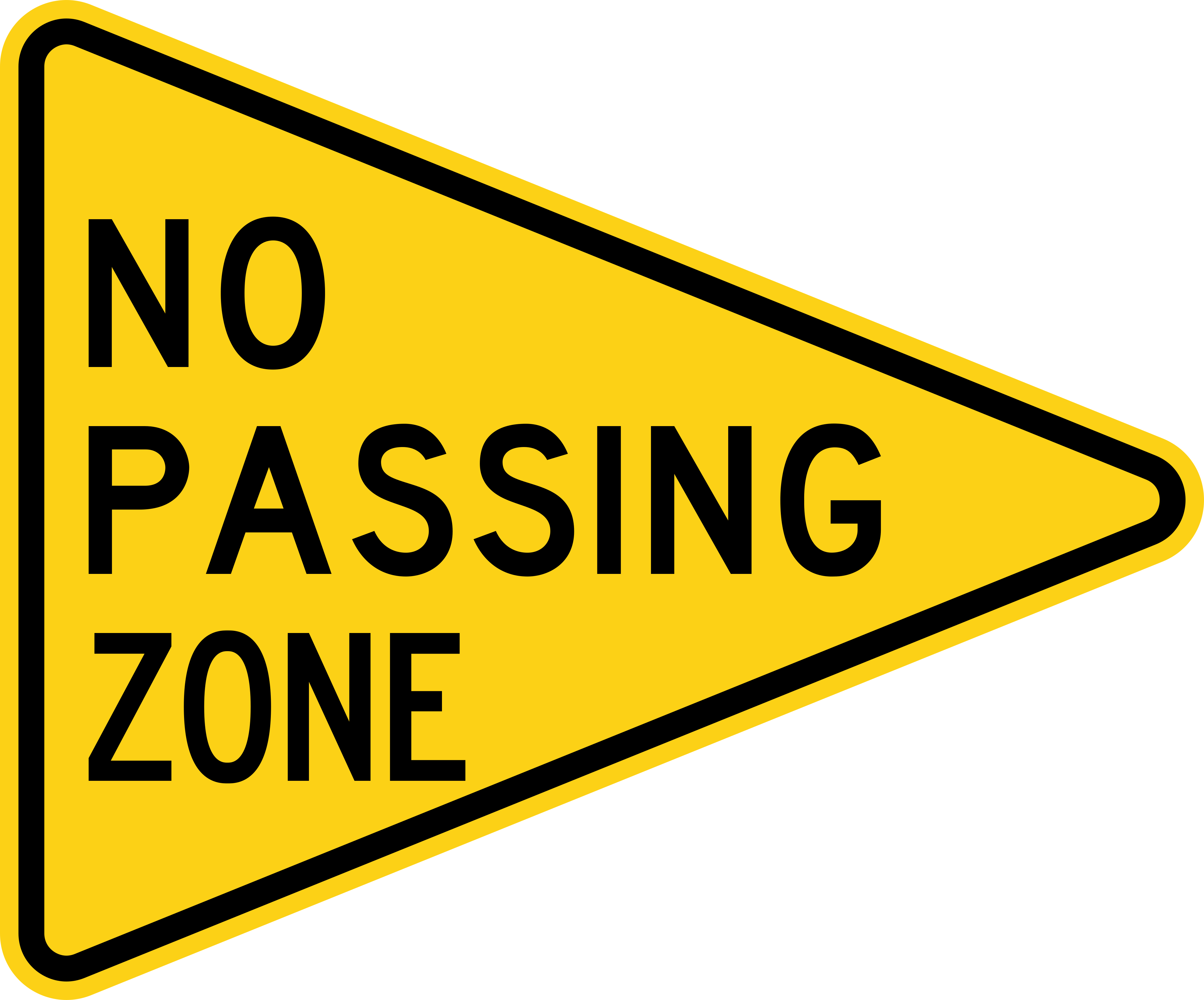
Show answer
B: On the left side of a two-lane road at the beginning of the no-passing zone. The pennant is placed on the left side of a two-lane road to warn of the beginning of a no-passing zone. Alabama Driver Manual: Warning Signs, page 48.
-
Question 83Where does zero mileage for Alabama highway mileposts usually begin?
Show answer
D: At the south and west state lines, or where routes begin. Milepost numbering normally starts at zero where a route enters the state on the south or west, or at the junction where the route begins. Alabama Driver Manual: Mileposts, page 52.
-
Question 84What color is the centerline on an Alabama two-lane highway?
Show answer
D: Yellow. Centerlines are yellow on two-lane highways; the manual says they are white on multi-lane highways and one-way streets. Alabama Driver Manual: Pavement Markings, page 52.
-
Question 85What does a double solid white line between same-direction lanes mean?
Show answer
C: Crossing is prohibited. Traffic on both sides of a double solid white line moves the same way, but you may not cross it. Alabama Driver Manual: Pavement Markings, page 53.
-
Question 86According to the Alabama manual, what does a steady yellow X over a lane mean?
Show answer
B: You may drive in the lane with caution; potentially hazardous conditions exist. The Alabama manual says a steady yellow X permits driving in that lane with caution because potentially hazardous conditions exist. Alabama Driver Manual: Lane Use Control Signals, page 56.
-
Question 87About how much do roundabouts reduce fatal crashes compared with other intersection control, according to the Alabama manual?
Show answer
C: About 90%. Roundabouts reduce fatal crashes about 90%, injury crashes about 75%, and overall crashes about 35%. Alabama Driver Manual: General Information for All Roundabouts, page 57.
-
Question 88You are already in a roundabout when an emergency vehicle approaches. What should you do?
Show answer
B: Continue to your exit, then pull over and let it pass. If you've entered, continue to your exit, then pull over. If you haven't entered, pull over before it. Avoid stopping in the roundabout. Alabama Driver Manual: Emergency Vehicles in the Roundabout, page 58.
-
Question 89What is the statutory speed limit in an Alabama urban district?
Show answer
B: 30 mph. The statutory limit in an urban district is 30 mph. Alabama Driver Manual: Statutory Speed Limits, page 60.
-
Question 90What is the statutory speed limit on an unpaved road in Alabama?
Show answer
C: 35 mph. The statutory limit on an unpaved road is 35 mph. Alabama Driver Manual: Statutory Speed Limits, page 60.
-
Question 91What is the statutory speed limit on an Alabama county paved road unless posted?
Show answer
B: 45 mph. County paved roads have a 45 mph limit unless posted. Alabama Driver Manual: Statutory Speed Limits, page 60.
-
Question 92What is the maximum speed on an Alabama interstate where posted?
Show answer
B: 70 mph. The limit is 70 mph where posted on the interstate, 65 mph where posted elsewhere, and 55 mph in other locations. Alabama Driver Manual: Statutory Speed Limits, page 60.
-
Question 93Coming out of an alley or private driveway in a business or residence district, where must you stop?
Show answer
A: Before crossing the sidewalk or crosswalk area. Always stop before crossing the sidewalk or crosswalk area when coming from an alley, driveway or building. Alabama Driver Manual: Stopping, page 60.
-
Question 94When may you turn left on a red light in Alabama?
Show answer
D: After stopping, from a one-way street onto a one-way street with traffic moving from right to left. After stopping, you may turn left on red from a one-way street onto a one-way street with traffic moving from right to left, yielding to traffic and pedestrians. Alabama Driver Manual: Stopping, page 60.
-
Question 95Do Alabama's stopping rules for a stopped school bus also apply to church buses?
Show answer
D: Yes, you must stop for a school or church bus with its stop arm extended and red lights flashing. The stop-for-the-bus rule covers church buses as well as school buses whenever the stop arm is out and the red lights flash. Alabama Driver Manual: Stopping, page 61.
-
Question 96Must you stop for a school bus stopped on the other side of a four-to-six lane undivided highway in Alabama?
Show answer
B: Yes. On an undivided highway of four to six lanes, traffic in both directions should stop for a stopped school or church bus. Alabama Driver Manual: Stopping, page 61.
-
Question 97When is a stop not required for a school bus stopped in the opposing roadway in Alabama?
Show answer
D: On a divided highway with four or more lanes when the bus is in the opposing roadway. No stop is required on a divided highway with four or more lanes, at least two in each direction, when meeting a bus stopped in the opposing roadway, or one in a loading zone where pedestrians can't cross. Alabama Driver Manual: Stopping, page 61.
-
Question 98How far from a stopped school bus must you stop in Alabama?
Show answer
B: At least 20 feet. Stop at least 20 feet from the bus. Alabama Driver Manual: School Buses, page 62.
-
Question 99In rural Alabama, how far before stopping does a school bus turn on its flashing amber lights?
Show answer
B: At least 300 feet. In rural areas the amber lights come on at least 300 feet before stopping; in municipalities, at least 100 feet. Alabama Driver Manual: School Buses, page 62.
-
Question 100You drive into an uncontrolled intersection faster than the legal speed. What happens to your right of way?
Show answer
B: You lose any right of way you might otherwise have. Speeding into an uncontrolled intersection costs you the right of way you would otherwise have had. Alabama Driver Manual: Right of Way and Yielding, page 63.
-
Question 101On a curve or hill, how much clear passing distance must you be able to see before crossing the center line to pass in Alabama?
Show answer
A: At least 500 feet. Do not cross the center line to pass on a hill or curve unless you can see at least 500 feet of clear road ahead. Alabama Driver Manual: No Passing Zones, page 65.
-
Question 102How close may a non-official vehicle follow an emergency vehicle on an emergency run in Alabama?
Show answer
B: No closer than 500 feet. Unless you are on official business, stay more than 500 feet behind an emergency vehicle answering a call. Alabama Driver Manual: Following Emergency Vehicles, page 65.
-
Question 103How many persons in the front seat does Alabama law prohibit if it obstructs the driver's view or control?
Show answer
C: More than three. It is unlawful to have more than three persons in the front seat if it obstructs the driver's view or hinders control. Alabama Driver Manual: Loads Must Conform to Law, page 67.
-
Question 104Your load sticks out 4 feet or more behind your vehicle in daytime. What does Alabama require?
Show answer
D: A red flag at least 12 inches square at the end. By day, mark a load sticking out 4 feet or more behind the vehicle with a red flag at least 12 inches square; at night, use a red light that can be seen from 200 feet. Alabama Driver Manual: Loads Must Conform to Law, page 67.
-
Question 105How far may a load extend beyond the front and rear of a vehicle in Alabama?
Show answer
B: 5 feet. Alabama limits loads to 5 feet of overhang past the front and rear of the vehicle. Alabama Driver Manual: Loads Must Conform to Law, page 67.
-
Question 106What does signing an Alabama traffic citation mean?
Show answer
B: It is not an admission of guilt, but refusing may lead to arrest. Signing a citation is not an admission of guilt, but refusing it may result in arrest. You can contest it in court. Alabama Driver Manual: What to Do and Expect During Law Enforcement Stop, page 67.
-
Question 107What are Alabama's minimum liability insurance limits?
Show answer
B: $25,000 per person / $50,000 per crash / $25,000 property. Minimum liability: $25,000 for one person, $50,000 for two or more persons, and $25,000 for property damage. Alabama Driver Manual: Mandatory Liability Insurance Law, page 68.
-
Question 108What is the maximum fine for a first mandatory liability insurance violation in Alabama?
Show answer
C: $500. A first violation can bring a fine up to $500; later violations up to $1,000 and/or a six-month suspension. Alabama Driver Manual: Mandatory Liability Insurance Law, page 68.
-
Question 109How much of the front windshield may be tinted in Alabama?
Show answer
B: Only the upper 6 inches. Only a transparent tint strip across the top 6 inches of the windshield is allowed, on every type of vehicle. Alabama Driver Manual: Window Tinting, page 68.
-
Question 110What is the minimum light transmission for side and rear window tint on Alabama passenger cars?
Show answer
B: 32 percent. Passenger car side and rear windows may have tint that allows at least 32 percent light transmission. Alabama Driver Manual: Window Tinting, page 68.
-
Question 111Under Alabama's Move-Over Law, what must you do on a road with four or more lanes when passing a stopped emergency vehicle with flashing lights?
Show answer
A: Vacate the lane closest to it; if you can't, slow to at least 15 mph below the limit. Move out of the lane closest to the stopped emergency vehicle or wrecker. If that's unsafe, slow to at least 15 mph below the posted limit. Alabama Driver Manual: Move-Over Law, page 68.
-
Question 112Does Alabama's Move-Over Law apply to wreckers (tow trucks) with flashing amber lights?
Show answer
C: Yes. The Move-Over Law covers stopped emergency vehicles with flashing lights and wreckers displaying flashing amber lights. Alabama Driver Manual: Move-Over Law, page 68.
-
Question 113On an Alabama two-lane road posted 20 mph or less, how fast may you pass a stopped emergency vehicle under the Move-Over Law?
Show answer
B: 10 mph. Move as far away as possible within your lane. If the limit is 25 mph or more, slow to 15 mph under it; if it is 20 mph or less, travel 10 mph. Alabama Driver Manual: Move-Over Law, page 68.
-
Question 114About what share of fatal crashes in Alabama occur during darkness?
Show answer
C: Approximately half. Approximately half of Alabama's fatal crashes occur during the hours of darkness, even though traffic is lighter. Alabama Driver Manual: Night Driving, page 69.
-
Question 115How far do high-beam headlights normally light the road, according to the Alabama manual?
Show answer
A: About 350 feet. Under normal conditions, high beams light up about 350 feet of road, so at night drive slowly enough to stop within that distance. Alabama Driver Manual: Night Driving, page 69.
-
Question 116Within what distance of an oncoming vehicle must you dim your high beams in Alabama?
Show answer
C: 500 feet. You must dim your headlights within 500 feet of an oncoming vehicle. Alabama Driver Manual: Night Driving, page 69.
-
Question 117Within what distance must you dim your high beams when following another vehicle in Alabama?
Show answer
B: 200 feet. Dim your headlights within 200 feet when following another vehicle. Alabama Driver Manual: Night Driving, page 69.
-
Question 118When must headlights be on in Alabama?
Show answer
C: From a half-hour after sunset to a half-hour before sunrise, and whenever you can't see clearly for 500 feet. Use headlights (parking lights alone are not enough) from 30 minutes after sunset until 30 minutes before sunrise, and any time you can't see clearly 500 feet ahead. Alabama Driver Manual: Night Driving, page 69.
-
Question 119Does Alabama require headlights when wipers are used only intermittently?
Show answer
D: No; headlights are required when wipers are in use because of rain, sleet or snow, but intermittent use doesn't require them. Headlights are required when wipers are in use because of rain, sleet or snow; intermittent wiper use does not require headlights. Alabama Driver Manual: Windshield Wipers/Headlights, page 71.
-
Question 120How far behind your disabled vehicle should you place flares or reflectors at night?
Show answer
B: 100 to 500 feet. Set out flares or reflectors behind the car, on the right edge of the road, between 100 and 500 feet back. Alabama Driver Manual: Night Driving, page 70.
-
Question 121On snow or ice, how much more distance can it take to stop than on dry pavement?
Show answer
A: Three to twelve times. On snow or ice it can take three to twelve times as much distance to stop as on dry pavement. Alabama Driver Manual: Slippery Roads Are Hazardous, page 71.
-
Question 122You have to stop suddenly on a slippery surface in a car without anti-lock brakes. What does the Alabama manual advise?
Show answer
A: Pump the brakes, releasing when the wheels lock and reapplying. Pump your brakes: if the wheels lock, release, then squeeze again, repeating until stopped. Alabama Driver Manual: Slippery Roads Are Hazardous, page 71.
-
Question 123Your car begins to skid. What should you avoid doing until you regain control of your direction?
Show answer
C: Braking. Braking increases a skid and can cause loss of steering when the front wheels lock, so don't brake until you regain directional control. Alabama Driver Manual: Skidding, page 71.
-
Question 124In a skid with a FRONT-wheel-drive vehicle, what does the Alabama manual suggest to straighten out?
Show answer
C: Step lightly on the gas to speed the front wheels. With front-wheel drive, stepping lightly on the gas speeds the front wheels so the front catches up with the sliding rear. Alabama Driver Manual: Skidding, page 72.
-
Question 125At about what speed does partial hydroplaning begin in a standard passenger car?
Show answer
C: 35 mph. Tires start to ride up on water at about 35 mph, and by about 55 mph they can lose contact with the road completely. Alabama Driver Manual: Hydroplaning – Water Skiing on the Highway, page 72.
-
Question 126Is coasting downhill with the transmission in neutral legal in Alabama?
Show answer
D: No, the law forbids it. Alabama law forbids coasting downhill with the transmission in neutral. Alabama Driver Manual: Driving in Hilly Country, page 73.
-
Question 127Your steering suddenly fails. What should you do?
Show answer
B: Ease off the accelerator without braking, then brake very gently as the car slows. Ease off the accelerator but don't brake or shift suddenly. As the car slows, you may brake very gently to stop. Alabama Driver Manual: Driving Emergencies, page 74.
-
Question 128Your stalled car can't be moved off the tracks and a train is coming. Which way should you walk, according to the Alabama manual?
Show answer
A: Alongside the tracks in the direction of the approaching train. Abandon the vehicle and walk quickly alongside the tracks toward the approaching train so you won't be hit by debris. Alabama Driver Manual: Driving Emergencies, page 75.
-
Question 129Your engine catches fire and you have no extinguisher. What should you use?
Show answer
D: Dirt or sand. Use dirt or sand to smother it. Don't use water; burning gasoline floats on it and spreads the fire. Alabama Driver Manual: Driving Emergencies, page 75.
-
Question 130What number can you dial on a cell phone to reach Alabama State Troopers for highway emergencies?
Show answer
C: *HP (*47). Dial *HP (*47) toll-free to contact Alabama State Troopers for emergencies, crashes and drunk drivers. Alabama Driver Manual: Chapter 8 - Driving the Freeways, page 76.
-
Question 131At a diamond interchange, where are left turns made?
Show answer
D: After leaving the freeway. A diamond interchange has four ramps, and left turns are made after leaving the freeway. Alabama Driver Manual: Interchanges, page 78.
-
Question 132What type of interchange eliminates left turns and cross-traffic conflicts using loop connections?
Show answer
B: Cloverleaf. A cloverleaf interchange uses loop connections for turns from four directions, eliminating left-turn and cross-traffic conflicts. Alabama Driver Manual: Interchanges, page 77.
-
Question 133How far behind your vehicle must your rearview mirrors let you see in Alabama?
Show answer
B: 200 feet. Rearview mirrors must let the driver see 200 feet to the rear. Alabama Driver Manual: Chapter 9 - Your Vehicle, page 79.
-
Question 134At what minimum distance must the high beams of an Alabama vehicle illuminate objects?
Show answer
B: 350 feet. High beams must illuminate objects at least 350 feet ahead; all lights must be visible from at least 500 feet. Alabama Driver Manual: Chapter 9 - Your Vehicle, page 79.
-
Question 135What is the minimum legal tire tread depth in Alabama?
Show answer
B: 1/16 inch. A tire is illegal if the tread is less than 1/16 inch deep. Alabama Driver Manual: Tires, page 80.
-
Question 136What following-distance rule does the Alabama manual recommend in good conditions?
Show answer
D: The two-second rule. The manual recommends the two-second rule, increased to four or five seconds in bad conditions or with longer vehicles. Alabama Driver Manual: How to Avoid Rear-End Collisions, page 36.
-
Question 137How much following distance does the Alabama manual recommend in poor road or weather conditions?
Show answer
B: Four or five seconds. In bad weather or on poor roads, stretch the two-second count to four or five seconds. Alabama Driver Manual: How to Avoid Rear-End Collisions, page 36.
-
Question 138According to the Alabama stopping-distance chart, what is the total stopping distance at 55 mph?
Show answer
B: About 228 feet. At 55 mph the chart shows 60 ft thinking distance plus 168 ft braking distance, about 228 ft total. Alabama Driver Manual: Stopping Distance, page 37.
-
Question 139Is it lawful to drive below a posted minimum speed in normal conditions in Alabama?
Show answer
D: No, it is unlawful under normal weather, road and traffic conditions. Where minimum limits are posted, driving below them is unlawful under normal conditions. Alabama Driver Manual: Statutory Speed Limits, page 60.
-
Question 140Where are three-point turns NOT permitted in Alabama?
Show answer
D: On interstate freeways, on curves, or near hilltops where you can't be seen within 500 feet. Three-point turns are not permitted on interstates, on curves, or near the top of hills where drivers within 500 feet can't see you. Alabama Driver Manual: Three-Point Turn, page 23.
-
Question 141According to the Alabama manual, what share of fatal crash injuries is caused by steering assemblies, which seat belts help prevent?
Show answer
B: About 30 percent. Steering assemblies cause about 30 percent of fatal injuries and striking the windshield or dash another 40 percent; safety belts prevent these 'second collisions.' Alabama Driver Manual: Chapter 9 - Your Vehicle, page 79.
Answer every question to see your score.
Remembering the numbers
Most mistakes on the Alabama ALEA test are about specifics: how many feet before a turn to signal, how far to park from a hydrant, the alcohol limit for drivers under 21. Write the numbers from these questions on a card and review them before the test, then take the exam simulator.