Hardest Hawaii permit test questions
96 questions that need exact knowledge rather than common sense: the numbers (distances, speeds, fines, limits), the exceptions and the rules that are easy to mix up. We chose them from our Hawaii question bank for that reason; they're not statistics from the HDOT.
-
Question 1How does the Hawaii Driver's Manual define an abandoned vehicle?
Show answer
B: Any vehicle left unattended on the highway for more than 24 hours. An abandoned vehicle is any vehicle left unattended on the highway for more than 24 hours. Official Hawaii Driver's Manual: Definitions: Abandoned Vehicle, page 8.
-
Question 2In Hawaii, a bus is defined as a motor vehicle designed to carry more than how many passengers?
Show answer
C: Ten. A bus is every motor vehicle designed for carrying more than ten passengers and used to transport persons. Official Hawaii Driver's Manual: Definitions: Bus, page 8.
-
Question 3Under Hawaii's definition, what is the minimum wheel diameter for a human-powered device to be a 'bicycle'?
Show answer
B: 16 inches. A bicycle is a device with two or three wheels having a diameter of 16 inches or greater propelled by human power. Official Hawaii Driver's Manual: Definitions: Bicycle, page 8.
-
Question 4A permit holder under 18 drives at 11:30 p.m. Who must be the accompanying driver?
Show answer
A: Their parent or guardian. Between 11:00 p.m. and 5:00 a.m., the permit holder must be accompanied by their parent or guardian. Official Hawaii Driver's Manual: Driving by Minors, page 13.
-
Question 5How long must a Hawaii minor hold an instruction permit before applying for a provisional license?
Show answer
D: 180 days. You must hold a valid instruction permit for 180 days before applying for a provisional license. Official Hawaii Driver's Manual: Driving by Minors, page 13.
-
Question 6How many passengers under 18 who are not household members may a Hawaii provisional licensee transport?
Show answer
C: One. A provisional license allows you to transport only one person under 18 who is not a household member. Official Hawaii Driver's Manual: Driving by Minors, page 13.
-
Question 7A provisional licensee wants to drive at midnight. When is that allowed without a parent or guardian?
Show answer
C: Only when driving to or from work or a school-authorized activity. Between 11 p.m. and 5 a.m. a licensed parent or guardian must accompany you unless you are driving to or from employment or a school-authorized activity. Official Hawaii Driver's Manual: Driving by Minors, page 14.
-
Question 8What is the minimum age for a Hawaii Class 3 driver's license?
Show answer
D: 17. The manual sets 17 as the minimum age for a Class 3 license; drivers under 18 must first go through the graduated licensing program. Official Hawaii Driver's Manual: Hawaii Licenses: Driver's License (class 3), page 12.
-
Question 9How old must you be to apply for a larger-class license (above Class 3) in Hawaii?
Show answer
C: 21. Every license class above Class 3 requires the applicant to be at least 21, and each class or endorsement has its own tests. Official Hawaii Driver's Manual: Hawaii Licenses: Larger Class License, page 12.
-
Question 10For how long are compact foreign licenses with an International Driving Permit valid in Hawaii?
Show answer
A: One year from arrival in the U.S.. Compact foreign licenses with an IDP are valid for one year from the date of arrival into the United States. Official Hawaii Driver's Manual: Persons Exempted from License, page 10.
-
Question 11How long after a conviction for drunk driving while unlicensed must you wait before you can be licensed in Hawaii?
Show answer
C: Two years. You cannot be licensed for a period of two years after a conviction of drunk driving while unlicensed. Official Hawaii Driver's Manual: Who Cannot Be Licensed, page 10.
-
Question 12How often must Real ID license holders who renew by mail appear in person for a new photo?
Show answer
B: No later than every 16 years. Real ID licenses can be renewed by mail, but the holder must come in at least once every 16 years so a new photo can be taken. Official Hawaii Driver's Manual: Identification and Legal Presence, page 11.
-
Question 13Is there a grace period after a Hawaii driver's license expires?
Show answer
A: No, every license is void after the expiration date. Every Hawaii license is void after the expiration date; there is no grace period. You may renew within a year after expiration, otherwise follow the original license procedure. Official Hawaii Driver's Manual: License Renewal, page 15.
-
Question 14How often may you renew your Hawaii license by mail?
Show answer
A: Once; you must appear before the examiner every other renewal. You may renew once by mail but must present yourself before the examiner every other renewal. Official Hawaii Driver's Manual: License Renewal, page 15.
-
Question 15Can you use an autocycle for the Hawaii Category 3 road test?
Show answer
B: No, even though you may drive one with a Category 3 license. Although you may drive an autocycle with a category 3 license, you may not use one for the category 3 performance test. Official Hawaii Driver's Manual: Driver Performance Test, page 15.
-
Question 16A moped in Hawaii has a motor no larger than:
Show answer
B: Two horsepower. Hawaii treats a two- or three-wheeled device as a moped when its motor is two horsepower or smaller. Official Hawaii Driver's Manual: Driver's License for Mopeds, page 17.
-
Question 17According to the Hawaii manual, tires should be replaced when the tread is less than:
Show answer
A: 1/16 inch. Replace tires that have less than 1/16 inch of tread; use the Lincoln penny test. Official Hawaii Driver's Manual: Vehicle Condition and Maintenance: Tires, page 20.
-
Question 18With power steering (engine running), what is the maximum free play your steering wheel should have?
Show answer
B: Two inches. No more than two inches of free play with power steering, or 3 inches without power steering. Official Hawaii Driver's Manual: Vehicle Condition and Maintenance: Steering, page 20.
-
Question 19Under the Hawaii manual, children under what age must ride in a child restraint?
Show answer
C: Under 4. Children under age 4 must be in a child restraint; older children under 8 may need a booster seat. Official Hawaii Driver's Manual: Vehicle Condition and Maintenance: Safety Belts, page 20.
-
Question 20Within how many days must you notify the county after changing the address on your vehicle registration?
Show answer
A: 30 days. The registered owner must notify the county agency in writing within thirty days after an address change. Official Hawaii Driver's Manual: Change of Address or Name on the Motor Vehicle Certificate of Registration, page 21.
-
Question 21According to the crash statistics in the Hawaii manual, which age group has the fewest crashes?
Show answer
C: 50 to 54. Drivers about 50 to 54 have the fewest crashes; the youngest drivers have about twice as many as expected. Official Hawaii Driver's Manual: Driver Age and Crashes, page 24.
-
Question 22In which of these situations must you NOT drive on the left half of a two-lane roadway?
Show answer
D: When approaching the top of a hill or on a curve. Driving on the left half is allowed to pass, to get around an obstruction, or on a one-way street. It is never allowed near the top of a hill or on a curve, within 100 feet of an intersection or railroad crossing, or on a road with four or more lanes. Official Hawaii Driver's Manual: Driving on the Left Side of Roadway, page 26.
-
Question 23On a road with four or more lanes for moving traffic, may you drive on the left half to pass?
Show answer
D: No, unless signs direct otherwise. You must not drive on the left half of a road with four or more lanes for moving traffic unless signs direct otherwise. Official Hawaii Driver's Manual: Driving on the Left Side of Roadway, page 26.
-
Question 24How far before turning, changing lanes or stopping must you signal in Hawaii?
Show answer
A: At least 100 feet (about five car lengths). Signals must be given for at least 100 feet before you change lanes, turn or stop; that's about five car lengths. Official Hawaii Driver's Manual: Required Signals, page 27.
-
Question 25When you have to stop for a train at a railroad crossing, how close to the nearest rail may you stop?
Show answer
C: No closer than 15 feet. Stop at least 15 feet from the nearest rail when lights, a gate, a flagger, a train's horn or a train you can see warns that a train is coming. Official Hawaii Driver's Manual: Railroad Crossings, page 27.
-
Question 26A train approaching within what distance gives audible warning that requires you to stop?
Show answer
C: 1,500 feet. You must stop when a train approaching within 1,500 feet gives audible warning of its approach. Official Hawaii Driver's Manual: Railroad Crossings, page 27.
-
Question 27How far from the curb may you park in Hawaii?
Show answer
A: No more than 12 inches. Parking more than 12 inches from the curb is prohibited. Official Hawaii Driver's Manual: Parking, page 28.
-
Question 28How much street width must remain for traffic where you park?
Show answer
B: At least 10 feet. Parking is prohibited where less than 10 feet of the street width remains for the free movement of traffic. Official Hawaii Driver's Manual: Parking, page 28.
-
Question 29How long may a vehicle be parked continuously on a Hawaii public street?
Show answer
B: No more than 24 hours. A vehicle may not stay parked on a public street or highway for more than 24 hours in a row. Official Hawaii Driver's Manual: Parking, page 29.
-
Question 30How many people in the front seat may constitute interference with the driver in Hawaii?
Show answer
B: More than three. Driving with more than three persons in the front seat may constitute interference with the driver, which is prohibited. Official Hawaii Driver's Manual: Interference with Driver, page 29.
-
Question 31An emergency vehicle is directly behind you in heavy traffic. What should you do?
Show answer
B: Keep moving slowly until you can get out of the way. Slow down, work out where the emergency vehicle is and get out of its path. If it is right behind you in heavy traffic, keep creeping forward until you can move aside; don't panic and slam on the brakes. Official Hawaii Driver's Manual: Emergency Vehicles, page 29.
-
Question 32You approach a stopped emergency vehicle with its lights flashing. What does Hawaii law require?
Show answer
A: Slow down or stop as appropriate and, if possible and safe, move so an empty lane separates you from it. Slow down or stop as appropriate and move away so there is an empty traffic lane between you and the emergency vehicle if possible and safe (291C-27, HRS). Official Hawaii Driver's Manual: Emergency Vehicles (stopped emergency vehicle rule, 291C-27), page 29.
-
Question 33When approaching a hill or curve, how much clear distance ahead should you have before passing?
Show answer
A: 700 to 1,000 feet. Do not pass approaching a hill or curve where there is not 700 to 1,000 feet of clear distance ahead. Official Hawaii Driver's Manual: No Passing Rules, page 30.
-
Question 34Another vehicle is passing you. Is it legal to speed up?
Show answer
A: No, it is unlawful to increase your speed while being passed. When you are being passed, it is unlawful to increase your speed. Official Hawaii Driver's Manual: No Passing Rules, page 30.
-
Question 35What does the end of a 'no passing zone' mean?
Show answer
D: There is increased visibility ahead, not that passing is automatically safe. A no-passing zone ending only means you can see farther ahead. You still have to judge whether a pass is safe. Official Hawaii Driver's Manual: No Passing Rules, page 31.
-
Question 36Within what distance of an intersection, railroad crossing or posted narrow bridge must you not pass?
Show answer
B: 100 feet. Do not pass when approaching within 100 feet of an intersection, railroad crossing, or posted narrow bridge, viaduct or tunnel. Official Hawaii Driver's Manual: No Passing Rules, page 31.
-
Question 37What shape and size is the Slow Moving Vehicle emblem?
Show answer
C: An 18-inch reflective triangle. The highly reflective 18-inch triangular emblem is displayed on vehicles designed to operate at 25 mph or less. Official Hawaii Driver's Manual: Slow Moving Vehicle Emblem, page 30.
-
Question 38The Slow Moving Vehicle emblem is required on vehicles designed to operate at what speed or less?
Show answer
C: 25 mph. It is required on vehicles designed to operate at speeds of 25 mph or less; reduce speed and approach cautiously. Official Hawaii Driver's Manual: Slow Moving Vehicle Emblem, page 30.
-
Question 39When may you cross double solid yellow lines in Hawaii?
Show answer
D: Only to make a left turn into or from an alley, private road or driveway. Double solid yellow lines mean no passing in either direction. The only time you may cross them is to turn left into or out of an alley, private road or driveway. Official Hawaii Driver's Manual: Pavement Markings: Double Solid Yellow Lines, page 33.
-
Question 40What does a single solid white line between lanes indicate in Hawaii?
Show answer
B: Moving from lane to lane is hazardous; cross only in unusual circumstances with great care. A single solid white line means lane changes are hazardous; the wider the line, the greater the hazard. Official Hawaii Driver's Manual: Lane Markings: Single Solid White Lines, page 34.
-
Question 41At night you see red reflectors in your lane ahead. What does that tell you?
Show answer
B: You are going the wrong direction. Lane reflectors that show red toward you mean you are driving against the direction of traffic in that lane. Official Hawaii Driver's Manual: Night Driving, page 77.
-
Question 42You see yellow obstruction markings around a bridge support in your lane. How must you pass?
Show answer
C: Only to the right of the yellow markings. You may pass on either side of white obstruction markings but only to the right of yellow markings. Official Hawaii Driver's Manual: Obstruction Markings, page 37.
-
Question 43In Hawaii, when may you turn left on a red light?
Show answer
D: After stopping, from a one-way street into a one-way street where traffic moves to the left, unless a sign prohibits it. After stopping you may turn left on red from a one-way street into a one-way street with traffic moving left, unless prohibited. Official Hawaii Driver's Manual: Traffic Signals: Standard Three-Color Signals, page 39.
-
Question 44A flashing yellow X lane control signal means:
Show answer
C: You may use the lane only when preparing to turn left. When the yellow X is flashing, you may use the lane only to prepare for a left turn. Official Hawaii Driver's Manual: Lane Control Signals, page 42.
-
Question 45Where does a new speed limit begin after a REDUCED SPEED AHEAD sign?
Show answer
C: At the next speed limit sign. Reduced Speed Ahead signs warn you to begin slowing; the new limit begins at the next speed limit sign. Official Hawaii Driver's Manual: Reduced Speed Ahead Signs, page 45.
-
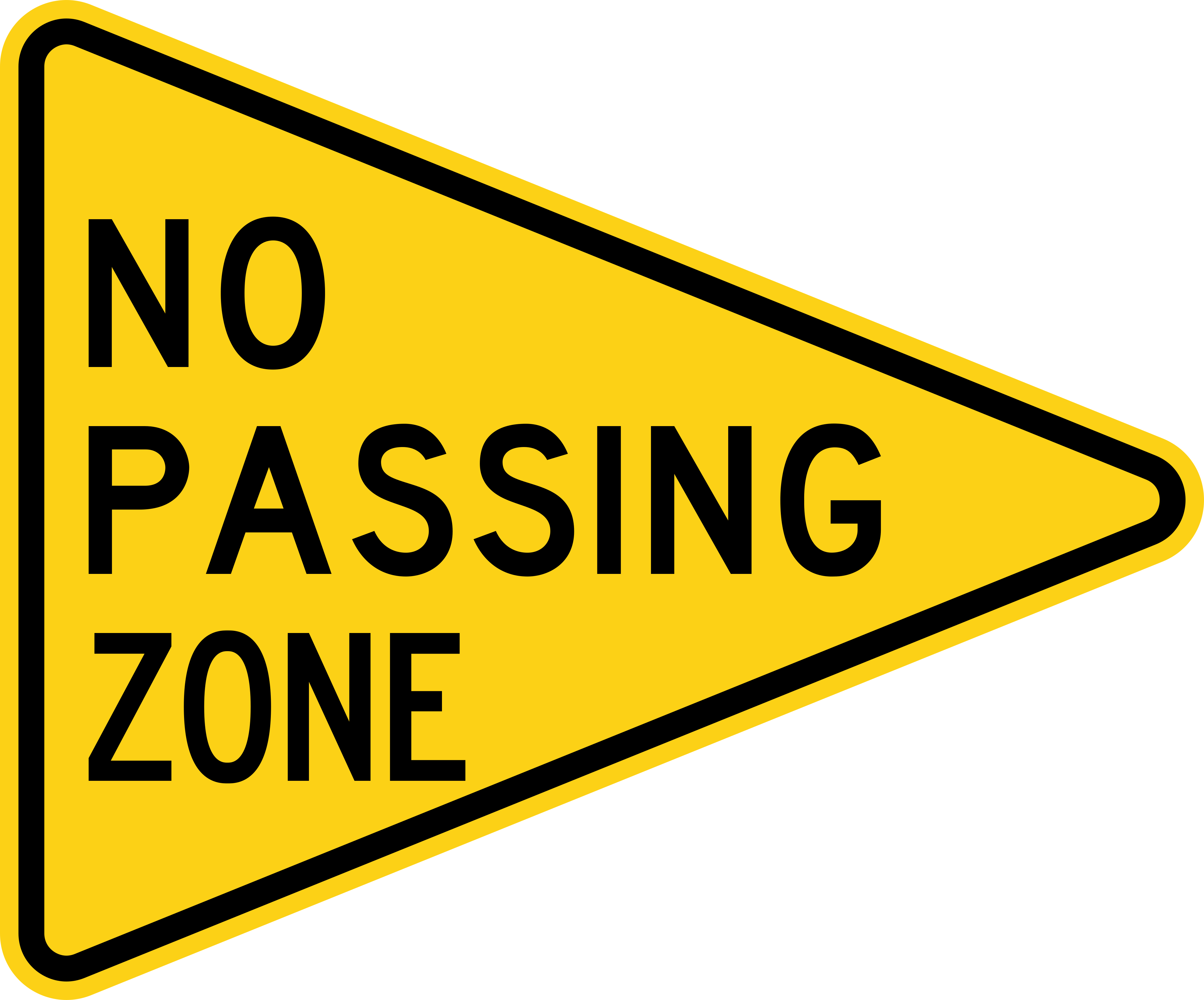
Question 46What shape is the NO PASSING ZONE sign, and where is it placed?
Show answer
A: Pennant-shaped yellow and black, on the left side of the road. The pennant-shaped yellow and black sign is on the left side of the road and points to the start of the no-passing zone. Official Hawaii Driver's Manual: No Passing Zone Signs, page 45.
-
Question 47On a barricade, stripes sloping downward to the left tell you to:
Show answer
D: Bear to the left. Stripes sloping down to the right mean bear right; sloping down to the left mean bear left. Official Hawaii Driver's Manual: Channelizing Devices, page 50.
-
Question 48In Hawaii, which crashes must be reported to the police immediately?
Show answer
B: Those with any personal injury or death, or property damage of $3,000 or more. Crashes with personal injury to any extent, death, or property damage of $3,000 or more must be reported to police immediately. Official Hawaii Driver's Manual: Crash Procedures, page 52.
-
Question 49Under Hawaii's Motor Vehicle Safety Responsibility Law, what must you file after a crash with death, injury or damage over $3,000?
Show answer
B: Form SR-21 evidence of insurance. Report the crash to police and your insurer and file evidence of insurance (Form SR-21). Official Hawaii Driver's Manual: Motor Vehicle Safety Responsibility Law, page 53.
-
Question 50After conviction of certain vehicle offenses, how long must you maintain proof of financial responsibility (SR-22) in Hawaii?
Show answer
B: Three years. You must file and maintain proof of financial responsibility for three years from the conviction date. Official Hawaii Driver's Manual: Motor Vehicle Safety Responsibility Law, page 53.
-
Question 51What are Hawaii's minimum liability coverages for bodily injury?
Show answer
A: $20,000 per person / $40,000 per accident. Hawaii requires liability of $20,000 per person with a $40,000 aggregate per accident for bodily injury, and $10,000 property damage. Official Hawaii Driver's Manual: Motor Vehicle Insurance Law, page 54.
-
Question 52What is Hawaii's minimum property damage liability coverage per accident?
Show answer
C: $10,000. Minimum property damage coverage is $10,000 per accident; damage to your own car isn't covered without extra insurance. Official Hawaii Driver's Manual: Motor Vehicle Insurance Law, page 54.
-
Question 53Hawaii basic no-fault benefits include up to how much per person for medical and rehabilitative expenses?
Show answer
A: $10,000. Hawaii's basic no-fault benefits pay up to $10,000 per person for medical and rehabilitation costs. Official Hawaii Driver's Manual: Motor Vehicle Insurance Law, page 54.
-
Question 54Under Hawaii's no-fault law, when can you sue for bodily injury?
Show answer
B: When medical bills exceed $5,000, or there is permanent loss of a body function or serious disfigurement, or death. You can sue for property damage at any time, but for bodily injury only if medical bills exceed $5,000, there's permanent loss or serious disfigurement, or death. Official Hawaii Driver's Manual: Motor Vehicle Insurance Law, page 54.
-
Question 55What is the maximum fine for violating Hawaii's motor vehicle insurance law?
Show answer
C: $5,000. Each violation can bring a fine not to exceed $5,000 or 30 days imprisonment, license suspension, or registration forfeiture, or a combination. Official Hawaii Driver's Manual: Motor Vehicle Insurance Law, page 54.
-
Question 56About what percent of fatal crashes in the U.S. involve alcohol, according to the Hawaii manual?
Show answer
B: About 40%. Alcohol is a factor in over 18,000 (about 40%) of fatal crashes each year in the U.S. Official Hawaii Driver's Manual: Alcohol and Other Drugs: The Problem, page 55.
-
Question 57Under Hawaii's Administrative License Revocation, what happens if your BAC is .08 or more or you refuse the test?
Show answer
A: Your license is taken and you get a 30-day temporary driving permit. Your license is taken and you're given a 30-day temporary permit; you may request a hearing. Official Hawaii Driver's Manual: The Law: Administrative License Revocation, page 55.
-
Question 58Under Hawaii's Zero Tolerance law, drivers under 21 may not drive with a BAC of:
Show answer
D: .02 or more. Drivers under 21 are prohibited from driving with a blood alcohol level of .02 or more. Official Hawaii Driver's Manual: Zero Tolerance, page 56.
-
Question 59Refusing an alcohol test in Hawaii may result in license revocation for:
Show answer
B: One, two or four years depending on prior alcohol enforcement contacts. Refusal may result in revocation for one, two or four years depending on prior alcohol enforcement contacts. Official Hawaii Driver's Manual: Alcohol and Other Drugs: The Law, page 56.
-
Question 60In Hawaii, a driver with a BAC above .05 but below .08 may be considered:
Show answer
B: Impaired. BAC over .05 but under .08 may be considered impaired; .08 or more is under the influence. Official Hawaii Driver's Manual: Alcohol and Other Drugs: The Law, page 56.
-
Question 61The brake warning lamp lights when you press the foot brake. What does this indicate?
Show answer
B: The brake system is defective and the vehicle should not be driven. If the brake warning light comes on when you press the brake pedal, the brake system has a fault; don't drive the vehicle until it is fixed. Official Hawaii Driver's Manual: Pre-Starting / Post-Starting, page 61.
-
Question 62How much more likely are you to be killed if thrown from your car in a crash?
Show answer
C: Five times. Being thrown out of the vehicle makes a crash five times more likely to kill you, which is one reason to wear a belt. Official Hawaii Driver's Manual: Safety Belts, page 61.
-
Question 63Without a seat belt, at what low speed is it possible to be killed in a crash, according to the manual?
Show answer
C: 12 mph. Without a belt, a crash at only 12 mph can be fatal; with lap and shoulder belts, crashes up to about 60 mph can be survivable. Official Hawaii Driver's Manual: Safety Belts, page 61.
-
Question 64Hawaii law prohibits leaving a child under what age unattended in a vehicle for five minutes or longer?
Show answer
D: Under 9. You or any adult passenger may not leave a child under nine years old unattended in a vehicle for five minutes or longer. Official Hawaii Driver's Manual: Warning! Do not leave children unattended, page 64.
-
Question 65What minimum following interval does the Hawaii manual say you should never go below?
Show answer
B: Two seconds. Count 'one thousand one, one thousand two'; you should never have less than a two-second interval. Official Hawaii Driver's Manual: Vehicle Speed (following interval), page 67.
-
Question 66When making a right turn at an intersection, may you drive in the bike lane?
Show answer
D: No. Don't use a bike lane as a right-turn lane. Stay out of it when turning right at an intersection, and look for bicyclists first. Official Hawaii Driver's Manual: Turns and Curves, page 67.
-
Question 67A conflict appears before you finish passing. What should you do?
Show answer
B: Brake sharply and return to your lane behind the vehicle. Brake sharply and return behind the overtaken vehicle; speed can be reduced faster by braking than increased by accelerating. Official Hawaii Driver's Manual: Overtaking and Passing, page 68.
-
Question 68You are about to hit an object and have standard brakes. What does the Hawaii manual say to do instead of locking the wheels?
Show answer
A: Apply and release the brakes rapidly and steer toward a clear area. Don't jam on the brakes and slide; apply and release them rapidly and steer toward a clear area, avoiding people and solid objects. Official Hawaii Driver's Manual: Use of Brakes, page 70.
-
Question 69When parking on a hill against a curb in Hawaii, which way should you turn your front wheels?
Show answer
C: Toward the curb. The Hawaii manual says to turn the front wheels toward the curb, whether you are parked uphill or downhill. If the brakes let go, the car would have to climb the curb before it could roll into traffic. Official Hawaii Driver's Manual: Parking on a Hill, page 71.
-
Question 70When parallel parked, how close may your bumpers be to other vehicles (unless marked otherwise)?
Show answer
A: No closer than two feet. Front and rear bumpers should not be closer than two feet from other vehicles unless the street is marked otherwise. Official Hawaii Driver's Manual: Parallel Parking, page 72.
-
Question 71In the first step of parallel parking, how far from the car in front of the space should you stop?
Show answer
D: About 18 inches. Signal and stop even with the front car about 18 inches from it, rear bumpers even. Official Hawaii Driver's Manual: Parallel Parking, page 72.
-
Question 72When should hazard warning signals (4-way flashers) never be used, per the Hawaii manual?
Show answer
C: When the vehicle is moving. Hazard signals warn that a vehicle is in a hazardous position; they should never be used when the vehicle is moving. Official Hawaii Driver's Manual: Hazard Warning Signals, page 73.
-
Question 73When rain first starts, how much following distance should you allow?
Show answer
B: At least twice the normal following distance. The first rain lifts oil off the road and makes it very slick. Slow down and keep at least double your usual following distance. Official Hawaii Driver's Manual: Driving in Inclement Weather: Rain, page 75.
-
Question 74At about what speed may partial hydroplaning start?
Show answer
D: 35 mph. Partial hydroplaning may start at 35 mph and increases with speed and water. Official Hawaii Driver's Manual: Driving in Inclement Weather: Rain, page 75.
-
Question 75At what speed in heavy rain may tires lose all contact with the pavement?
Show answer
A: 55 mph. At 55 mph in heavy rain the tires may lose all contact with the pavement, leaving you no control. Official Hawaii Driver's Manual: Driving in Inclement Weather: Rain, page 75.
-
Question 76Never drive through a flooded area where swiftly moving water is deeper than:
Show answer
A: One foot. Never drive through a flooded area where water over one foot deep is moving swiftly; it will sweep your vehicle off the road. Official Hawaii Driver's Manual: Driving in Inclement Weather: Rain, page 76.
-
Question 77In fog, if you can't see at least two car lengths (40 feet) ahead, what should you do?
Show answer
A: Pull completely off the pavement, stop and turn on hazard signals. Sharply reduce speed with low beams; if you can't see at least two car lengths (40 feet), pull completely off the pavement and stop with hazards on. Official Hawaii Driver's Manual: Fog, page 76.
-
Question 78The freeway entrance lane is congested. What should you do?
Show answer
B: Slow down or stop near the beginning of the entrance lane, not at its end. If congested, slow or stop near the entrance; don't move slowly to the end of the entrance lane and stop, which makes merging dangerous. Official Hawaii Driver's Manual: Entering the Freeway, page 78.
-
Question 79You see another driver in trouble on the freeway. What does the Hawaii manual advise?
Show answer
C: Don't stop; report the situation to the proper authorities. Do not stop to assist other drivers in trouble on the freeway; report it to the proper authorities. Official Hawaii Driver's Manual: Emergency Stops, page 79.
-
Question 80You have a tire blowout. What should you do first?
Show answer
A: Do not apply the brakes; grip the wheel firmly and steer to stay in your lane. Do not apply the brakes; grip the wheel, stay in your lane, slow gradually, then brake lightly and pull off. Official Hawaii Driver's Manual: Tire Blowouts, page 81.
-
Question 81Your accelerator sticks open. According to the Hawaii manual, what should you try first?
Show answer
C: Slap the accelerator pedal hard with your foot. Slap the accelerator pedal (quickly fully depress and release); then turn the ignition off without locking the steering, brake, and pull off. Official Hawaii Driver's Manual: Accelerator Stuck Open, page 83.
-
Question 82When turning off the ignition because the accelerator is stuck, what should you be careful not to do?
Show answer
B: Turn it far enough to lock the steering wheel. Move the ignition switch only far enough to stop the engine, not to engage the steering lock. Official Hawaii Driver's Manual: Accelerator Stuck Open, page 83.
-
Question 83The rear of your car is skidding to the right. Which way should you turn the wheel?
Show answer
B: Right. Turn the wheel in the direction the rear is skidding: right for a skid to the right, left for a skid to the left. Official Hawaii Driver's Manual: Skids, page 83.
-
Question 84What should you NOT use on a gasoline, oil or electrical car fire?
Show answer
C: Water. Use an extinguisher, dirt, sand or a blanket on small fires; do not use water on gasoline, oil or electrical fires. Official Hawaii Driver's Manual: Fire, page 84.
-
Question 85When must a trailer you tow have its own brakes and breakaway protection in Hawaii?
Show answer
A: When the loaded trailer weighs more than half the towing vehicle's weight or 3,000 pounds or more. If the loaded trailer weighs more than half the towing vehicle's weight or is 3,000 pounds or more, it must have brakes and breakaway protection. Official Hawaii Driver's Manual: Towing Trailers: Brakes, page 87.
-
Question 86About what percent of the trailer's weight should rest on the hitch?
Show answer
D: 10% to 15%. About 10% to 15% of the trailer weight should be on the hitch; too little makes the trailer fishtail. Official Hawaii Driver's Manual: Trailer Load, page 88.
-
Question 87What share of car/motorcycle crashes result from a car driver turning in front of the motorcyclist?
Show answer
B: Over two-thirds. Research shows over two-thirds of car/motorcycle crashes result from a car driver turning in front of the motorcyclist. Official Hawaii Driver's Manual: Sharing the Road with Motorcycles, page 89.
-
Question 88What share of Hawaii traffic fatalities are pedestrians, according to the manual?
Show answer
A: 20%. In Hawaii 20% of all traffic fatalities are pedestrians; almost half of those killed are under 15 or over 65. Official Hawaii Driver's Manual: Pedestrian Safety: Summary of Facts, page 95.
-
Question 89A school bus is stopped with alternating red lights flashing. Which drivers must stop?
Show answer
C: Those in the bus's lane and all lanes adjacent to it. Drivers in the lane occupied by the bus and all adjacent lanes must stop before reaching it until it moves or the lights go off. Official Hawaii Driver's Manual: Stopping for a School Bus, page 96.
-
Question 90What can failing to stop for a school bus with flashing red lights cost you in Hawaii?
Show answer
A: $1,000. Failure to comply with the school bus law (291C-95, HRS) can cost you $1,000. Official Hawaii Driver's Manual: Stopping for a School Bus, page 96.
-
Question 91When are vehicles not required to stop for a stopped school bus with flashing red lights in Hawaii?
Show answer
A: When traveling the opposite direction on a divided highway. Vehicles going the opposite direction on a divided highway (roadways separated by a strip not for vehicles) are not required to stop. Official Hawaii Driver's Manual: Stopping for a School Bus, page 96.
-
Question 92How much space should you leave when passing a bicyclist in Hawaii?
Show answer
D: At least 3 feet. Motorists should maintain at least 3 feet between the bicyclist and their vehicle until safely past. Official Hawaii Driver's Manual: Bicycles: Motorists, page 97.
-
Question 93About what share of bicycle-car crashes involve bicyclists riding the wrong way?
Show answer
A: 25%. Riding against traffic leads to approximately 25% of all bicycle-car crashes; watch for it when turning. Official Hawaii Driver's Manual: Bicycles: Motorists, page 97.
-
Question 94Where are bicycles not allowed to ride on sidewalks in Hawaii?
Show answer
D: Business districts. Bicycles may not ride on sidewalks in business districts; elsewhere they may at 10 mph or less, yielding to pedestrians. Official Hawaii Driver's Manual: Bicyclists: Traffic Regulations, page 98.
-
Question 95How fast may a bicyclist ride on a sidewalk where it is allowed in Hawaii?
Show answer
A: 10 mph or less. Outside business districts, bicyclists may ride on sidewalks at 10 mph or less and must yield to pedestrians. Official Hawaii Driver's Manual: Bicyclists: Traffic Regulations, page 98.
-
Question 96How does Hawaii define a business district along a highway?
Show answer
B: Where within any 600 feet, business buildings occupy at least 300 feet of frontage on one side or collectively on both sides. A business district is where, within any 600 feet along a highway, business buildings occupy at least 300 feet of frontage on one side or both sides collectively. Official Hawaii Driver's Manual: Definitions: Business District, page 8.
Answer every question to see your score.
Remembering the numbers
Most mistakes on the Hawaii HDOT test are about specifics: how many feet before a turn to signal, how far to park from a hydrant, the alcohol limit for drivers under 21. Write the numbers from these questions on a card and review them before the test, then take the exam simulator.