Hawaii HDOT permit practice test 5
25 questions written from the Official Hawaii Driver's Manual, covering lanes, highways and freeways, following and passing, turns and intersections, sharing the road, parking and more. Pick an answer to see straight away whether you're right and why. The real Hawaii HDOT test has 30 questions and you need 24 right.
-
Question 1The freeway entrance lane is congested. What should you do?
Show answer
B: Slow down or stop near the beginning of the entrance lane, not at its end. If congested, slow or stop near the entrance; don't move slowly to the end of the entrance lane and stop, which makes merging dangerous. Official Hawaii Driver's Manual: Entering the Freeway, page 78.
-
Question 2A school bus with flashing lights is on the same roadway ahead. May you pass it?
Show answer
D: No. Do not pass when there is a school bus on the same roadway with its flashing lights operating. Official Hawaii Driver's Manual: No Passing Rules, page 31.
-
Question 3While waiting to turn left on a green light, how should your front wheels be pointed?
Show answer
C: Straight ahead until it's clear to turn. While waiting for a gap to turn left on a green light, keep your wheels straight. Then turn once the intersection is clear and it is safe. Official Hawaii Driver's Manual: Turns and Curves, page 67.
-
Question 4What is the 'slipstream' effect of large fast-moving vehicles?
Show answer
D: Wind gusts strong enough to change the direction of smaller vehicles. Large fast vehicles create wind gusts that can push smaller vehicles; be ready to correct your steering. Official Hawaii Driver's Manual: Slipstream, page 86.
-
Question 5When parking on a hill against a curb in Hawaii, which way should you turn your front wheels?
Show answer
C: Toward the curb. The Hawaii manual says to turn the front wheels toward the curb, whether you are parked uphill or downhill. If the brakes let go, the car would have to climb the curb before it could roll into traffic. Official Hawaii Driver's Manual: Parking on a Hill, page 71.
-
Question 6At an intersection where your road meets a protected through route with a stop sign for you, what must you do?
Show answer
B: Stop and yield to all traffic on the protected route. Stop and yield to all traffic on the protected route. Official Hawaii Driver's Manual: The Rules of Right-of-Way, page 32.
-
Question 7Where does a new speed limit begin after a REDUCED SPEED AHEAD sign?
Show answer
C: At the next speed limit sign. Reduced Speed Ahead signs warn you to begin slowing; the new limit begins at the next speed limit sign. Official Hawaii Driver's Manual: Reduced Speed Ahead Signs, page 45.
-
Question 8What is a two-way left turn lane used for?
Show answer
A: Left turns only, by vehicles from either direction; never for passing. The center lane marked with solid and dashed yellow lines is for left turns by either direction only and must never be used for passing. Official Hawaii Driver's Manual: Two-Way Left Turn Channelization Markings, page 36.
-
Question 9How should you apply the parking brake after a brake failure?
Show answer
A: Gradually, to avoid losing control. Apply the parking brake gradually; applying it rapidly or with great force may cause loss of control. Official Hawaii Driver's Manual: Brake Failure, page 81.
-
Question 10Is it legal to keep an opened alcoholic beverage container in the passenger area while driving in Hawaii?
Show answer
A: No, storing an open container in the area occupied by the driver or passengers is prohibited. Storing an opened alcoholic beverage container in the area normally occupied by the driver or passengers is prohibited on public roads. Official Hawaii Driver's Manual: Alcohol and Other Drugs: The Law, page 56.
-
Question 11Never drive through a flooded area where swiftly moving water is deeper than:
Show answer
A: One foot. Never drive through a flooded area where water over one foot deep is moving swiftly; it will sweep your vehicle off the road. Official Hawaii Driver's Manual: Driving in Inclement Weather: Rain, page 76.
-
Question 12A permit holder under 18 drives at 11:30 p.m. Who must be the accompanying driver?
Show answer
A: Their parent or guardian. Between 11:00 p.m. and 5:00 a.m., the permit holder must be accompanied by their parent or guardian. Official Hawaii Driver's Manual: Driving by Minors, page 13.
-
Question 13Under the Hawaii manual, children under what age must ride in a child restraint?
Show answer
C: Under 4. Children under age 4 must be in a child restraint; older children under 8 may need a booster seat. Official Hawaii Driver's Manual: Vehicle Condition and Maintenance: Safety Belts, page 20.
-
Question 14Which freeway lanes should through traffic use in Hawaii?
Show answer
A: The left or center lanes, at or near the posted limit. Through traffic should use the left or center lanes; the right lane is for slower vehicles and those entering or leaving. Official Hawaii Driver's Manual: Driving on the Freeway, page 79.
-
Question 15What does the end of a 'no passing zone' mean?
Show answer
D: There is increased visibility ahead, not that passing is automatically safe. A no-passing zone ending only means you can see farther ahead. You still have to judge whether a pass is safe. Official Hawaii Driver's Manual: No Passing Rules, page 31.
-
Question 16When making a right turn at an intersection, may you drive in the bike lane?
Show answer
D: No. Don't use a bike lane as a right-turn lane. Stay out of it when turning right at an intersection, and look for bicyclists first. Official Hawaii Driver's Manual: Turns and Curves, page 67.
-
Question 17When must a trailer you tow have its own brakes and breakaway protection in Hawaii?
Show answer
A: When the loaded trailer weighs more than half the towing vehicle's weight or 3,000 pounds or more. If the loaded trailer weighs more than half the towing vehicle's weight or is 3,000 pounds or more, it must have brakes and breakaway protection. Official Hawaii Driver's Manual: Towing Trailers: Brakes, page 87.
-
Question 18When parallel parked, how close may your bumpers be to other vehicles (unless marked otherwise)?
Show answer
A: No closer than two feet. Front and rear bumpers should not be closer than two feet from other vehicles unless the street is marked otherwise. Official Hawaii Driver's Manual: Parallel Parking, page 72.
-
Question 19A school crossing guard signals you to stop. What must you do?
Show answer
D: Stop. Be especially watchful near schools, parks and playgrounds, and stop upon the signal of any school crossing guard. Official Hawaii Driver's Manual: Your Responsibility as a Driver, page 95.
-
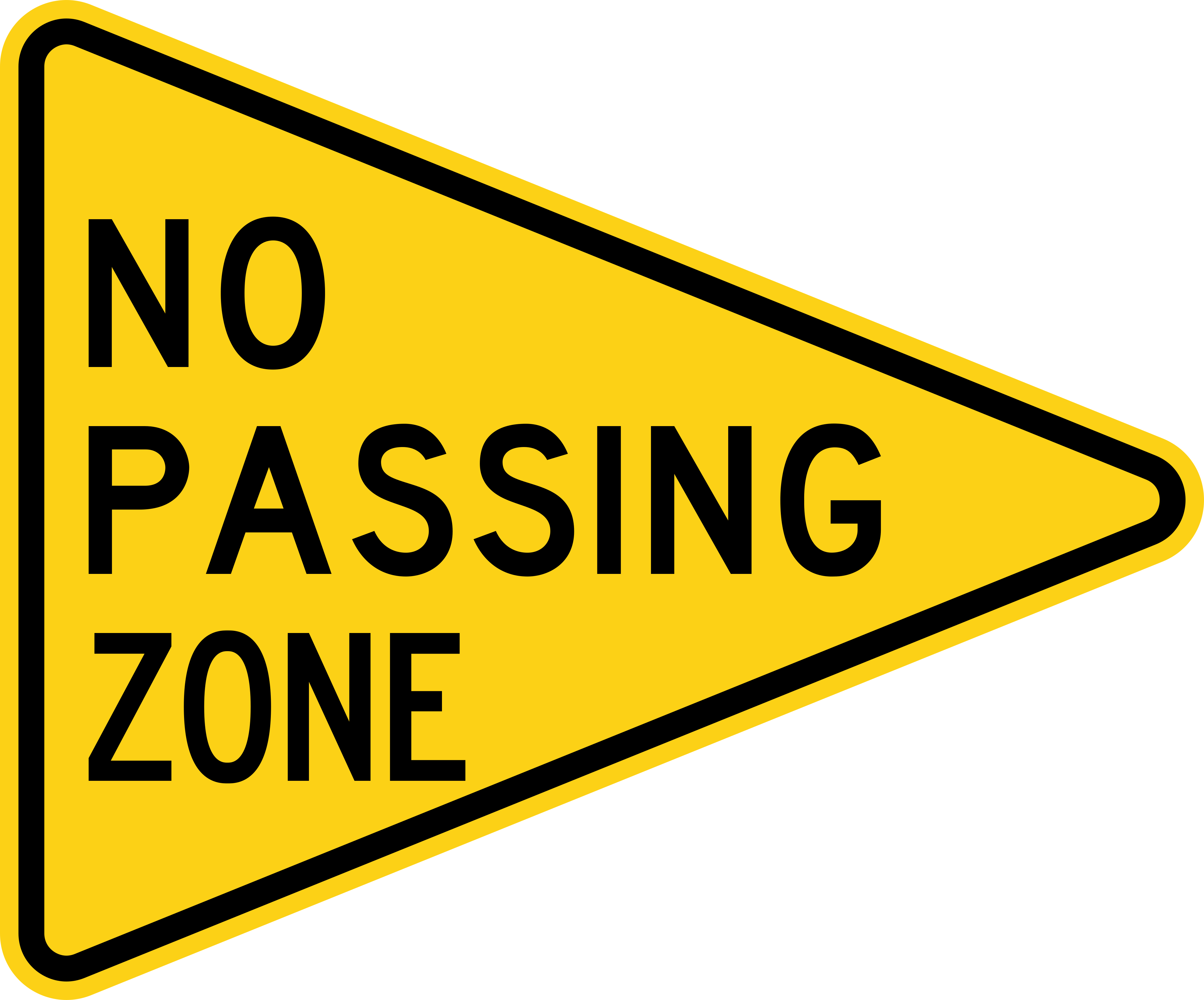
Question 20What shape is the NO PASSING ZONE sign, and where is it placed?
Show answer
A: Pennant-shaped yellow and black, on the left side of the road. The pennant-shaped yellow and black sign is on the left side of the road and points to the start of the no-passing zone. Official Hawaii Driver's Manual: No Passing Zone Signs, page 45.
-
Question 21You see yellow obstruction markings around a bridge support in your lane. How must you pass?
Show answer
C: Only to the right of the yellow markings. You may pass on either side of white obstruction markings but only to the right of yellow markings. Official Hawaii Driver's Manual: Obstruction Markings, page 37.
-
Question 22Your wheels drop off the edge of the pavement. What should you do?
Show answer
C: Keep driving with wheels off, slow down, brake gently, then steer back at a safe speed. Don't jerk the steering wheel; continue with the wheels off, reduce speed, brake gently, and return when at a safe speed. Official Hawaii Driver's Manual: Wheels Off Pavement, page 82.
-
Question 23Why are drugs bought on the illegal market especially dangerous?
Show answer
B: There's no way to be certain of their strength or purity. Drugs sold illegally are dangerous because you can never know how strong or how pure they are. Official Hawaii Driver's Manual: Other Drugs, page 56.
-
Question 24In fog, if you can't see at least two car lengths (40 feet) ahead, what should you do?
Show answer
A: Pull completely off the pavement, stop and turn on hazard signals. Sharply reduce speed with low beams; if you can't see at least two car lengths (40 feet), pull completely off the pavement and stop with hazards on. Official Hawaii Driver's Manual: Fog, page 76.
-
Question 25How long must a Hawaii minor hold an instruction permit before applying for a provisional license?
Show answer
D: 180 days. You must hold a valid instruction permit for 180 days before applying for a provisional license. Official Hawaii Driver's Manual: Driving by Minors, page 13.
Answer every question to see your score.
More Hawaii practice tests
- Practice test 125 questions
- Practice test 225 questions
- Practice test 325 questions
- Practice test 425 questions
- Practice test 625 questions
- Practice test 725 questions
- Practice test 825 questions
- Practice test 925 questions
- Practice test 1025 questions
- Practice test 1125 questions
- Exam simulatorThe real format, 30 questions
How to use these tests
Read each explanation, even when you get the question right: it tells you the rule and the handbook section, so you can look it up. Your answers are saved in this browser only, so the weak spots mode can give you more questions on the topics you miss. When you're scoring well, take the exam simulator: it uses the same number of questions and passing score as the real test.
Our own questions, written from the Official Hawaii Driver's Manual and checked against it. Not affiliated with the Hawaii Department of Transportation, Motor Vehicle Safety Office (licenses issued by the county driver licensing offices of Honolulu, Hawaii, Maui and Kauai). Found a mistake? Tell us.