Hardest Indiana permit test questions
169 questions that need exact knowledge rather than common sense: the numbers (distances, speeds, fines, limits), the exceptions and the rules that are easy to mix up. We chose them from our Indiana question bank for that reason; they're not statistics from the BMV.
-
Question 1How long do you have to get an Indiana driver's license after becoming an Indiana resident?
Show answer
B: 60 days. New Indiana residents have 60 days to obtain an Indiana driver's license. Indiana Driver's Manual: Chapter 1: Indiana Residency Requirements — New Indiana Residents, page 7.
-
Question 2What is the minimum age for an Indiana learner's permit if you are enrolled in a BMV-licensed behind-the-wheel driver training course?
Show answer
B: 15. At 15 you can get a permit only if you're enrolled with a BMV-licensed behind-the-wheel school and bring its enrollment certificate. Indiana Driver's Manual: Chapter 1: Learner's Permits, page 8.
-
Question 3Without enrolling in driver education, at what age can you get an Indiana learner's permit?
Show answer
C: 16. Applicants 16 or older may get a learner's permit by meeting document, vision and knowledge exam requirements. Indiana Driver's Manual: Chapter 1: Learner's Permits, page 8.
-
Question 4How early can a Certificate of Driver Education Enrollment be dated before the class starts?
Show answer
A: No earlier than three weeks before the class. The certificate must be dated no earlier than three weeks before the start of the class. Indiana Driver's Manual: Chapter 1: Learner's Permits, page 8.
-
Question 5An Indiana learner's permit applicant under 18 must provide an emergency contact of what minimum age?
Show answer
B: 18. Applicants under 18 must provide an emergency contact who is at least 18. Indiana Driver's Manual: Chapter 1: Learner's Permits, page 8.
-
Question 6A 15-year-old Indiana permit holder in driver education wants to practice with a relative. How old must the licensed relative be?
Show answer
C: 25 or older. The licensed relative (by blood, marriage or legal status) must be 25 or older and sit in the front passenger seat. Indiana Driver's Manual: Chapter 1: Practice Driving with Your Learner's Permit, page 9.
-
Question 7An Indiana permit holder may practice with their spouse. How old must the licensed spouse be?
Show answer
C: 21 or older. A permit holder may practice with a spouse who is licensed and at least 21 years old. Indiana Driver's Manual: Chapter 1: Practice Driving with Your Learner's Permit, page 9.
-
Question 8How long is an Indiana learner's permit valid?
Show answer
C: Two years. An Indiana learner's permit lasts two years from the day it is issued. Indiana Driver's Manual: Chapter 1: Learner's Permit Validity, page 9.
-
Question 9When renewing an Indiana learner's permit, you must retest if it has been expired for more than how long?
Show answer
C: 180 days. If your learner's permit has been expired more than 180 days, you must retest. Indiana Driver's Manual: Chapter 1: Learner's Permit Validity, page 9.
-
Question 10If you fail the Indiana knowledge exam, when may you retake it?
Show answer
A: The next business day. A failed knowledge exam can be retaken starting the next business day. Indiana Driver's Manual: Chapter 1: Knowledge Exam, page 10.
-
Question 11How long before a BMV branch closes must you arrive to take the knowledge exam that day?
Show answer
B: 30 minutes. The computer-based exam is only given same-day if you get to the branch at least half an hour before closing. Indiana Driver's Manual: Chapter 1: Knowledge Exam, page 10.
-
Question 12An Indiana driver renewing a license has six or more active points. What extra step is required?
Show answer
A: Taking the knowledge exam. A driver with six or more active points who is renewing must take the knowledge exam. Indiana Driver's Manual: Chapter 1: Knowledge Exam, page 10.
-
Question 13How much classroom and behind-the-wheel training does a full Indiana driver education course include?
Show answer
A: 30 hours theoretical and 6 hours behind the wheel. A complete driver education course is 30 hours of classroom (theory) instruction plus six hours driving with an instructor. Indiana Driver's Manual: Chapter 1: Driving Skills Exam, page 10.
-
Question 14How far in advance can an Indiana driving skills exam be scheduled?
Show answer
A: No more than three weeks and no less than 48 business hours. Skills exam appointments must be booked at least 48 business hours ahead but no more than three weeks out. Indiana Driver's Manual: Chapter 1: Driving Skills Exam, page 10.
-
Question 15Which action causes automatic failure of the Indiana driving skills exam?
Show answer
A: Backing over a curb. Backing over a curb is an automatic failure; the other errors can lower your score. Indiana Driver's Manual: Chapter 1: Driving Skills Exam, page 12.
-
Question 16If you pass the driving skills exam with a participating driver training school, how long do the results stay valid?
Show answer
A: Until your learner's permit expires. A skills exam passed with a BMV-licensed driver training school counts until the learner's permit it was taken on runs out. Indiana Driver's Manual: Chapter 1: Driving Skills Exam, page 10.
-
Question 17After failing an Indiana driving skills exam, how long must you wait to retake it?
Show answer
B: Seven days. After a failed skills exam you must wait a week (seven days) to try again. Indiana Driver's Manual: Chapter 1: Driving Skills Exam, page 12.
-
Question 18After a third failed driving skills exam on the same Indiana learner's permit, how long must you wait?
Show answer
C: Two months. After a third failure while holding a learner's permit, wait two months from the last failed exam. Indiana Driver's Manual: Chapter 1: Driving Skills Exam, page 12.
-
Question 19What happens to a minor's learner's permit or license if the adult who signed for financial liability files a written request to withdraw?
Show answer
A: It is canceled. A written request to withdraw financial liability cancels the minor's learner's permit or license. Indiana Driver's Manual: Chapter 1: Financial Liability for Injury or Damage, page 13.
-
Question 20What is the minimum age for an Indiana driver's license if you completed a BMV-licensed driver education program?
Show answer
B: 16. You must be at least 16 with completion of a BMV-licensed driver education program. Indiana Driver's Manual: Chapter 1: Applying for a Driver's License — Age and Experience Requirements, page 14.
-
Question 21Without driver education, how old must you be to get an Indiana driver's license?
Show answer
D: 16 years and 270 days. Without a BMV-licensed driver education program, you must be at least 16 years and 270 days old. Indiana Driver's Manual: Chapter 1: Applying for a Driver's License — Age and Experience Requirements, page 14.
-
Question 22How long must you hold an Indiana learner's permit before getting a driver's license (if under 18)?
Show answer
B: 180 days. You must hold a valid Indiana learner's permit for at least 180 days. Indiana Driver's Manual: Chapter 1: Applying for a Driver's License — Age and Experience Requirements, page 14.
-
Question 23How many hours of supervised driving practice must be logged before an Indiana driver's license?
Show answer
C: 50. Applicants must complete at least 50 hours of supervised driving practice. Indiana Driver's Manual: Chapter 1: Applying for a Driver's License — Age and Experience Requirements, page 14.
-
Question 24How many of Indiana's 50 supervised practice hours must be at night (without a daytime-only restriction)?
Show answer
B: 10. At least 10 hours must be completed at night unless the permit carries a daytime-only restriction. Indiana Driver's Manual: Chapter 1: Applying for a Driver's License — Age and Experience Requirements, page 14.
-
Question 25For how long is an Indiana driver's license valid if you are under 75?
Show answer
B: Six years. A driver's license is valid for six years if you are younger than 75. Indiana Driver's Manual: Chapter 1: Driver's License Validity, page 14.
-
Question 26How long is an Indiana driver's license valid for a driver aged 75 through 84?
Show answer
C: Three years. Drivers aged 75 through 84 receive a license valid for three years. Indiana Driver's Manual: Chapter 1: Driver's License Validity, page 14.
-
Question 27How long is an Indiana driver's license valid for a driver who is 85 or older?
Show answer
B: Two years. Drivers 85 and older receive a two-year license. Indiana Driver's Manual: Chapter 1: Driver's License Validity, page 14.
-
Question 28Until what age is an Indiana driver's license considered probationary?
Show answer
C: 21. A license obtained before 21 is probationary until you turn 21; it is valid until 21 years and 30 days. Indiana Driver's Manual: Chapter 1: Probationary Driver's License Validity, page 15.
-
Question 29During the first 180 days of an Indiana probationary license, who may ride with you without another adult present?
Show answer
A: Your child, stepchild, sibling (including step or half) or spouse. For the first 180 days, family members such as your own child, stepchild, sibling (step or half included) or spouse may ride with you without a supervising adult. Indiana Driver's Manual: Chapter 1: Probationary Driver's License Passenger Restrictions, page 15.
-
Question 30During the first 180 days with an Indiana probationary license, when may you NOT drive?
Show answer
A: Between 10 p.m. and 5 a.m.. For the first 180 days, you may not drive between 10 p.m. and 5 a.m. Indiana Driver's Manual: Chapter 1: Probationary Driver's License Time Restrictions, page 15.
-
Question 31After the first 180 days, an Indiana probationary driver under 18 may not drive on Sunday through Thursday after what time?
Show answer
B: 11 p.m.. After 180 days and under 18, you may not drive Sunday through Thursday after 11 p.m. Indiana Driver's Manual: Chapter 1: Probationary Driver's License Time Restrictions, page 15.
-
Question 32After the first 180 days, between what hours on Saturday and Sunday may an Indiana probationary driver under 18 not drive?
Show answer
A: Between 1 a.m. and 5 a.m.. On Saturday and Sunday the restricted hours are between 1 a.m. and 5 a.m. Indiana Driver's Manual: Chapter 1: Probationary Driver's License Time Restrictions, page 15.
-
Question 33When may any Indiana driver use a telecommunications device such as a phone while driving?
Show answer
A: Only hands-free, or to make a 911 emergency call. Indiana prohibits telecommunications device use while driving unless hands-free or to make a 911 emergency call. Indiana Driver's Manual: Chapter 7: Distracted Driving, page 50.
-
Question 34What does restriction G on an Indiana credential mean?
Show answer
A: Daylight driving only. Restriction G means daylight driving only. Indiana Driver's Manual: Chapter 2: Restrictions and Endorsements, page 18.
-
Question 35At what age may you operate a motor driven cycle (MDC) in Indiana?
Show answer
B: 15. You must be at least 15 to operate an MDC. Indiana Driver's Manual: Chapter 2: Motor Driven Cycle (MDC), page 20.
-
Question 36What is the maximum speed for a motor driven cycle in Indiana?
Show answer
C: 35 mph. An MDC must operate at no more than 35 miles per hour and may not use interstates. Indiana Driver's Manual: Chapter 2: Motor Driven Cycle (MDC), page 20.
-
Question 37Within how many days must you apply for an amended Indiana credential after changing your principal address?
Show answer
B: 30 days. You must notify the BMV and apply for an amended credential within 30 days of an address change. Indiana Driver's Manual: Chapter 4: Amending a Credential — Address Change, page 25.
-
Question 38How many points does Indiana assess for driving 1 to 15 mph over the speed limit?
Show answer
B: 2 points. Speeding 1-15 mph over the limit is 2 points. Indiana Driver's Manual: Chapter 5: Point Values, page 26.
-
Question 39How many points does Indiana assess for driving 16 to 25 mph over the speed limit?
Show answer
B: 4 points. Speeding 16-25 mph over the limit is 4 points. Indiana Driver's Manual: Chapter 5: Point Values, page 26.
-
Question 40How many points does Indiana assess for driving 26 mph or more over the speed limit?
Show answer
B: 6 points. Speeding 26 or more mph over the limit is 6 points. Indiana Driver's Manual: Chapter 5: Point Values, page 26.
-
Question 41How many points does Indiana assess for following another vehicle too closely?
Show answer
C: 6 points. Following too closely is a 6-point violation. Indiana Driver's Manual: Chapter 5: Point Values, page 26.
-
Question 42How many points does a hand-held device violation carry in Indiana?
Show answer
B: 4 points. A violation for using a hand-held device is 4 points. Indiana Driver's Manual: Chapter 5: Point Values, page 26.
-
Question 43How many points does failing to yield to an emergency vehicle carry in Indiana?
Show answer
C: 6 points. Failure to yield to an emergency vehicle is 6 points. Indiana Driver's Manual: Chapter 5: Point Values, page 26.
-
Question 44How long do points stay active on an Indiana driver record?
Show answer
B: Two years. Points stay active for two years from the conviction date. Indiana Driver's Manual: Chapter 5: Point Values, page 26.
-
Question 45How many points of credit does completing a BMV-approved Driver Safety Program give?
Show answer
C: Four. Completing a BMV-approved DSP gives a four-point credit, once in a three-year period. Indiana Driver's Manual: Chapter 5: Driver Safety Program, page 26.
-
Question 46How often may an Indiana driver receive the Driver Safety Program point credit?
Show answer
C: Once in a three-year period. The four-point Driver Safety Program credit can be used only once in any three-year span. Indiana Driver's Manual: Chapter 5: Driver Safety Program, page 26.
-
Question 47If the BMV orders you to take a Driver Safety Program, within how many days must you complete it?
Show answer
C: 90. You must complete a required DSP within 90 days of the notice, or your privileges are suspended. Indiana Driver's Manual: Chapter 5: Driver Safety Program, page 26.
-
Question 48What is Indiana's minimum auto liability insurance?
Show answer
A: 25/50/25. Indiana requires $25,000 per person, $50,000 per accident for injury, and $25,000 property damage (25/50/25). Indiana Driver's Manual: Chapter 5: Insurance Requirements, page 27.
-
Question 49Under Indiana's 25/50/25 insurance minimum, how much coverage is required for property damage in one accident?
Show answer
C: $25,000. The minimum is $25,000 for property damage in any one accident. Indiana Driver's Manual: Chapter 5: Insurance Requirements, page 27.
-
Question 50Within how many days must your insurer's Certificate of Compliance reach the BMV after a request to verify insurance?
Show answer
C: 90. The COC must be received and processed within 90 days of the BMV's request, or your privileges will be suspended. Indiana Driver's Manual: Chapter 5: Insurance Requirements — Proof of Financial Responsibility, page 27.
-
Question 51What is the reinstatement fee for a first no-insurance suspension in Indiana (after Jan. 1, 2015)?
Show answer
B: $250. Reinstatement fees are $250 for a first, $500 for a second, and $1,000 for a third or later no-insurance suspension. Indiana Driver's Manual: Chapter 5: No-Insurance Reinstatement Fees, page 28.
-
Question 52How long must an SR22 be maintained continuously to end an indefinite no-insurance suspension in Indiana?
Show answer
B: 180 days. Indefinite no-insurance suspensions end after an SR22 is maintained continuously for 180 days. Indiana Driver's Manual: Chapter 5: SR22 Requirement Period, page 28.
-
Question 53In Indiana, how long is your license suspended if you fail a chemical test for alcohol?
Show answer
B: 180 days. A motorist who fails a chemical test faces a 180-day suspension. Indiana Driver's Manual: Chapter 5: Suspensions — Operating a Vehicle While Intoxicated, page 29.
-
Question 54In Indiana, how long is your license suspended if you refuse a chemical test (with no prior OWI conviction)?
Show answer
B: One year. Refusing a chemical test results in a one-year suspension. Indiana Driver's Manual: Chapter 5: Suspensions — Operating a Vehicle While Intoxicated, page 29.
-
Question 55A driver with a previous OWI conviction refuses a chemical test in Indiana. How long is the suspension?
Show answer
C: Two years. With a previous OWI conviction, refusing a chemical test brings a two-year suspension. Indiana Driver's Manual: Chapter 5: Suspensions — Operating a Vehicle While Intoxicated, page 29.
-
Question 56In Indiana, what happens to your driving privileges if you are convicted of operating a watercraft while intoxicated?
Show answer
A: They face the same penalties as for a motor vehicle. An OWI conviction on a watercraft carries the same driving-privilege penalties as for a motor vehicle. Indiana Driver's Manual: Chapter 5: Operating a Watercraft While Intoxicated, page 29.
-
Question 57Under Indiana's Habitual Traffic Violator law, how long is the suspension for 10 or more traffic violations in 10 years (including one major offense)?
Show answer
B: Five years. Section C HTVs with 10 or more violations in 10 years, one of them major, face a five-year suspension. Indiana Driver's Manual: Chapter 5: Habitual Traffic Violators — Section C, page 31.
-
Question 58Under Indiana's HTV law, what suspension follows three major offenses such as OWI or reckless driving within 10 years?
Show answer
B: Ten years. Drivers with three judgments from the Section B list within 10 years are suspended for 10 years. Indiana Driver's Manual: Chapter 5: Habitual Traffic Violators — Section B, page 30.
-
Question 59What do fluorescent yellow-green signs warn of?
Show answer
A: Nearby schools, pedestrians, bicycles, playgrounds and school bus routes. Fluorescent yellow-green signs warn of nearby schools, pedestrians, bicycles, playgrounds and bus routes. Indiana Driver's Manual: Chapter 6: Traffic Sign Colors, page 32.
-
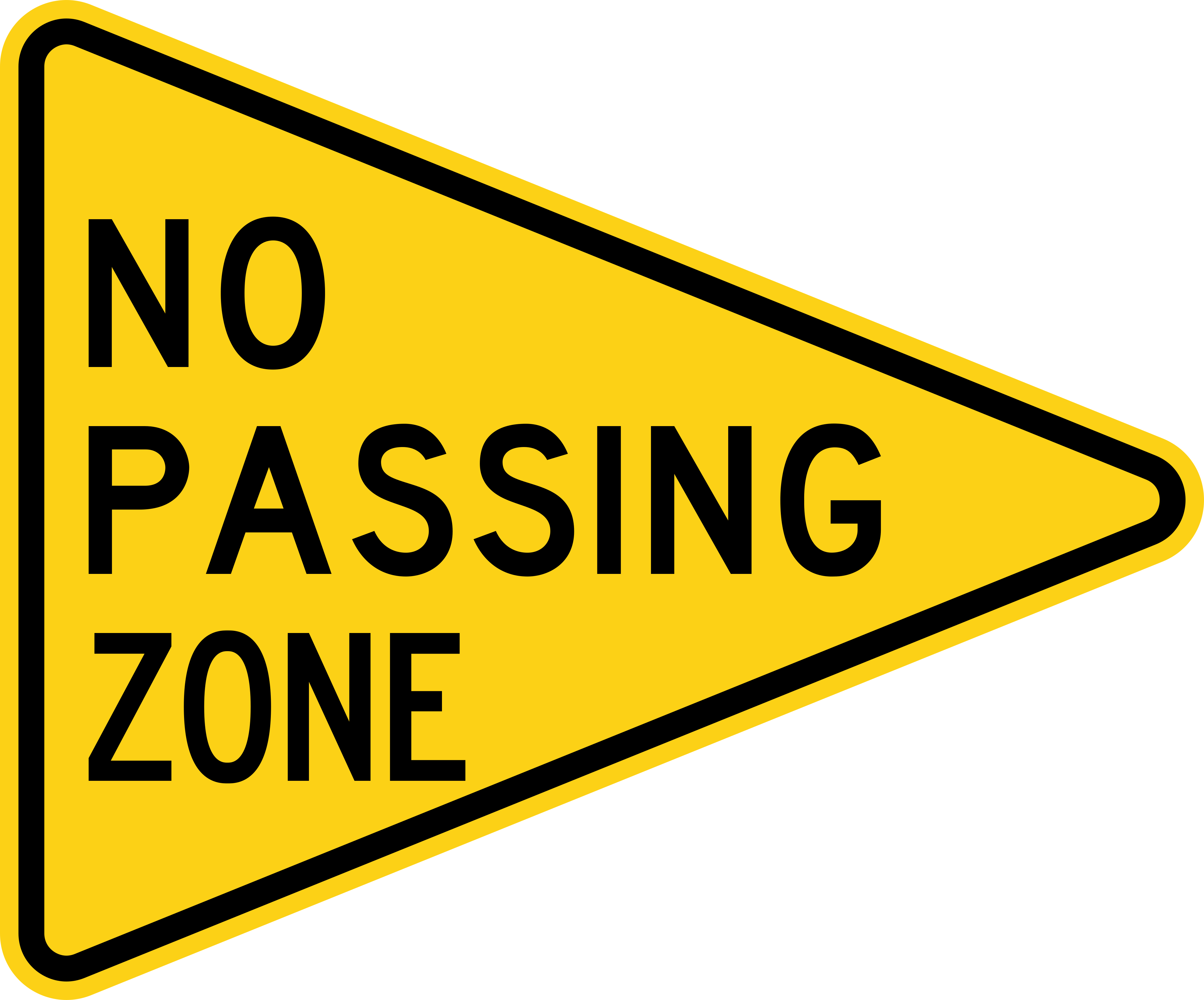
Question 60Where are pennant-shaped No Passing Zone signs posted?
Show answer
A: On the left-hand side of two-way roads. Pennant-shaped signs are posted on the left side of two-way roads to warn drivers not to pass. Indiana Driver's Manual: Chapter 6: Traffic Sign Shapes, page 33.
-
Question 61A rectangular advisory speed sign posted with a diamond warning sign tells you what?

Show answer
A: A recommended speed for a hazard such as a sharp curve. Rectangular signs can warn of hazards with an advisory speed for a sharp curve, often posted with a diamond warning sign. Indiana Driver's Manual: Chapter 6: Traffic Sign Shapes, page 33.
-
Question 62This yellow diamond sign shows a second lane joining the road with no merge. What is it called in the Indiana manual?

Show answer
A: Added Lane. The manual's warning-sign chart labels this sign Added Lane; it differs from Merging Traffic and Lane Ends. Indiana Driver's Manual: Chapter 6: Warning Signs, page 34.
-
Question 63What does a Worksite Added Penalties sign mean?
Show answer
A: Added penalties apply to traffic violations in the work site. The manual lists worksite added penalty signs among construction signs that convey regulations: violations in the work site carry added penalties. Indiana Driver's Manual: Chapter 6: Highway Construction and Maintenance Signs, page 35.
-
Question 64What is the top speed of a vehicle displaying an orange slow-moving vehicle emblem in Indiana?
Show answer
B: 25 mph. The slow-moving vehicle emblem (orange center, red reflective borders) marks a vehicle that cannot exceed 25 mph. Indiana Driver's Manual: Chapter 6: Slow-Moving Vehicle Emblem, page 35.
-
Question 65What does a white MINIMUM SPEED 40 sign mean?
Show answer
A: You must not drive slower than 40 mph in normal conditions. A Minimum Speed sign sets the lowest speed allowed on that road. Indiana Driver's Manual: Chapter 6: Traffic Regulation Signs, page 36.
-
Question 66A plaque under a stop sign reads CROSS TRAFFIC DOES NOT STOP. What should you do?

Show answer
A: Stop and wait for a safe gap; cross traffic will not stop for you. The plaque tells you that traffic on the cross street does not have to stop. Indiana Driver's Manual: Chapter 6: Traffic Regulation Signs — Supplemental Plaques, page 37.
-
Question 67How many vehicles at a time may move into an intersection to turn left on a green ball signal?
Show answer
A: One. On a green ball, left-turning vehicles enter the intersection one at a time. Indiana Driver's Manual: Chapter 6: Traffic Signals — Turning through an Intersection, page 39.
-
Question 68What does a flashing yellow arrow for a turn mean?
Show answer
A: Turn only after yielding to pedestrians and oncoming traffic. A yellow flashing arrow means you may turn only after yielding to pedestrians and oncoming traffic. Indiana Driver's Manual: Chapter 6: Traffic Signals — Yellow Flashing Arrows for Turning Movements, page 39.
-
Question 69In Indiana, when may you turn left at a red light?
Show answer
A: When turning from a one-way street onto a one-way street, after a full stop. A left turn on red is allowed only from a one-way street onto a one-way street, after a full stop and check. Indiana Driver's Manual: Chapter 6: Traffic Signals — Turning through a Solid Red Light, page 39.
-
Question 70When do rectangular rapid flashing beacons at crosswalks flash?
Show answer
A: Only when activated by a pedestrian. These beacons stay dark until a pedestrian pushes the button to cross. Indiana Driver's Manual: Chapter 6: Traffic Signals — Yellow Flashing Lights, page 39.
-
Question 71You face a flashing red light at an intersection where cross traffic does not have to stop. When may you go?
Show answer
A: After stopping, once the intersection is clear and you will not get in the way of cross traffic. Flashing red works like a stop sign. Where cross traffic keeps moving, you stop and go only when there is a gap that doesn't cut off cross traffic. Indiana Driver's Manual: Chapter 6: Traffic Signals — Red Flashing Lights, page 39.
-
Question 72A bicyclist is stopped at a bicycle signal that will not change to green. Under Indiana law, how long must they stop before proceeding with caution?
Show answer
C: At least two minutes. A bicyclist may proceed through a steady red bicycle signal after a complete stop of at least two minutes, using due caution. Indiana Driver's Manual: Chapter 6: Traffic Signals — Bicycle Signals, page 40.
-
Question 73Indiana lets motorcycle and motor driven cycle riders go through a red light that won't change after waiting two minutes. Which vehicle is NOT covered by this rule?
Show answer
A: Autocycles. The two-minute stuck-signal rule applies to motorcycles and MDCs, but the manual says it does not apply to autocycles. Indiana Driver's Manual: Chapter 6: Traffic Signals — Approaching a Red Light or Stop Sign, page 40.
-
Question 74You approach an intersection where the traffic signal is not operating. What should you do?
Show answer
A: Stop before entering, then yield before proceeding with caution. At a non-operating signal, stop before entering the intersection and yield before proceeding with caution. Indiana Driver's Manual: Chapter 6: Traffic Signals — Approaching an Intersection with Non-Operating Signal, page 40.
-
Question 75At a non-operating signal, you and another vehicle arrive at the same time and it is to your right. Who goes first?
Show answer
A: The vehicle on your right. At a dark signal, a vehicle that arrives with you from your right goes first. Indiana Driver's Manual: Chapter 6: Traffic Signals — Approaching an Intersection with Non-Operating Signal, page 40.
-
Question 76A pedestrian hybrid beacon is dark. What does that mean for drivers?
Show answer
A: It has not been activated; drive normally. A pedestrian hybrid beacon is dark unless activated by a pedestrian. Indiana Driver's Manual: Chapter 6: Pedestrian Hybrid Beacons, page 41.
-
Question 77A pedestrian hybrid beacon shows alternating flashing red lights. What may you do?
Show answer
A: Proceed after stopping if the crossing is clear of pedestrians. The flashing red lights allow drivers to proceed if the crossing is clear of pedestrians. Indiana Driver's Manual: Chapter 6: Pedestrian Hybrid Beacons, page 41.
-
Question 78When may you cross a solid yellow center line?
Show answer
A: Only to turn. You may cross a broken yellow line to pass when safe, but should not cross a solid yellow line except to turn. Indiana Driver's Manual: Chapter 7: Lane Markings — Yellow Lane Markings, page 42.
-
Question 79When passing on a two-lane road, how far ahead of any oncoming vehicle must you return to the right side?
Show answer
B: At least 100 feet. Finish passing and be back in your lane with at least 100 feet to spare before any oncoming vehicle. Indiana Driver's Manual: Chapter 7: Changing Lanes and Passing Other Vehicles — Passing Other Vehicles, page 43.
-
Question 80Within how many feet of an intersection, railroad crossing, bridge, viaduct or tunnel is passing prohibited in Indiana?
Show answer
B: 100 feet. It is illegal to pass within 100 feet of an intersection, railroad crossing, bridge, viaduct or tunnel. Indiana Driver's Manual: Chapter 7: Changing Lanes and Passing Other Vehicles — Prohibited Passing, page 43.
-
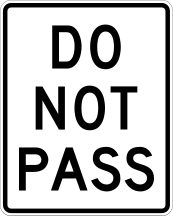
Question 81Where is the white rectangular Do Not Pass sign posted?
Show answer
A: On the right-hand side of the road. A white rectangular Do Not Pass sign is posted on the right side; the yellow pennant is on the left. Indiana Driver's Manual: Chapter 7: Changing Lanes and Passing Other Vehicles — Prohibited Passing, page 43.
-
Question 82May you use hand signals on the Indiana driving skills exam?
Show answer
A: No. Hand signals may be used if your lighted signals malfunction, but not on a driving skills exam. Indiana Driver's Manual: Chapter 7: Rules for Safe and Legal Turning — Signaling Intention to Turn, page 44.
-
Question 83What is a median U-turn or J-turn intersection?
Show answer
A: An intersection where left turns are made by going through and making a U-turn at a median opening. At median U-turn (J-turn) intersections, left turns are prohibited at the intersection and made by U-turning at an upcoming median opening. Indiana Driver's Manual: Chapter 7: U-Turns, page 44.
-
Question 84At an all-way stop, you arrive at the same time as a driver on your right. What should you do?
Show answer
A: Yield; the vehicle on the left yields. When two drivers arrive at the same time, the vehicle on the left yields the right-of-way. Indiana Driver's Manual: Chapter 7: All-Way Stops, page 44.
-
Question 85In a multi-lane roundabout, a tractor-trailer is driving through beside you. What must you do?
Show answer
A: Yield to the large vehicle, slowing or stopping if needed. Drivers must yield to large vehicles in a multi-lane roundabout, including slowing or stopping. Indiana Driver's Manual: Chapter 7: Roundabouts, page 45.
-
Question 86Two large trucks are going through a roundabout at the same time. Which must yield?
Show answer
A: The truck in the right lane yields to the truck in the left lane. If two large trucks are in a roundabout together, the driver in the right lane must yield to the driver in the left lane. Indiana Driver's Manual: Chapter 7: Roundabouts, page 45.
-
Question 87How does a traffic circle differ from a roundabout?
Show answer
A: A traffic circle may have clockwise and counterclockwise traffic and stop signs at entries. A traffic circle may have traffic in both directions and stop-controlled approaches instead of yield signs. Indiana Driver's Manual: Chapter 7: Roundabouts, page 45.
-
Question 88What is the maximum speed limit for passenger vehicles on a rural Indiana interstate unless posted otherwise?
Show answer
D: 70 mph. Passenger vehicles may not exceed 70 mph or the posted limit on rural interstates. Indiana Driver's Manual: Chapter 7: Speed Limits — Rural Interstate Highway Speed Limits, page 45.
-
Question 89What is the maximum speed on a rural Indiana interstate for trucks with a declared gross weight over 26,000 pounds?
Show answer
C: 65 mph. Trucks over 26,000 pounds may not exceed 65 mph or the posted limit on rural interstates. Indiana Driver's Manual: Chapter 7: Speed Limits — Rural Interstate Highway Speed Limits, page 45.
-
Question 90Unless posted otherwise, what is the speed limit on a rural Indiana state divided highway?
Show answer
B: 60 mph. Unless signs say otherwise, the limit on a rural state divided highway is 60 mph. Indiana Driver's Manual: Chapter 7: Speed Limits — Rural Interstate Highway Speed Limits, page 45.
-
Question 91What is the maximum speed on an urban Indiana interstate unless posted otherwise?
Show answer
B: 55 mph. On an urban interstate, vehicles may not exceed 55 mph or the posted limit. Indiana Driver's Manual: Chapter 7: Speed Limits — Urban Speed Limits, page 46.
-
Question 92Unless posted otherwise, what is the speed limit in most Indiana urban residential areas?
Show answer
C: 30 mph. In most urban residential areas, vehicles may not exceed 30 mph or the posted limit. Indiana Driver's Manual: Chapter 7: Speed Limits — Urban Speed Limits, page 46.
-
Question 93What is the maximum speed in an Indiana alley unless posted otherwise?
Show answer
C: 15 mph. In alleys, vehicles may not exceed 15 mph or the posted limit. Indiana Driver's Manual: Chapter 7: Speed Limits — Urban Speed Limits, page 46.
-
Question 94Unless posted otherwise, what is the speed limit on Indiana county roads?
Show answer
C: 55 mph. On county roads, vehicles may not exceed 55 mph or the posted limit. Indiana Driver's Manual: Chapter 7: Speed Limits — Urban Speed Limits, page 46.
-
Question 95What are common hours for Indiana school zone speed limits?
Show answer
A: 7 a.m. to 4:30 p.m., Monday through Friday, or when beacons flash. Common school zone hours are 7 a.m. to 4:30 p.m. Monday through Friday, or when school speed beacons are flashing. Indiana Driver's Manual: Chapter 7: Speed Limits — School Zone Speed Limits, page 46.
-
Question 96How much lower are Indiana work site speed limits than the normal maximum for the area?
Show answer
B: At least 10 mph lower. Work site speed limits are always at least 10 mph below the maximum established limit. Indiana Driver's Manual: Chapter 7: Speed Limits — Reduced Speed Limits in Highway Work Zones, page 46.
-
Question 97Off interstate and state highways, what is the maximum speed limit for a school bus in Indiana?
Show answer
B: 40 mph. When not on an interstate or state highway, a school bus may not exceed 40 mph unless the posted limit is lower. Indiana Driver's Manual: Chapter 7: Speed Limits — School Bus Speed Limits, page 46.
-
Question 98At 55 mph, about how many feet does a vehicle travel in one second?
Show answer
B: 80.7 feet. The manual's chart shows 80.7 feet per second at 55 mph. Indiana Driver's Manual: Chapter 7: Braking and Following Distances, page 46.
-
Question 99What following distance does the Indiana Driver's Manual recommend behind the vehicle ahead?
Show answer
B: At least two to three seconds. Keep a gap of at least two to three seconds between you and the vehicle in front. Indiana Driver's Manual: Chapter 7: Braking and Following Distances, page 46.
-
Question 100Your vehicle has conventional brakes and the rear wheels begin sliding sideways. Which way do you steer?
Show answer
A: In the direction the rear of the car is sliding. With conventional brakes, ease off the gas and steer in a controlled way in the direction the rear is sliding. Indiana Driver's Manual: Chapter 7: Braking and Following Distances — Skidding, page 47.
-
Question 101Your vehicle has anti-lock brakes (ABS) and begins to skid. How should you brake?
Show answer
A: Keep firm, continuous pressure on the pedal and steer normally. With ABS, maintain firm and continuous brake pressure while steering; do not pump. Indiana Driver's Manual: Chapter 7: Braking and Following Distances — Skidding, page 47.
-
Question 102About what share of passenger vehicle deaths come from rollover crashes, according to the manual?
Show answer
B: Nearly one-third. The manual says rollovers cause nearly a third of passenger-vehicle deaths. Indiana Driver's Manual: Chapter 7: Braking and Following Distances — Rollover, page 47.
-
Question 103Above what speed does fuel consumption increase steadily, according to the manual?
Show answer
B: 45 mph. Fuel consumption increases steadily above 45 mph. Indiana Driver's Manual: Chapter 7: Fuel Economy, page 47.
-
Question 104How much more fuel do cars use at 75 mph compared with 55 mph?
Show answer
C: About 50 percent more. Cars and light trucks use about 50 percent more fuel at 75 mph than at 55 mph. Indiana Driver's Manual: Chapter 7: Fuel Economy, page 47.
-
Question 105How much air pressure can tires lose each month?
Show answer
A: Up to 1 psi. Tires can lose up to 1 psi every month, so check them monthly or before a long trip. Indiana Driver's Manual: Chapter 7: Tire Pressure and Tread Depth, page 48.
-
Question 106Where should you find the correct tire pressure for your vehicle?
Show answer
A: On the sticker inside the driver's door jamb or in the owner's manual. Compare with the psi on the driver's door sticker or owner's manual, not the tire sidewall. Indiana Driver's Manual: Chapter 7: Tire Pressure and Tread Depth, page 48.
-
Question 107When are wet roads especially slick?
Show answer
A: Immediately following a rainfall. The manual says wet roads can be dangerously slick, especially immediately following a rainfall, because tires ride on a thin layer of oil, dirt and water. Indiana Driver's Manual: Chapter 7: Driving in Uncertain Weather Conditions — Rain, page 48.
-
Question 108Which roadway weather event causes more deaths than any other each year?
Show answer
A: Flash flooding. The manual says flash floods kill more people on the road each year than any other weather event. Indiana Driver's Manual: Chapter 7: Driving in Uncertain Weather Conditions — Flash Flooding, page 49.
-
Question 109When must Indiana drivers use headlights?
Show answer
A: Between sunset and sunrise and whenever visibility is under 500 feet. Headlights are required between sunset and sunrise and any time visibility is less than 500 feet. Indiana Driver's Manual: Chapter 7: Driving at Night — Headlights, page 49.
-
Question 110Within what distance of an oncoming vehicle must you dim to low beams in Indiana?
Show answer
C: 500 feet. Switch to low beams once an oncoming vehicle is within 500 feet. Indiana Driver's Manual: Chapter 7: Driving at Night — Headlights, page 49.
-
Question 111Within what distance behind another vehicle must you use low beams in Indiana?
Show answer
B: 200 feet. Low beams must be used when following within 200 feet of another vehicle. Indiana Driver's Manual: Chapter 7: Driving at Night — Headlights, page 49.
-
Question 112Going 18 hours without sleep impairs a driver about as much as what BAC?
Show answer
C: .08. Studies show 18 hours without sleep leaves a driver as impaired as one with a .08 BAC. Indiana Driver's Manual: Chapter 7: Impaired and Dangerous Driving — Drowsy Driving, page 50.
-
Question 113Which age group is at the highest risk for drowsy-driving crashes?
Show answer
A: Young adults ages 16-29. Young adults ages 16-29 are at highest risk, accounting for 64 percent of fatigue-related accidents. Indiana Driver's Manual: Chapter 7: Impaired and Dangerous Driving — Drowsy Driving, page 50.
-
Question 114How long does sending or reading a text take your eyes off the road?
Show answer
C: About five seconds. A text takes your eyes away for about five seconds; at 55 mph that covers a football field. Indiana Driver's Manual: Chapter 7: Distracted Driving, page 50.
-
Question 115Under Indiana law, a driver commits aggressive driving by doing at least how many listed actions in one episode of continuous driving?
Show answer
B: Three. Aggressive driving is committing at least three listed acts, such as tailgating or failure to yield, in one episode. Indiana Driver's Manual: Chapter 7: Aggressive Driving, page 51.
-
Question 116Who may make a U-turn by crossing the median of an Indiana interstate?
Show answer
A: Only emergency or highway maintenance vehicles. It is illegal for any vehicle other than an emergency or highway maintenance vehicle to U-turn across an interstate median. Indiana Driver's Manual: Chapter 7: Driving on Interstate Highways, page 51.
-
Question 117On an Indiana interstate with two lanes in one direction, which lane are trucks restricted to?
Show answer
A: The right lane. Trucks are restricted to the right lane with two lanes, and the right two lanes with three or more. Indiana Driver's Manual: Chapter 7: Driving on Interstate Highways, page 51.
-
Question 118A flashing arrow board in a work zone shows no direction. What does it mean?
Show answer
A: Use caution; you do not have to change lanes. A flashing arrow board not indicating a direction means caution but does not require a lane change. Indiana Driver's Manual: Chapter 7: Work Zones, page 52.
-
Question 119What is "zipper merging" in a work zone?
Show answer
A: Merging late, toward the lane closure, to reduce the length of the backup, where signs direct it. At some locations signs encourage late or zipper merging at the lane closure to reduce backups. Indiana Driver's Manual: Chapter 7: Work Zones — Work Zone Safety Driving Tips, page 53.
-
Question 120Vehicles required to stop at railroad crossings must stop within what distance of the nearest rail?
Show answer
B: Between 15 and 50 feet. Vehicles that must stop at tracks stop at least 15 feet but no more than 50 feet from the closest rail. Indiana Driver's Manual: Chapter 7: Railroad Crossings, page 53.
-
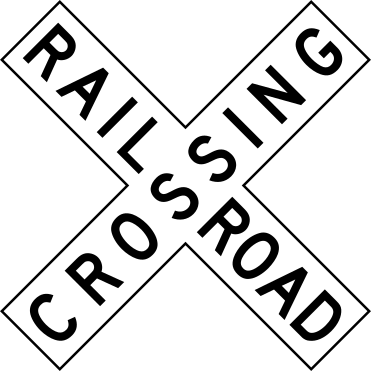
Question 121How should you treat a railroad crossbuck that is displayed alone?
Show answer
A: As a yield sign; you must stop if a train is approaching. A crossbuck alone should be treated as a yield sign; stop if a train is approaching. Indiana Driver's Manual: Chapter 7: Railroad Crossings — Crossbucks, page 53.
-
Question 122Once crossing lights begin to flash and the gate lowers, about how long do you have to escape from the crossing?
Show answer
B: About 20 seconds. You have approximately 20 seconds to escape once lights flash and the gate begins to lower. Indiana Driver's Manual: Chapter 7: Safety at Railroad Crossings, page 54.
-
Question 123If you are stuck on the tracks with a train coming, which way should you run?
Show answer
A: Away from the tracks at a 45-degree angle toward the oncoming train. Get away from the tracks at about a 45-degree angle, heading toward the direction the train is coming from, then call 911 once you are clear. Indiana Driver's Manual: Chapter 7: Safety at Railroad Crossings, page 54.
-
Question 124No train is coming but your car is disabled on a railroad crossing. Whom should you call first?
Show answer
A: The Emergency Notification System number on the blue sign at the crossing. Immediately call the ENS number on the blue sign, then call 911. Indiana Driver's Manual: Chapter 7: Safety at Railroad Crossings, page 54.
-
Question 125What is the maximum width of a vehicle that may operate in Indiana without a special permit?
Show answer
B: 8 feet 6 inches. The maximum width without a special permit is eight feet six inches. Indiana Driver's Manual: Chapter 7: Sharing the Road with Tractor-Trailers, page 54.
-
Question 126About how far does an average passenger car at 55 mph need to stop?
Show answer
B: About 130 to 140 feet. An average car at 55 mph can stop in about 130 to 140 feet, about half a football field. Indiana Driver's Manual: Chapter 7: Sharing the Road with Tractor-Trailers — Braking, page 55.
-
Question 127How far may a fully loaded tractor-trailer with hot brakes need to stop from 55 mph?
Show answer
C: More than 400 feet. A fully loaded tractor-trailer with hot brakes may need more than 400 feet to stop. Indiana Driver's Manual: Chapter 7: Sharing the Road with Tractor-Trailers — Braking, page 55.
-
Question 128How far behind a tractor-trailer can its blind spot extend?
Show answer
D: Up to 200 feet. Blind spots extend up to 20 feet in front of the cab, along both sides, and up to 200 feet behind. Indiana Driver's Manual: Chapter 7: Sharing the Road with Tractor-Trailers — Blind Spots, page 55.
-
Question 129Why do many car-truck collisions happen at intersections?
Show answer
A: Car drivers underestimate how close and fast the truck is. A truck's size makes it seem slower than it is, so drivers misjudge how close it is or how fast it's approaching. Indiana Driver's Manual: Chapter 7: Sharing the Road with Tractor-Trailers — Tips, page 55.
-
Question 130You approach a stopped emergency vehicle with flashing red, red and white, or red and blue lights. What does Indiana's Move Over law require?
Show answer
A: Change lanes away from it; if you cannot, slow to 10 mph under the limit. Move to a lane away from the stopped emergency vehicle. If you can't, slow to 10 mph below the posted limit and pass carefully. Indiana Driver's Manual: Chapter 7: Sharing the Road with Other Vehicles — Indiana's Move Over Law, page 56.
-
Question 131In Indiana, failing to move over or slow down for a stopped emergency vehicle with flashing red, red and white, or red and blue lights is what kind of offense?
Show answer
A: Class A infraction. Not complying with the Move Over law for an emergency vehicle is a Class A infraction. For amber-light service vehicles and disabled vehicles it is a Class B infraction. Indiana Driver's Manual: Chapter 7: Sharing the Road with Other Vehicles — Emergency Vehicles, page 56.
-
Question 132Does Indiana's Move Over law apply to tow trucks and highway maintenance vehicles with amber flashing lights?
Show answer
A: Yes. Motorists must change lanes away from authorized parked vehicles with amber lights, such as tow trucks, or slow down. Indiana Driver's Manual: Chapter 7: Sharing the Road with Other Vehicles — Authorized Parked Vehicles, page 56.
-
Question 133You approach a disabled vehicle stopped with its hazard warning lights flashing. What does Indiana law require?
Show answer
A: Change lanes away from it, or slow to 10 mph under the limit. Move over for disabled vehicles with flashing hazards, or reduce speed to 10 mph under the limit. Indiana Driver's Manual: Chapter 7: Sharing the Road with Other Vehicles — Disabled Vehicles, page 56.
-
Question 134A school bus stopped on the other side of a road divided by a barrier has its red lights flashing. Must you stop in Indiana?
Show answer
A: No, only traffic going the same direction as the bus must stop. With a barrier or unimproved median between you and the bus, only traffic going the bus's direction has to stop. Indiana Driver's Manual: Chapter 7: Sharing the Road with Other Vehicles — School Buses, page 57.
-
Question 135What is the penalty level for disregarding a school bus stop arm in Indiana (no injury)?
Show answer
A: Class A misdemeanor. Disregarding a stop arm is a Class A misdemeanor, a Level 6 felony with injury, or a Level 5 felony with death. Indiana Driver's Manual: Chapter 7: Sharing the Road with Other Vehicles — School Buses, page 57.
-
Question 136How much following distance should you allow behind a motorcycle?
Show answer
C: At least three or four seconds. Allow at least three or four seconds when following a motorcycle. Indiana Driver's Manual: Chapter 7: Sharing the Road with Other Vehicles — Motorcycles and Motor Driven Cycles, page 57.
-
Question 137A motorcycle ahead has its turn signal flashing. What should you assume?
Show answer
A: The signal may not mean a turn; wait to see what the rider does. Motorcycle signals usually aren't self-canceling; wait to be sure the rider will act. Indiana Driver's Manual: Chapter 7: Sharing the Road with Other Vehicles — Motorcycles and Motor Driven Cycles, page 57.
-
Question 138What is the minimum space Indiana's manual says to leave beside a bicyclist when passing?
Show answer
B: Three feet. Pass a cyclist only with at least three feet of room and no danger from oncoming traffic. Indiana Driver's Manual: Chapter 7: Sharing the Road with Other Vehicles — Bicycles, page 57.
-
Question 139How many bicyclists may ride side by side on an Indiana roadway (outside bike paths)?
Show answer
B: Two. Bicyclists may not ride more than two abreast except on paths set aside for bicycles. Indiana Driver's Manual: Chapter 7: Sharing the Road with Other Vehicles — Bicycles, page 57.
-
Question 140Is a bicyclist required to ride in a designated bike lane in Indiana?
Show answer
A: No, they may use the bike lane or the travel lane. Cyclists may choose the bike lane or the regular travel lane. Indiana Driver's Manual: Chapter 7: Sharing the Road with Other Vehicles — Bicycles, page 57.
-
Question 141When may a driver cross a bicycle lane?
Show answer
A: Only when turning or entering or leaving an alley, driveway or private road. Cross a bike lane only when turning or entering or leaving an alley, driveway or private road; don't move into it to prepare for a turn. Indiana Driver's Manual: Chapter 7: Sharing the Road with Other Vehicles — Bicycle Lanes, page 58.
-
Question 142What may red-colored pavement in a lane mark in Indiana?
Show answer
A: A bus or transit lane. Red pavement may enhance visibility of bus or transit lanes; green pavement enhances bike lanes. Indiana Driver's Manual: Chapter 7: Sharing the Road with Other Vehicles — Bicycle Lane and Bus Lane Markings, page 58.
-
Question 143What rights does a rider of a horse or horse-drawn vehicle have on Indiana highways?
Show answer
A: The same rights and responsibilities as a motor vehicle driver. People riding or driving horses on a public highway have the same rights and duties as motorists. Indiana Driver's Manual: Chapter 7: Sharing the Road with Other Vehicles — Slow-Moving Vehicles, page 58.
-
Question 144Does a funeral procession have the right of way at an intersection when its signal is red?
Show answer
A: Yes, official processions have the right of way regardless of the signal. Official processions, such as funerals, have the right of way regardless of a traffic signal. Indiana Driver's Manual: Chapter 7: Sharing the Road with Other Vehicles — Traffic Control Officers and Official Processions, page 59.
-
Question 145When starting to parallel park, how far from the vehicle in front of the empty space should you position your car?
Show answer
B: At least two feet. Position your vehicle parallel with the car in front of the space and keep at least two feet from it. Indiana Driver's Manual: Chapter 7: Parking and Reversing — Parallel Parking, page 59.
-
Question 146While parallel parking, you back up and turn the wheel sharply right. At about what angle should your vehicle be?
Show answer
B: About 45 degrees. Reverse slowly with the wheel sharply right until the vehicle is at about a 45-degree angle. Indiana Driver's Manual: Chapter 7: Parking and Reversing — Parallel Parking, page 59.
-
Question 147When you park facing downhill, which way should you turn your wheels?
Show answer
A: Toward the curb. Facing downhill, turn your wheels toward the curb. Indiana Driver's Manual: Chapter 7: Parking and Reversing — Parallel Parking, page 59.
-
Question 148When you park facing uphill next to a curb, which way should you turn your wheels?
Show answer
A: Away from the curb. Facing uphill, turn your wheels away from the curb. Indiana Driver's Manual: Chapter 7: Parking and Reversing — Parallel Parking, page 59.
-
Question 149You park on a hill with no curb. Which way should you turn your wheels?
Show answer
A: Away from the street. If there is no curb, turn your wheels away from the street. Indiana Driver's Manual: Chapter 7: Parking and Reversing — Parallel Parking, page 59.
-
Question 150How close to a fire hydrant may you park in Indiana?
Show answer
C: No closer than 15 feet. Parking within 15 feet of a fire hydrant is prohibited. Indiana Driver's Manual: Chapter 7: Parking and Reversing — Illegal Parking Areas, page 59.
-
Question 151May you park in the diagonally striped area next to an accessible parking space if you have a valid placard?
Show answer
A: No, never. Parking in the striped area is prohibited even with a valid placard; it is needed for wheelchair transfers and ramps. Indiana Driver's Manual: Chapter 7: Parking and Reversing — Handicap Accessible Parking, page 60.
-
Question 152How much do seat belts increase front-seat occupants' chance of survival in a crash?
Show answer
C: By 45 percent. For drivers and front-seat passengers, belts raise survival odds by 45 percent and halve the risk of serious injury. Indiana Driver's Manual: Chapter 7: Seat Belts and Child Safety Restraints, page 60.
-
Question 153How far from the steering wheel should a driver sit?
Show answer
C: At least 12 inches. The driver should sit at least 12 inches from the steering wheel. Indiana Driver's Manual: Chapter 7: Seat Belts and Child Safety Restraints, page 60.
-
Question 154Under Indiana law, passengers younger than what age must be in a child restraint system such as a car seat or booster?
Show answer
C: 8. Passengers younger than eight must be properly secured in a child restraint system. Indiana Driver's Manual: Chapter 7: Seat Belts and Child Safety Restraints — Child Safety Restraints, page 61.
-
Question 155If a car has a passenger-side air bag, children under what age should ride in the back seat, per the National Safety Council?
Show answer
C: 12. The National Safety Council recommends children under 12 ride in the back seat. Indiana Driver's Manual: Chapter 7: Seat Belts and Child Safety Restraints — Passenger Air Bags, page 61.
-
Question 156At night on a divided highway, where should a warning device for your disabled car be placed?
Show answer
A: 100 feet behind and 100 feet in front, in the center of your lane. Place a lighted fuse, red lantern or reflector 100 feet behind and 100 feet in front in your lane, plus one about 10 feet away on the traffic side. Indiana Driver's Manual: Chapter 7: Truck Equipment Requirements — Warning Devices for Stopped Vehicles, page 62.
-
Question 157Your disabled car is stopped within 500 feet of a curve or hilltop. How far away must a warning device be displayed?
Show answer
C: At least 500 feet. If stopped within 500 feet of a curve, hilltop or other obstruction, display a warning device at least 500 feet from your car. Indiana Driver's Manual: Chapter 7: Truck Equipment Requirements — Warning Devices for Stopped Vehicles, page 62.
-
Question 158According to the manual, what is the most common factor in Indiana collisions?
Show answer
A: Failure to yield the right of way. Not yielding the right of way is the leading factor in Indiana crashes. Indiana Driver's Manual: Chapter 8: Accidents and Emergency Situations, page 63.
-
Question 159When should you NOT move your vehicle after an accident?
Show answer
A: When the accident results in injury, death or entrapment, or involves hazardous materials. Do not move the vehicle if the accident involves hazardous materials or results in injury, death or entrapment. Indiana Driver's Manual: Chapter 8: What to Do After an Accident — Should You Move Your Vehicle?, page 63.
-
Question 160Which is safer to hit if you must, according to the manual?
Show answer
A: Something moving in the same direction as you. Hit something moving in the same direction rather than something stopped, and anything rather than head-on. Indiana Driver's Manual: Chapter 8: Avoiding Collisions, page 63.
-
Question 161After escaping a vehicle in water, where does the manual suggest you go first?
Show answer
A: Onto the roof. Move to the roof, call 911 and find the nearest dry land; swim only as a last resort. Indiana Driver's Manual: Chapter 8: Avoiding Collisions — Plunging into Water, page 64.
-
Question 162When a driver under 18 is cited for operating a vehicle while intoxicated, which court may also recommend suspending their driving privileges?
Show answer
A: The Juvenile Court. For OWI citations against drivers under 18, the manual says the Juvenile Court may also recommend a suspension. Indiana Driver's Manual: Chapter 5: Suspensions — Operating a Vehicle While Intoxicated, page 29.
-
Question 163How far behind your vehicle should you place a red emergency triangle on a flat, straight road?
Show answer
C: 200 feet. Place the triangle 200 feet behind your vehicle, or 500 feet if on a hill or curve. Indiana Driver's Manual: Chapter 8: Roadside Emergency Situations, page 65.
-
Question 164You have a tire blowout. What should you do with the brakes?
Show answer
A: Do not apply them until the car has slowed and is almost stopped. Hold the wheel firmly, take your foot off the gas, don't brake until the car is almost stopped, and pull off. Indiana Driver's Manual: Chapter 8: Vehicle Equipment Failures — Tire Blowout, page 65.
-
Question 165Why should you never turn the ignition to lock while the vehicle is moving?
Show answer
A: The steering will lock, causing a loss of control. With a steering wheel interlock, turning to lock while moving locks the steering and causes loss of control. Indiana Driver's Manual: Chapter 8: Vehicle Equipment Failures — Ignition Locking, page 65.
-
Question 166To reduce vehicle theft, which way does the manual suggest turning your front wheels when parked?
Show answer
A: Sharply to the right. Park with the front wheels turned sharply right and set the emergency brake. Indiana Driver's Manual: Chapter 8: Avoiding Vehicle Theft, page 65.
-
Question 167How should you acknowledge a police officer signaling you to pull over?
Show answer
A: Turn on your right turn signal. Turn on your right turn signal to show you recognize the officer, then move to the right shoulder. Indiana Driver's Manual: Chapter 8: Traffic Stops by Law Enforcement, page 65.
-
Question 168What does signing a traffic ticket in Indiana mean?
Show answer
A: You acknowledge receiving it; it is not an admission of guilt. Signing a ticket is only an acknowledgment of receiving it, not an admission of guilt. Indiana Driver's Manual: Chapter 8: Traffic Stops by Law Enforcement, page 66.
-
Question 169In heavy, congested traffic, what does the manual suggest to reduce carbon monoxide exposure?
Show answer
A: Close the fresh-air vent. In congested traffic, close the fresh-air vent; on highways in cold weather, open it. Indiana Driver's Manual: Chapter 8: Carbon Monoxide Poisoning — How to Avoid Carbon Monoxide Poisoning, page 67.
Answer every question to see your score.
Remembering the numbers
Most mistakes on the Indiana BMV test are about specifics: how many feet before a turn to signal, how far to park from a hydrant, the alcohol limit for drivers under 21. Write the numbers from these questions on a card and review them before the test, then take the exam simulator.