Hardest New Mexico permit test questions
92 questions that need exact knowledge rather than common sense: the numbers (distances, speeds, fines, limits), the exceptions and the rules that are easy to mix up. We chose them from our New Mexico question bank for that reason; they're not statistics from the MVD.
-
Question 1How old must the licensed supervising driver be for a New Mexico instructional permit holder?
Show answer
C: 21. A permit holder must be supervised by a licensed driver at least 21 years old (or an approved instructor). New Mexico Driver Manual: Instructional Permit, page 1.
-
Question 2Besides being 21, how long must a supervising driver have been licensed?
Show answer
C: At least three years. The supervising licensed driver must be 21 or older and licensed for at least three years in this or any other state. New Mexico Driver Manual: Instructional Permit, page 1.
-
Question 3When a permit holder rides a motorcycle, where must the licensed supervising driver be?
Show answer
B: Following the learner. On motorcycles, the licensed driver must follow the learner. New Mexico Driver Manual: Instructional Permit, page 1.
-
Question 4What must a 15-year-old be doing to hold a New Mexico instructional permit?
Show answer
B: Enrolled in and attending a Traffic Safety Bureau-approved driver education course with DWI education. A person 15 or older must be enrolled in and attending an approved driver education course that includes DWI education and practice driving. New Mexico Driver Manual: Instructional Permit, page 1.
-
Question 5What is the minimum age for a New Mexico provisional license?
Show answer
B: 15 years 6 months. The minimum age is 15 years and 6 months if the driver has held the permit for 6 months. New Mexico Driver Manual: Provisional License, page 1.
-
Question 6How many hours of practice driving are required for a New Mexico provisional license?
Show answer
C: 50 hours, including 10 at night. The driver must complete not less than 50 hours of practice driving, including at least 10 at night, certified by a parent or guardian. New Mexico Driver Manual: Provisional License, page 1.
-
Question 7To get a provisional license, you must not have been convicted of a traffic violation in the prior:
Show answer
C: 90 days. The driver must not have been convicted of a traffic violation in the 90 days before applying. New Mexico Driver Manual: Provisional License, page 2.
-
Question 8During which hours may a New Mexico provisional license holder not drive (without an exception)?
Show answer
C: Midnight to 5:00 a.m.. Provisional licensees may not drive between midnight and 5:00 a.m. unless an exception applies. New Mexico Driver Manual: Provisional License, page 2.
-
Question 9Without a licensed driver 21 or older present, how many non-family passengers under 21 may a provisional driver carry?
Show answer
B: One. A provisional driver may not have more than one passenger under 21 who is not an immediate family member, unless a licensed driver 21+ is present. New Mexico Driver Manual: Provisional License, page 1.
-
Question 10How long must you hold a provisional license before getting an unrestricted license?
Show answer
B: The 12-month period immediately before applying. The driver must have held a provisional license for the 12 months immediately before applying. New Mexico Driver Manual: Unrestricted Driver License, page 2.
-
Question 11When may you renew a New Mexico driver license?
Show answer
B: Up to 90 days before or 30 days after it expires. You may renew up to 90 days before or 30 days after the license expires. New Mexico Driver Manual: Driver License Renewal, page 2.
-
Question 12What happens if a New Mexico driver gets twelve or more points in a twelve-month period?
Show answer
B: License suspended for one year. Twelve or more points within twelve months results in a one-year license suspension. New Mexico Driver Manual: Traffic Violations, page 14.
-
Question 13Which traffic offense does NOT carry points but requires a court appearance?
Show answer
B: Driving without insurance. Offenses like driving without insurance or registration do not carry points; they require a court appearance. New Mexico Driver Manual: Traffic Violations, page 14.
-
Question 14Up to what age must all children wear appropriate safety restraints while the vehicle moves?
Show answer
C: Under 12. The law requires all children under 12 to wear appropriate safety restraints while the vehicle is in motion. New Mexico Driver Manual: Safety Belts and Child Restraints, page 3.
-
Question 15Children under what age or weight must be secured in an approved child safety device?
Show answer
B: Under 24 months or under 60 pounds. Children under 24 months, or weighing less than 60 pounds, must be secured in an approved safety device. New Mexico Driver Manual: Safety Belts and Child Restraints, page 3.
-
Question 16When traffic lights are together, what is their order from bottom to top?
Show answer
B: Green, yellow, red. Traffic lights are green, yellow and red from bottom to top. New Mexico Driver Manual: Traffic Signals, page 3.
-
Question 17What does a small, very bright blinking light in the middle of a red signal mean?
Show answer
B: It alerts you to the red light; you must stop. The bright blinking light inside the red light alerts you to the red and that you must stop. New Mexico Driver Manual: Traffic Signals, page 4.
-
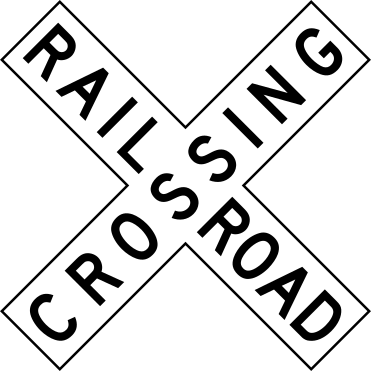
Question 18The white X-shaped crossbuck at a railroad crossing has the same meaning as what sign?
Show answer
B: Yield. The crossbuck has the same meaning as a Yield sign; you must yield to crossing trains. New Mexico Driver Manual: Railroad Crossing Warning Signs, page 5.
-
Question 19If a road's minimum posted speed is too fast for you, what should you do?
Show answer
B: Use another road. Some high-speed roads have minimum limits; if the minimum is too fast for you, use another road. New Mexico Driver Manual: Speed Limit Signs, page 7.
-
Question 20A reflective orange triangle on the back of a vehicle means it travels slower than:
Show answer
B: 25 mph. A reflective orange triangle means the vehicle is traveling less than 25 mph. New Mexico Driver Manual: Slow Moving Vehicle, page 7.
-
Question 21May you cross a solid yellow line to turn into a driveway?
Show answer
B: Yes, if it is safe. You may cross a solid yellow line to turn into a driveway if it is safe. New Mexico Driver Manual: Pavement Markings, page 8.
-
Question 22How are reversible lanes usually marked?
Show answer
B: Double-dashed yellow lines. Reversible lanes are usually marked by double-dashed yellow lines. New Mexico Driver Manual: Reversible Lanes, page 9.
-
Question 23Over a reversible lane, what does a steady yellow X mean?
Show answer
B: The lane use is changing; move out of it as soon as it is safe. A steady yellow X means the lane's use is changing and you should move out as soon as safe; a flashing yellow X means turns only. New Mexico Driver Manual: Reversible Lanes, page 9.
-
Question 24What does 'HOV 3' on a reserved lane sign mean?
Show answer
B: At least three people must be in the vehicle. HOV 3 means there must be at least three people in the vehicle. New Mexico Driver Manual: Reserved Lanes, page 9.
-
Question 25On a road with three or more lanes in your direction and lots of entering and exiting traffic, which lane should you use?
Show answer
B: The center lane. With three or more lanes and a lot of entering or exiting traffic, use the center travel lane. New Mexico Driver Manual: General Rules, page 10.
-
Question 26When may you back a vehicle in a travel lane?
Show answer
A: Never, except to parallel park. Never back in any travel lane except to parallel park. New Mexico Driver Manual: General Rules, page 10.
-
Question 27Does the law give anyone the right-of-way?
Show answer
B: No; it only says who must yield. The law says who must yield the right-of-way; it does not give anyone the right-of-way. New Mexico Driver Manual: Right-of-Way, page 11.
-
Question 28Must you yield to a pedestrian who is not obeying traffic controls?
Show answer
B: Yes, you must always yield to a pedestrian. You must always yield to a pedestrian, even if the pedestrian is not obeying traffic controls. New Mexico Driver Manual: Right-of-Way, page 11.
-
Question 29When may you enter an intersection?
Show answer
B: Only when you can get through it without having to stop. Drivers may not enter an intersection unless they can get through without having to stop and block it. New Mexico Driver Manual: Right-of-Way, page 11.
-
Question 30You are overtaking a vehicle that is slowing to stop. Who must yield?
Show answer
B: You, the overtaking driver. Drivers overtaking a vehicle in the same direction must yield to it, even if it is slowing or stopping. New Mexico Driver Manual: Right-of-Way, page 12.
-
Question 31An emergency vehicle with siren approaches while you are in an intersection. What should you do?
Show answer
B: Drive through the intersection, then pull over to the right. If you are in an intersection, drive through it before pulling over. New Mexico Driver Manual: Right-of-Way, page 12.
-
Question 32When are you NOT required to stop for a school bus with flashing red lights?
Show answer
B: When the bus is coming toward you and the road is separated by a median or physical barrier. You need not stop if the bus is traveling toward you and the roadway is separated by a median or other barrier. New Mexico Driver Manual: Right-of-Way, page 12.
-
Question 33What is the maximum speed in a posted New Mexico school zone?
Show answer
B: 15 mph. The maximum speed within a posted school zone is 15 mph. New Mexico Driver Manual: Speed Limits, page 12.
-
Question 34Unless otherwise posted, what is the speed limit in New Mexico business or residential areas?
Show answer
B: 30 mph. The limit is 30 mph in business or residential areas unless posted otherwise. New Mexico Driver Manual: Speed Limits, page 12.
-
Question 35What is the maximum speed on New Mexico rural interstate highways unless posted otherwise?
Show answer
C: 75 mph. The manual lists 75 mph on rural interstate highways unless posted otherwise. New Mexico Driver Manual: Speed Limits, page 12.
-
Question 36On a wet road, by about how much should you reduce your speed?
Show answer
B: About 10 mph. On a wet road, reduce your speed by about 10 mph. New Mexico Driver Manual: Adjusting to Road Conditions, page 20.
-
Question 37On packed snow, how much should you reduce your speed?
Show answer
C: Cut it in half. On packed snow you should cut your speed in half; on ice, slow to a crawl. New Mexico Driver Manual: Adjusting to Road Conditions, page 20.
-
Question 38In New Mexico, do not park within how many feet of a fire hydrant?
Show answer
B: 15 feet. Do not park within 15 feet of a fire hydrant. New Mexico Driver Manual: Parking, page 13.
-
Question 39In New Mexico, do not park within how many feet of a crosswalk at an intersection?
Show answer
C: 25 feet. Do not park within 25 feet of a crosswalk at an intersection. New Mexico Driver Manual: Parking, page 13.
-
Question 40In New Mexico, do not park within how many feet of a traffic signal, stop sign or yield sign?
Show answer
D: 30 feet. Do not park within 30 feet of a traffic signal, stop sign or yield sign. New Mexico Driver Manual: Parking, page 13.
-
Question 41In New Mexico, do not park within how many feet of a railroad crossing?
Show answer
C: 50 feet. Do not park within 50 feet of a railroad crossing. New Mexico Driver Manual: Parking, page 13.
-
Question 42When parked along a curb, your vehicle may not be more than how far from the curb?
Show answer
C: 18 inches. Do not park more than 18 inches from the curb. New Mexico Driver Manual: Parking, page 13.
-
Question 43How close may you park to a fire station driveway on the same side of the street?
Show answer
B: No closer than 20 feet. Do not park within 20 feet of a fire station driveway on the same side, or within 75 feet on the other side. New Mexico Driver Manual: Parking, page 13.
-
Question 44What does a white-painted curb mean?
Show answer
A: Only short stops are permitted. A white curb means only short stops are permitted. New Mexico Driver Manual: Parking, page 14.
-
Question 45After a sharp turn using hand-over-hand steering, how should you straighten the wheel?
Show answer
B: Straighten it out by hand. Straighten the wheel by hand; letting it slip through your fingers could be dangerous. New Mexico Driver Manual: Steering, page 15.
-
Question 46How far ahead do safer drivers tend to look?
Show answer
C: At least 10 seconds. Safer drivers look at least 10 seconds ahead; in the city that is about one block. New Mexico Driver Manual: Scanning, page 15.
-
Question 47When is the most important time to look left and right at an intersection, even with a green light?
Show answer
B: Just after the light has turned green. Right after the light turns green, cross-street drivers are most likely to hurry through. New Mexico Driver Manual: Scanning, page 16.
-
Question 48How much farther do high beams let you see compared with low beams?
Show answer
B: About twice as far. High beams let you see twice as far as low beams; use them whenever there are no oncoming vehicles. New Mexico Driver Manual: Use Your Lights, page 18.
-
Question 49When should you dim your high beams for an oncoming vehicle?
Show answer
B: Within about one block. Dim your high beams whenever you come within about a one-block distance of an oncoming vehicle. New Mexico Driver Manual: Use Your Lights, page 18.
-
Question 50When following another vehicle, use low beams within how many feet?
Show answer
B: 200 feet. Use your low beams within 200 feet when following another vehicle or in heavy traffic. New Mexico Driver Manual: Use Your Lights, page 18.
-
Question 51Should you turn on your headlights when driving away from a rising or setting sun?
Show answer
B: Yes, so drivers coming toward you can see you. Drivers coming toward you may have trouble seeing you against the sun; headlights help. New Mexico Driver Manual: Letting Others Know You Are There, page 18.
-
Question 52When lights are necessary, within what distance of an approaching car should you be using headlights (not parking lights)?
Show answer
B: At least 500 feet. Whenever lights are necessary, use headlights within at least 500 feet when approaching another car. New Mexico Driver Manual: Letting Others Know You Are There, page 18.
-
Question 53How far before a turn should you signal in New Mexico?
Show answer
B: At least 100 feet. Signal at least 100 feet before you make your turn. New Mexico Driver Manual: Letting Others Know What You Are Doing, page 19.
-
Question 54A car is about to enter the street between you and the driveway where you plan to turn. When should you signal?
Show answer
B: After you pass that car. Wait until you have passed it to signal; otherwise the other driver may think you're turning where they are and pull into your path. New Mexico Driver Manual: Letting Others Know What You Are Doing, page 19.
-
Question 55Why can ice be more slippery near the freezing point?
Show answer
B: Ice can become wet, making it more slippery than at colder temperatures. When the temperature is around freezing, ice can become wet and more slippery. New Mexico Driver Manual: Adjusting to Road Conditions, page 20.
-
Question 56Up to about what speed do most tires keep good traction on a wet road?
Show answer
B: 35 mph. Most tires have good traction up to about 35 mph on a wet road; faster, they can start to hydroplane. New Mexico Driver Manual: Adjusting to Road Conditions, page 20.
-
Question 57In a heavy rain, at about what speed can tires lose all traction with the road?
Show answer
C: 50 mph. In heavy rain, tires can lose all traction at about 50 mph; bald tires lose traction at lower speeds. New Mexico Driver Manual: Adjusting to Road Conditions, page 20.
-
Question 58In what part of New Mexico should you especially watch for elk?
Show answer
B: The western three-quarters of the state. Watch for elk in the western three-quarters of the state, and pronghorn antelope in the eastern plains. New Mexico Driver Manual: Wildlife on the roadway, page 21.
-
Question 59Farm tractors, animal-drawn vehicles and road maintenance vehicles usually go how fast?
Show answer
A: 25 mph or less. These vehicles usually go 25 mph or less and should display a slow-moving vehicle decal. New Mexico Driver Manual: Adjusting to Traffic, page 22.
-
Question 60On dry pavement with good tires and brakes, about how far does it take to react and stop at 50 mph?
Show answer
C: About 400 feet. At 50 mph it can take about 400 feet to react and stop — about a city block. New Mexico Driver Manual: How Well Can You See?, page 22.
-
Question 61About how far does it take to react and stop at 30 mph?
Show answer
B: About 200 feet. At 30 mph it can take about 200 feet to stop, almost half a city block. New Mexico Driver Manual: How Well Can You See?, page 22.
-
Question 62About how far ahead do your headlights let you see at night?
Show answer
C: About 400 feet. Headlights let you see about 400 feet ahead, so drive at a speed that lets you stop within that distance, about 50 mph. New Mexico Driver Manual: How Well Can You See?, page 23.
-
Question 63In a very heavy rain or thick fog where you can see only about 200 feet, what is the safe maximum speed?
Show answer
B: 30 mph. If you can't see farther than about 200 feet, you cannot safely drive faster than 30 mph. New Mexico Driver Manual: How Well Can You See?, page 23.
-
Question 64Which situation calls for a four-second following distance?
Show answer
B: Following a motorcycle. Four seconds is needed on slippery roads, following motorcycles, with heavy loads or trailers, behind emergency vehicles, near railroad crossings, or stopped on a hill. New Mexico Driver Manual: Space Ahead, page 24.
-
Question 65How big a gap do you need to merge with traffic?
Show answer
B: About four seconds. You need a gap of about four seconds to merge, change lanes or enter a roadway. New Mexico Driver Manual: Space to Merge, page 24.
-
Question 66At 55 mph, about how much time do you need to pass another vehicle?
Show answer
C: About 10 seconds. At 55 mph you need about 10 seconds to pass, so you need a 10-second gap in oncoming traffic. New Mexico Driver Manual: Space to Pass, page 25.
-
Question 67You should not start to pass within what distance of a hill or curve?
Show answer
C: One-third of a mile. You must be able to see at least one-third of a mile ahead; don't start to pass within one-third mile of a hill or curve. New Mexico Driver Manual: Space to Pass, page 25.
-
Question 68How much space does the New Mexico manual say to try to give when passing a bicyclist?
Show answer
C: At least five feet. Keep a safe distance when passing a bicyclist, trying for at least five feet. New Mexico Driver Manual: Bicycles Are Vehicles, page 25.
-
Question 69Who must wear a bicycle helmet according to the New Mexico manual?
Show answer
B: Minors must; adults should. Adults should, and minors must, wear a well-fitting helmet. New Mexico Driver Manual: Bicycles Are Vehicles, page 26.
-
Question 70An average car at 55 mph can stop in about 400 feet. About how far might a large truck need?
Show answer
B: Almost 800 feet. A large truck could take almost 800 feet to stop. New Mexico Driver Manual: Large Trucks and RVs, page 27.
-
Question 71You are following a big truck that looks like it is turning left. What should you do before you start to pass?
Show answer
B: Wait a second and check its turn signals again; it may really be turning right. Big rigs swing wide for right turns, so a truck that seems to be turning left may actually be turning right. Wait a moment and recheck its signals before passing. New Mexico Driver Manual: Large Trucks and RVs, page 27.
-
Question 72How far from a railroad crossing must school buses and vehicles carrying hazardous materials stop?
Show answer
B: At least 15 feet. School buses, for-hire passenger vehicles and hazardous-material trucks must stop at least 15 feet from the crossing. New Mexico Driver Manual: Railroad Crossing Warning Signs, page 6.
-
Question 73What must a school bus driver do before crossing railroad tracks in New Mexico?
Show answer
B: Open the bus doors. A school bus driver must open the doors of the bus before crossing. New Mexico Driver Manual: Railroad Crossing Warning Signs, page 6.
-
Question 74What is one of the leading causes of fatalities at railroad crossings?
Show answer
B: Assuming that a train is not coming. Assuming a train is not coming is one of the leading causes of fatalities at railroad crossings. New Mexico Driver Manual: Scanning, page 16.
-
Question 75Over half of motorcycle/car collisions are caused by what?
Show answer
B: Drivers entering the rider's right-of-way. Over half of motorcycle/car collisions are caused by drivers entering a rider's right-of-way. New Mexico Driver Manual: Intersections, page 38.
-
Question 76In New Mexico, who is required by law to wear a motorcycle helmet?
Show answer
B: Riders and passengers under 18. New Mexico law requires motorcycle drivers and passengers under 18 to wear a helmet; it is recommended for all. New Mexico Driver Manual: Helmet Requirements, page 37.
-
Question 77What vision does New Mexico require to get a driver license?
Show answer
B: At least 20/40 in at least one eye. You must have at least 20/40 vision in at least one eye, with or without corrective lenses. New Mexico Driver Manual: Vision, page 28.
-
Question 78On a long trip, how often does the manual suggest taking a break?
Show answer
B: Every hour or so. Take breaks every hour or so, or when you need to. New Mexico Driver Manual: Fatigue, page 28.
-
Question 79Drivers with epilepsy in New Mexico should be seizure-free for how long before being licensed?
Show answer
C: 6 months. People with epilepsy should be stable and seizure-free for a 6-month period before being issued a license. New Mexico Driver Manual: Health, page 30.
-
Question 80Alcohol is involved in about what percent of traffic crashes in which someone is killed?
Show answer
C: About 40%. Alcohol is involved in about 40% of the traffic crashes in which someone is killed. New Mexico Driver Manual: Drinking and Driving, page 28.
-
Question 81How long does alcohol take to reach the brain?
Show answer
B: 20 to 40 minutes. Alcohol goes from the stomach into the blood and reaches the brain in 20 to 40 minutes. New Mexico Driver Manual: Why is Drinking and Driving So Dangerous?, page 29.
-
Question 82With how many drinks in your bloodstream does the manual say you are impaired and could be arrested?
Show answer
B: Two or more. With two or more drinks in your bloodstream you are impaired and could be arrested; even one drink affects driving. New Mexico Driver Manual: Effects of Alcohol, page 29.
-
Question 83At what BAC can a driver under 21 be arrested in New Mexico?
Show answer
B: .02%. If you are under 21, you can be arrested for a BAC of .02%. New Mexico Driver Manual: Alcohol and The Law, page 29.
-
Question 84What can happen if you refuse a BAC test when asked by an officer?
Show answer
B: You can lose your driver license for one year. If you refuse a BAC test, you can lose your driver license for one year. New Mexico Driver Manual: Alcohol and The Law, page 29.
-
Question 85How long does a DWI conviction stay on your New Mexico driving record?
Show answer
D: 25 years. Any DWI conviction remains on your driving record for twenty-five years. New Mexico Driver Manual: Alcohol and The Law, page 29.
-
Question 86The engine dies while you are driving. What is true about steering and brakes?
Show answer
B: Steering may be harder to turn but works; brakes work but need much harder pressure. Keep a strong grip; steering is harder but works, and brakes still work but need more pressure. New Mexico Driver Manual: Power Failure, page 31.
-
Question 87Which is usually quicker: stopping or turning to avoid a collision?
Show answer
B: Turning. In most cases, you can turn the vehicle quicker than you can stop it. New Mexico Driver Manual: Turning Quickly, page 32.
-
Question 88Without ABS, how should you turn quickly to avoid something?
Show answer
B: Step on the brake, then let up and turn the wheel. Without ABS, brake, then let up and turn; braking puts weight on the front tires for a quicker turn. New Mexico Driver Manual: Turning Quickly, page 32.
-
Question 89Should you give an injured person water?
Show answer
B: No, do not give them anything to drink. Do not give injured persons anything to drink, not even water. New Mexico Driver Manual: If someone is injured, page 34.
-
Question 90What minimum liability coverage does New Mexico require for bodily injury to one person?
Show answer
C: $25,000. Minimums are $25,000 for one person, $50,000 for two or more, and $10,000 for property damage. New Mexico Driver Manual: Financial Responsibility Law (66-5-205/208)— Motor Vehicle Insurance, page 35.
-
Question 91What is New Mexico's minimum required coverage for property damage in one accident?
Show answer
B: $10,000. The minimum for injury to or destruction of property of others in one accident is $10,000. New Mexico Driver Manual: Financial Responsibility Law (66-5-205/208)— Motor Vehicle Insurance, page 35.
-
Question 92What is the minimum bodily injury coverage for two or more persons in one accident?
Show answer
C: $50,000. The minimum is $50,000 for bodily injury to or death of two or more persons in one accident. New Mexico Driver Manual: Financial Responsibility Law (66-5-205/208)— Motor Vehicle Insurance, page 35.
Answer every question to see your score.
Remembering the numbers
Most mistakes on the New Mexico MVD test are about specifics: how many feet before a turn to signal, how far to park from a hydrant, the alcohol limit for drivers under 21. Write the numbers from these questions on a card and review them before the test, then take the exam simulator.