Colorado DMV permit practice test 5
25 questions written from the Colorado Driver Handbook (DR 2337), covering safe and defensive driving, signals and pavement markings, road signs, right of way, speed limits and more. Pick an answer to see straight away whether you're right and why.
-
Question 1Which of these is exempt from Colorado's seat belt law?
Show answer
A: A person with a written physician's statement saying they need not wear one. Exceptions include emergency personnel, buses, farm equipment, delivery van drivers on the job, and anyone with a written medical statement from a physician. Colorado Driver Handbook (DR 2337): Seat Belt Laws, page 6.
-
Question 2A flashing red light means the same as:
Show answer
A: A stop sign. Treat a flashing red signal like a STOP sign: stop fully, yield to pedestrians and traffic, then go. Colorado Driver Handbook (DR 2337): Traffic Signals: Flashing red light, page 10.
-
Question 3A merging traffic warning sign tells you:

Show answer
A: Vehicles may be entering from a side road. The merge sign warns that traffic from a side road or ramp may be joining your road ahead. Colorado Driver Handbook (DR 2337): Traffic Signs: Warning signs, page 11.
-
Question 4You approach an emergency vehicle stopped beside a road posted at 40 mph and can't move over a lane. Under the handbook's emergency-vehicle rule, what speed should you slow to?
Show answer
A: 25 mph. Unless directed otherwise, slow to 25 mph if the posted limit is 45 mph or less, or to 20 mph under the limit if it is above 45 mph. Colorado Driver Handbook (DR 2337): Right-of-Way: Emergency vehicles, page 14.
-
Question 5Which vehicles have a 45 mph default limit in Colorado?
Show answer
A: Vehicles in the business of hauling trash. The handbook lists 45 mph for vehicles in the business of hauling trash. Colorado Driver Handbook (DR 2337): Speed: Limits, page 15.
-
Question 6Where should you wait when preparing to turn left at an intersection, according to the Colorado handbook?
Show answer
A: At the stop line or crosswalk until there is a big enough gap. When turning left, wait at the stop line or crosswalk until there is a big enough gap; pulling into the intersection blocks it and puts you at risk. Colorado Driver Handbook (DR 2337): Turning: Left turns, page 16.
-
Question 7When parking uphill next to a curb, how should you turn your front wheels?
Show answer
A: Away from the curb, letting the car roll back until the wheel rests against it. On an uphill slope with a curb, turn the wheels away from it and let the car ease back until the front tire touches the curb. Colorado Driver Handbook (DR 2337): Parking: Uphill, page 17.
-
Question 8Where is a blind spot?
Show answer
A: Slightly to the rear and side of your vehicle, not visible in mirrors. Your blind spot is slightly to the rear and side of your vehicle where you can't see in your mirrors; look over your shoulder. Colorado Driver Handbook (DR 2337): Changing Lanes, page 18.
-
Question 9When passing a bicyclist on a two-lane road, may you briefly cross a double yellow line?
Show answer
A: Yes, when there is no oncoming traffic and you have a clear view. To give a bicyclist the required 3 feet, you may briefly cross a double yellow line if no traffic is coming and you can see clearly ahead. Colorado Driver Handbook (DR 2337): Bicyclists: Colorado laws regarding motorists and bicyclists, page 25.
-
Question 10A bicyclist holds the left arm bent upward at a right angle. What does it mean?
Show answer
A: Right turn. For a right turn, a bicyclist extends the right arm straight out or holds the left arm upward at a right angle. Colorado Driver Handbook (DR 2337): Hand signals for bicyclists, page 26.
-
Question 11When are snowy and icy roads MOST hazardous?
Show answer
A: When the snow or ice begins to melt. Snow, snowpack or ice are most hazardous when they begin to melt. Colorado Driver Handbook (DR 2337): Snow and Ice, page 19.
-
Question 12Your gas pedal jams. What does the Colorado handbook say to do?
Show answer
A: Keep your eyes on the road, quickly shift to neutral, pull off when safe and turn off the engine. Keep eyes on the road, quickly shift to neutral, pull off when safe, then turn off the engine. Colorado Driver Handbook (DR 2337): Vehicle Emergencies: Jammed gas pedal, page 29.
-
Question 13Who currently gives most Colorado drive tests?
Show answer
A: Certified commercial driving schools. You cannot schedule a drive test at a state office at this time; drive tests are primarily given by certified commercial driving schools (some county offices also test). Colorado Driver Handbook (DR 2337): Driving Skills Test (drive test), page 4.
-
Question 14What are the possible points for a first DWAI conviction for drivers 21 and older?
Show answer
A: 8 points. Table 1 lists a first DWAI (0.05% BAC) at 8 points toward suspension, a $200-$500 fine, 2-180 days jail and 24-48 hours public service. Colorado Driver Handbook (DR 2337): Table 1: Possible Penalties for Impaired Driving, page 7.
-
Question 15May you drive in Colorado while wearing earphones that cover both ears?
Show answer
A: No. You may not operate a motor vehicle while wearing earphones (devices covering all or part of both ears); hearing aids and single-ear devices are excluded. Colorado Driver Handbook (DR 2337): Hearing, page 8.
-
Question 16What do HAWK signals do?
Show answer
A: Help pedestrians cross, using a yellow-red flashing sequence to alert motorists. A HAWK (High Intensity Activated Crosswalk) signal is a pedestrian-activated light. It flashes yellow, then red, so drivers stop for people crossing. Colorado Driver Handbook (DR 2337): Traffic Signals: HAWK signals, page 10.
-
Question 17Advisory speed signs show the safe speed:

Show answer
A: Around curves, corners and off-ramps in ideal conditions. An advisory speed plaque gives the recommended top speed for a curve, corner or off-ramp in good conditions. Colorado Driver Handbook (DR 2337): Traffic Signs: Advisory speed signs, page 11.
-
Question 18Approaching an emergency vehicle stopped beside a highway posted at 65 mph, and you can't change lanes, what speed should you slow to?
Show answer
A: 45 mph (20 mph under the limit). If the posted limit is above 45 mph, slow to 20 mph under the posted limit. Colorado Driver Handbook (DR 2337): Right-of-Way: Emergency vehicles, page 14.
-
Question 19Is driving slower than a posted minimum speed limit a violation?
Show answer
A: Yes, unless road or weather conditions require it. Some roads have minimum limits; driving slower than the minimum is a violation unless due to road or weather conditions. Colorado Driver Handbook (DR 2337): Speed: Limits, page 15.
-
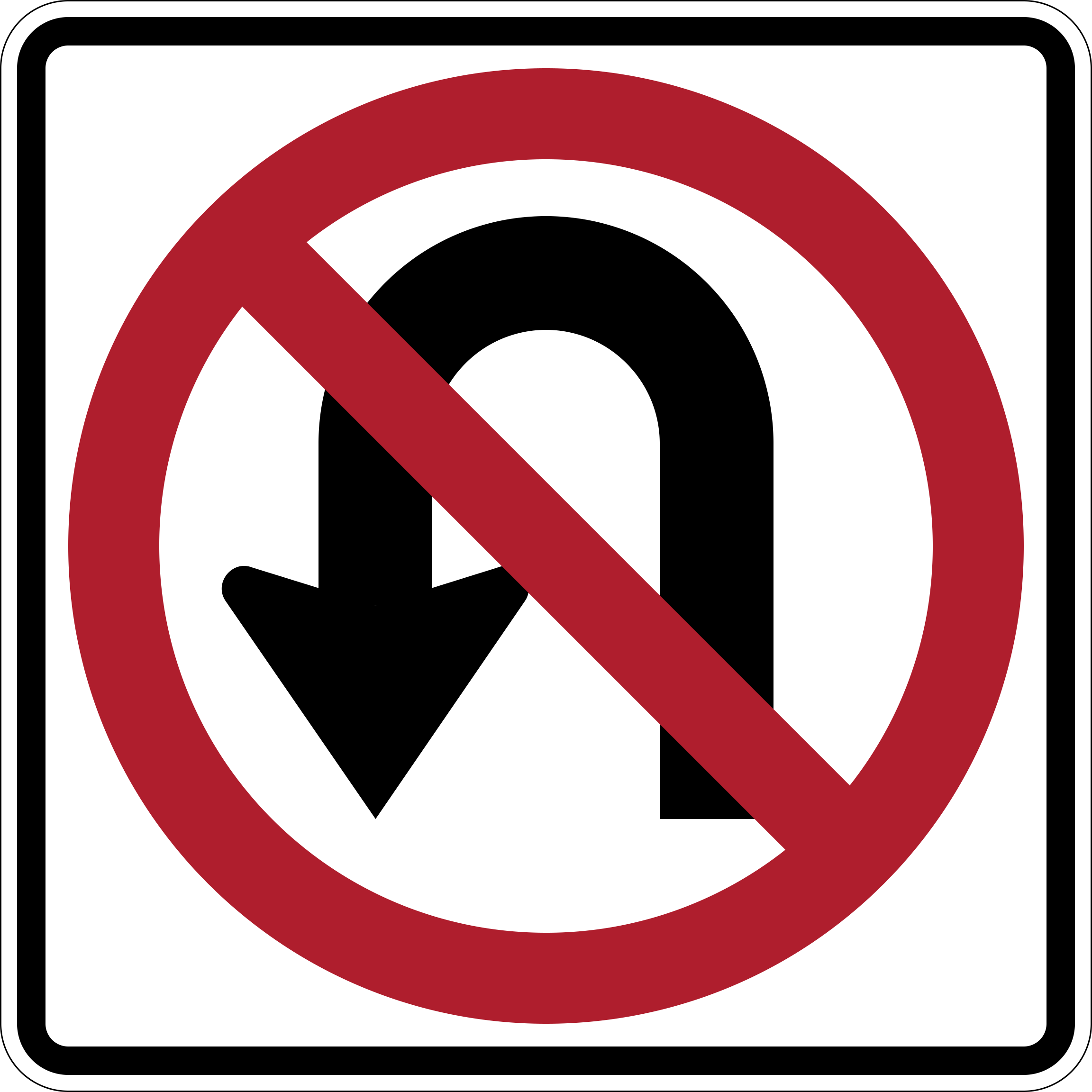
Question 20When are U-turns forbidden in Colorado?
Show answer
A: Where they can't be made without endangering others, or where No U-turn signs are posted. A U-turn is illegal wherever a No U-turn sign is posted, and anywhere it can't be made without putting other road users at risk. Colorado Driver Handbook (DR 2337): Turning: U-turns, page 16.
-
Question 21When parking uphill or downhill on a road with no curb, which way should you turn your wheels?
Show answer
A: To the right in both cases. With no curb, turn the front wheels to the right whether headed uphill or downhill, so the car would roll off the highway. Colorado Driver Handbook (DR 2337): Parking: No curb, page 17.
-
Question 22May you drive across or within a freeway median or island?
Show answer
A: No. Medians and traffic islands are off-limits; never drive over, across or inside them. Colorado Driver Handbook (DR 2337): Freeway Driving, page 17.
-
Question 23If you can't give a bicyclist three feet when passing, what should you do?
Show answer
A: Slow down and stay behind until it is safe to pass. If there isn't room to give a bicyclist 3 feet, slow down and stay behind them until you can pass safely. Colorado Driver Handbook (DR 2337): Bicyclists: Colorado laws regarding motorists and bicyclists, page 25.
-
Question 24How far from a stopped school bus with flashing red lights must you stop in Colorado?
Show answer
A: At least 20 feet. You must stop at least 20 feet before reaching a school bus stopped with its red lights flashing. Colorado Driver Handbook (DR 2337): Right-of-Way: School bus, page 14.
-
Question 25Can a 4-wheel-drive vehicle stop sooner on snow than a conventional car?
Show answer
A: No. Vehicles with 4-wheel drive have increased traction but cannot stop any sooner than a conventional car. Colorado Driver Handbook (DR 2337): Seasonal Driving, page 20.
Answer every question to see your score.
More Colorado practice tests
- Practice test 125 questions
- Practice test 225 questions
- Practice test 325 questions
- Practice test 425 questions
- Practice test 625 questions
- Practice test 725 questions
- Practice test 825 questions
- Practice test 925 questions
- Practice test 1025 questions
- Practice test 1125 questions
- Practice test 1221 questions
- Exam simulatorThe real format
How to use these tests
Read each explanation, even when you get the question right: it tells you the rule and the handbook section, so you can look it up. Your answers are saved in this browser only, so the weak spots mode can give you more questions on the topics you miss. When you're scoring well, take the exam simulator: it uses 25 questions at the DMV's pass mark, since it doesn't publish the number of questions.
Our own questions, written from the Colorado Driver Handbook (DR 2337) and checked against it. Not affiliated with the Colorado Division of Motor Vehicles (Colorado Department of Revenue). Found a mistake? Tell us.