Florida FLHSMV permit practice test 4
25 questions written from the Official Florida Driver License Handbook (Class E), covering speed limits, following and passing, parking, sharing the road, hazards, weather and night driving and more. Pick an answer to see straight away whether you're right and why. The real Florida FLHSMV test has 50 questions and you need 40 right.
-
Question 1Can you be cited for driving too slowly in Florida?
Show answer
A: Yes, if you block or delay traffic moving at normal, safe speeds. Driving too slowly is against Florida law; you must not block or delay traffic moving at normal, safe speeds. Official Florida Driver License Handbook (Class E): Florida Standard Speed Limits, page 76.
-
Question 2How close may you legally follow a fire truck responding to an emergency?
Show answer
A: No closer than 500 feet. It is against the law to follow a fire truck responding to an emergency closer than 500 feet. Official Florida Driver License Handbook (Class E): Following Distances, page 70.
-
Question 3You are parking uphill on a road with no curb. How should you turn your wheels?
Show answer
A: To the right. Uphill without a curb: turn the wheels to the right, so the car would roll away from traffic. Official Florida Driver License Handbook (Class E): Parking on Hills, page 74.
-
Question 4Bicycle brakes must be able to stop the bike within what distance from 10 mph?
Show answer
A: 25 feet. Bicyclists must have brakes that can stop the bike within 25 feet from a speed of 10 mph. Official Florida Driver License Handbook (Class E): Rules for Bicyclists, page 90.
-
Question 5What lights should you use when driving in fog or smoke?
Show answer
A: Low beam headlights. Drive with lights on low beam; high beams reflect off fog and impair visibility even more. Parking lights are not a substitute. Official Florida Driver License Handbook (Class E): Low Visibility, page 79.
-
Question 6After your right wheels go off the pavement, how should you return to the road?
Show answer
A: When the road is clear, turn back at a slow speed and signal. Wait until the road is clear and turn back onto the pavement at a slow speed, signaling your intention. Official Florida Driver License Handbook (Class E): Right Wheels Off Pavement, page 87.
-
Question 7By signing your Florida driver license, you have agreed to:
Show answer
A: Take breath, blood or urine tests if an officer has reasonable cause to believe you are impaired. Under the Implied Consent Law, by signing your license you agree to take these tests if asked by an officer with reasonable cause. Official Florida Driver License Handbook (Class E): Implied Consent Law, page 33.
-
Question 8How many hours of certified driving experience does a driver under 18 need before getting a Class E license?
Show answer
A: 50 hours, including 10 at night. A parent, guardian or responsible adult 21+ must certify at least 50 hours of driving experience, 10 of them at night. Official Florida Driver License Handbook (Class E): Requirements for Class E Learner's & Driver License, page 16.
-
Question 9Another driver is threatening you and driving dangerously around you. What should you do?
Show answer
A: Stay calm, slow down and let them pass, avoid eye contact, and call *FHP (*347) or 911 if you need help. Remain calm, put as much distance between you as possible, slow down and let them pass, don't make eye contact or gestures, and call *FHP (*347) or 911 if needed. Official Florida Driver License Handbook (Class E): Road Rage, page 44.
-
Question 10A sign reading SPEEDING FINES DOUBLED is posted in which areas?
Show answer
A: Active school zones and work zones. This sign is posted in active school and work zones, where fines are doubled if you are cited for speeding. Official Florida Driver License Handbook (Class E): Regulatory Signs: Speeding Fines Doubled, page 55.
-
Question 11Two yellow center lines: the one on your side is solid and the one on the other side is broken. May you pass?
Show answer
A: No, passing is not allowed from your lane. When the solid line is on your side, passing is not allowed from your lane (you may still turn left or pass a bicyclist when safe). Official Florida Driver License Handbook (Class E): Pavement Markings: Double Yellow Lines, page 52.
-
Question 12If your vehicle breaks down on a limited access highway, how long may it remain off the pavement?
Show answer
A: No more than six hours. If your vehicle breaks down you must move it completely off the pavement, and it may remain there no more than six hours. Official Florida Driver License Handbook (Class E): Limited Access Highway Safety Reminders, page 72.
-
Question 13According to the Florida handbook, who must do everything possible to avoid a crash?
Show answer
A: Every driver, motorcyclist, moped rider, pedestrian and bicyclist. Right-of-way rules say who must yield, but every road user must do everything possible to avoid a crash. Official Florida Driver License Handbook (Class E): Right-of-Way, page 76.
-
Question 14When completing a left turn, which lane may you finish in?
Show answer
A: Any lane lawfully available and safe for your direction of travel. A left turn may be completed in any lane lawfully available—or safe—for the desired direction of travel. Official Florida Driver License Handbook (Class E): Turning, page 78.
-
Question 15Is there a legal 'buffer' that lets you drive up to 10 mph over the speed limit?
Show answer
A: No, the speeding buffer is a myth; you can be cited. The 'speeding buffer' is a myth; you are not allowed to drive up to 10 mph over the limit and may be cited. Official Florida Driver License Handbook (Class E): Speed Limits, page 76.
-
Question 16Outside cities and towns, how far must a truck or a vehicle towing another vehicle stay behind another truck or towing vehicle?
Show answer
A: 300 feet. A truck or vehicle towing another vehicle must not follow within 300 feet of another truck or vehicle in tow (the rule doesn't apply to passing or within cities or towns). Official Florida Driver License Handbook (Class E): Following Distance for Trucks, page 70.
-
Question 17When parking on a hill with a manual transmission, which gear should you leave it in when facing downhill?
Show answer
A: Reverse. Manual transmission: shift to Reverse when downhill and First when uphill; automatic: Park. Official Florida Driver License Handbook (Class E): Parking on Hills, page 73.
-
Question 18When riding in a group, how many bicyclists may ride side by side on a regular roadway?
Show answer
A: No more than two, and single file if they are impeding traffic. Bicyclists may not ride more than two side-by-side (except on paths or bike-only parts of a road) and must ride single file if impeding traffic. Official Florida Driver License Handbook (Class E): Rules for Bicyclists, page 90.
-
Question 19What does 'over-driving' your headlights mean?
Show answer
A: Driving too fast to stop within the distance you can see. Avoid over-driving your lights, which means driving too fast for what you can see. Official Florida Driver License Handbook (Class E): Night Driving, page 81.
-
Question 20You have a tire blowout. What should you do?
Show answer
A: Take your foot off the gas, don't brake, concentrate on steering, slow gradually, then brake softly once under control. Take your foot off the gas without braking, concentrate on steering, slow gradually and brake softly once the car is under control, then pull off the road. Official Florida Driver License Handbook (Class E): Tire Blowout, page 88.
-
Question 21For a first DUI conviction, what is the minimum license revocation?
Show answer
A: 180 days. A first DUI conviction carries a minimum 180-day license revocation. Official Florida Driver License Handbook (Class E): Penalties for DUI: First DUI Conviction, page 34.
-
Question 22A 16-year-old with a Florida driver license may not drive between which hours (unless going to or from work or with a licensed driver 21+)?
Show answer
A: 11 p.m. and 6 a.m.. A 16-year-old licensed driver may not drive between 11 p.m. and 6 a.m. unless driving to or from work or accompanied by a licensed driver 21+. Official Florida Driver License Handbook (Class E): Restrictions for Minors (Driving Curfews), page 33.
-
Question 23Who must wear a safety belt under Florida law?
Show answer
A: All drivers, front-seat passengers, and passengers under 18. Florida law requires all drivers, front seat passengers and passengers under 18 to wear safety belts. Official Florida Driver License Handbook (Class E): Safety Belts and Child Passenger Safety, page 36.
-
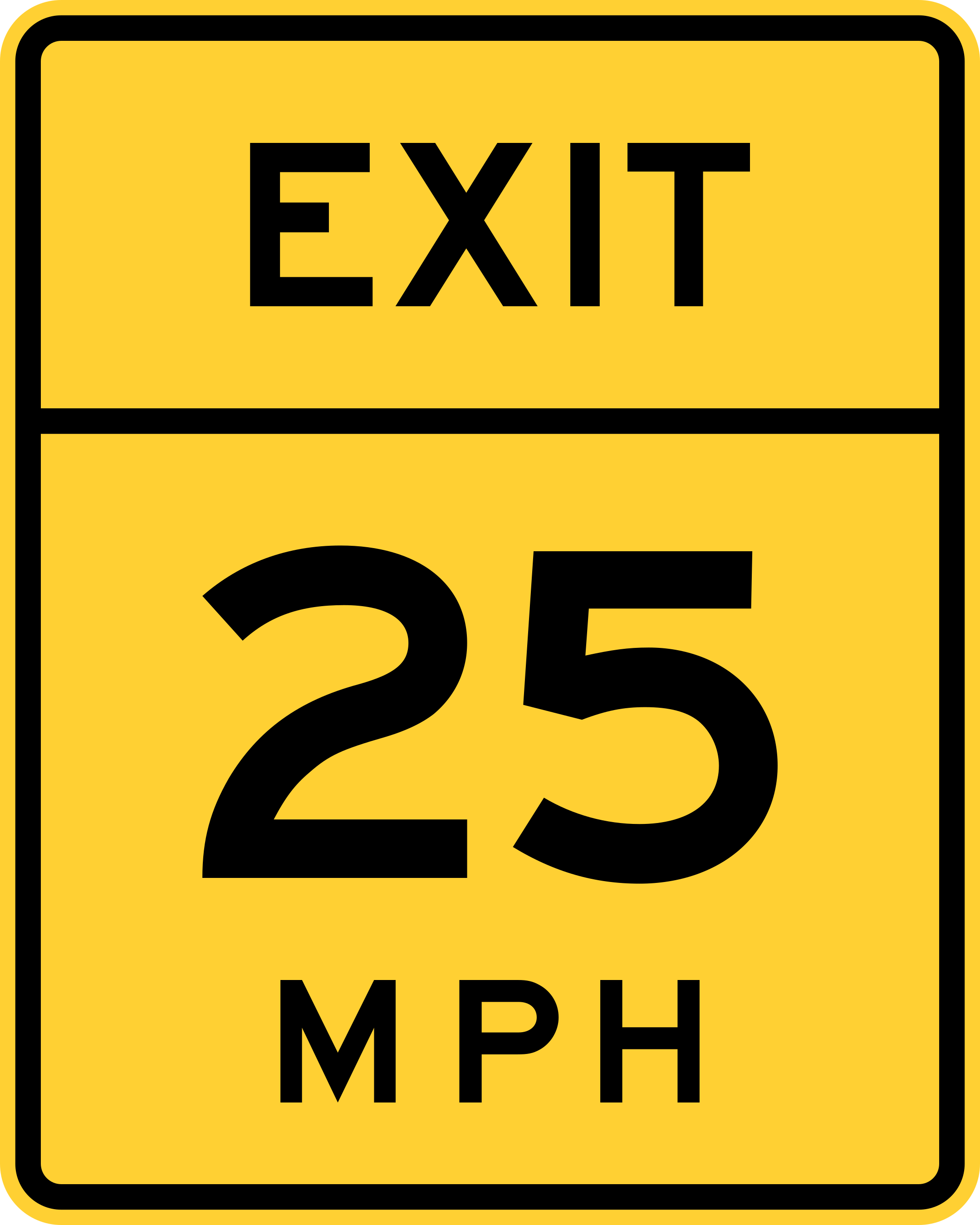
Question 24What does an EXIT SPEED sign on an expressway show?
Show answer
A: The maximum safe speed for the exit ramp. An exit speed sign lists the maximum safe speed for the exit ramp; slow down to that speed. Official Florida Driver License Handbook (Class E): Regulatory Signs: Exit Speed, page 55.
-
Question 25Two yellow center lines: the one on your side is broken and the one on the far side is solid. What does this mean for you?
Show answer
A: You may pass when it is safe. When the broken line is on your side, passing is permitted from your lane when safe. Official Florida Driver License Handbook (Class E): Pavement Markings: Double Yellow Lines, page 52.
Answer every question to see your score.
More Florida practice tests
- Practice test 125 questions
- Practice test 225 questions
- Practice test 325 questions
- Practice test 525 questions
- Practice test 625 questions
- Practice test 725 questions
- Practice test 825 questions
- Practice test 925 questions
- Practice test 1025 questions
- Practice test 1125 questions
- Practice test 1225 questions
- Practice test 1325 questions
- Practice test 1425 questions
- Practice test 1522 questions
- Exam simulatorThe real format, 50 questions
How to use these tests
Read each explanation, even when you get the question right: it tells you the rule and the handbook section, so you can look it up. Your answers are saved in this browser only, so the weak spots mode can give you more questions on the topics you miss. When you're scoring well, take the exam simulator: it uses the same number of questions and passing score as the real test.
Our own questions, written from the Official Florida Driver License Handbook (Class E) and checked against it. Not affiliated with the Florida Department of Highway Safety and Motor Vehicles. Found a mistake? Tell us.