Virginia DMV permit practice test 12
25 questions written from the Virginia Driver's Manual (DMV 39), covering signals and pavement markings, road signs, sharing the road, safe and defensive driving, licensing laws and penalties. Pick an answer to see straight away whether you're right and why. The real Virginia DMV test has 40 questions and you need 34 right.
-
Question 1A broken yellow center line means:
Show answer
C: Passing on the left is allowed in either direction when the way ahead is clear. Broken yellow center lines mean passing on the left is allowed in either direction when the way is clear. Virginia Driver's Manual (DMV 39): Pavement Markings, page 13.
-
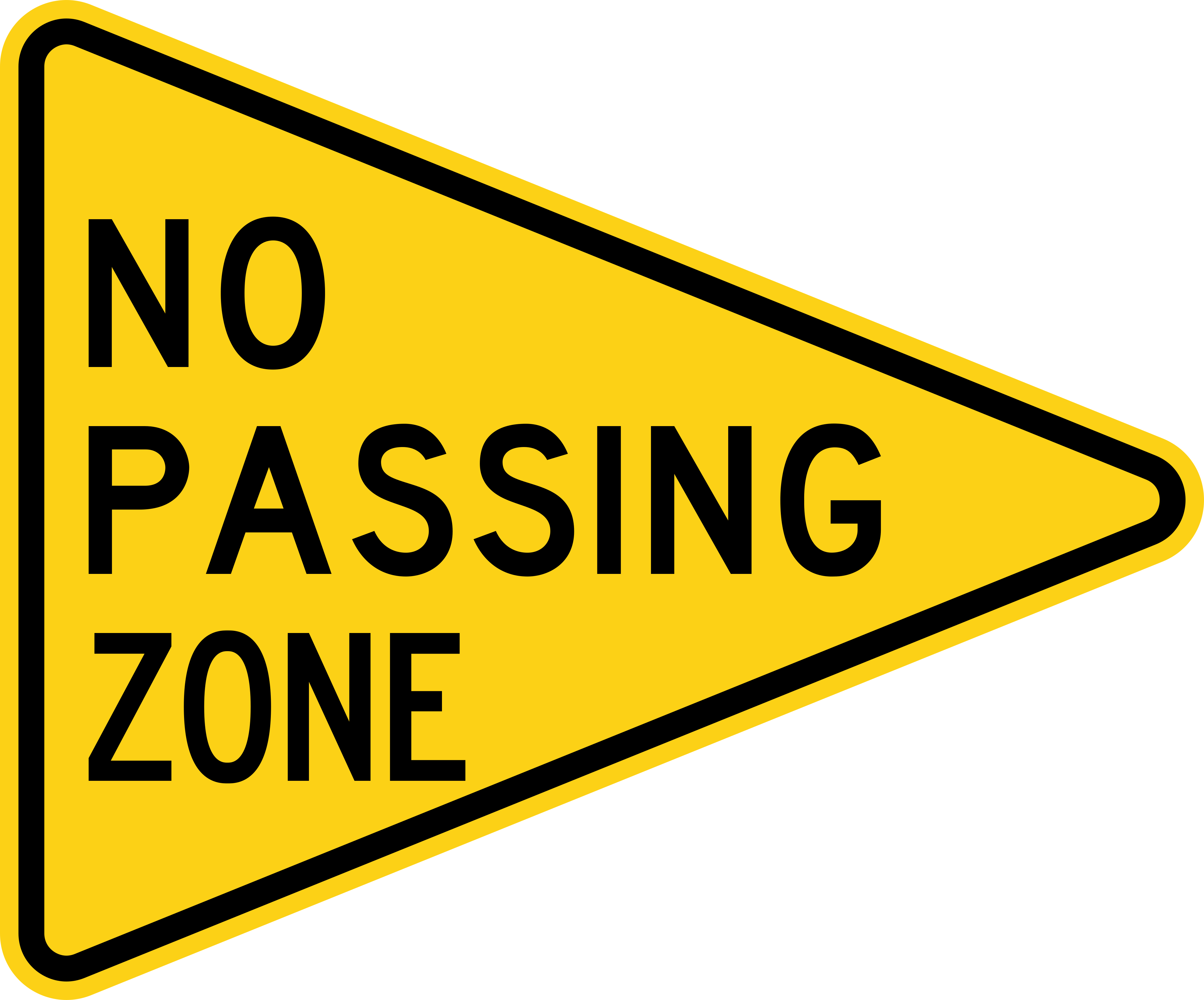
Question 2A pennant-shaped yellow 'No Passing Zone' sign is placed:
Show answer
D: At the beginning of a no-passing zone. The No Passing Zone sign marks the beginning of a no-passing zone. Virginia Driver's Manual (DMV 39): Warning signs: No Passing Zone, page 10.
-
Question 3Compared with cars, about how much time and room do trucks, buses and RVs need to stop?
Show answer
D: Nearly twice as much. These vehicles need nearly twice the time and room to stop as cars, so don't cut in front of them. Virginia Driver's Manual (DMV 39): Trucks, Tractor-Trailers, Buses and RVs, page 23.
-
Question 4To avoid drowsy driving, which hours does the Virginia manual suggest avoiding driving?
Show answer
D: 10 p.m. to 6 a.m.. The manual advises avoiding driving from 10 p.m. to 6 a.m. Virginia Driver's Manual (DMV 39): Drowsy Driving, page 26.
-
Question 5Where must license plates be displayed on a Virginia passenger vehicle?
Show answer
C: Front and rear. License plates must be displayed on the front and rear of the vehicle. Virginia Driver's Manual (DMV 39): Titles, Registrations, License Plates, Decals, page 35.
-
Question 6A solid yellow line is next to a broken yellow line. Passing is allowed:
Show answer
B: Only from the side with the broken line. Passing is allowed from the broken-line side but not from the solid-line side. Virginia Driver's Manual (DMV 39): Pavement Markings, page 13.
-
Question 7At a 'Merge' sign, who is responsible for merging safely?

Show answer
D: Drivers in both lanes. The Merge sign means two lanes are about to become one, and drivers in both lanes are responsible for merging safely. Virginia Driver's Manual (DMV 39): Warning signs: Merge, page 10.
-
Question 8After passing a truck, when is it safe to pull back in front of it?
Show answer
B: When you can see the entire front of the truck in your rearview mirror. Look for the entire front of the truck in your rearview mirror before pulling in front, then maintain your speed. Virginia Driver's Manual (DMV 39): Trucks, Tractor-Trailers, Buses and RVs, page 23.
-
Question 9You are pulled over by police at night. What should you do?
Show answer
A: Stay in the vehicle, turn on interior lights and keep your hands in plain view. Stay in the vehicle, turn on your interior lights at night, keep belts fastened and hands in plain view. Virginia Driver's Manual (DMV 39): Traffic Stops, page 28.
-
Question 10The Division of Child Support Enforcement can direct DMV to suspend your license if your child support payments are late by:
Show answer
C: 90 days or $5,000. DMV will suspend if child support payments are late by 90 days or $5,000, or for failing to appear in related court proceedings. Virginia Driver's Manual (DMV 39): Suspensions for Failing to Satisfy Child Support-Related Requirements, page 32.
-
Question 11On the solid side of a yellow center line, when may you cross it?
Show answer
C: To pass pedestrians, bicyclists, or scooter or skateboard riders when the opposite lane is clear and you can pass safely. The manual allows crossing the solid line only to pass pedestrians, bicyclists, and riders of scooters or skateboards when the opposite lane is clear and passing is safe. Virginia Driver's Manual (DMV 39): Pavement Markings, page 13.
-
Question 12A 'Lane Reduction' sign shows the right lane ends soon. What should drivers in the left lane do?

Show answer
D: Allow other vehicles to merge smoothly. Drivers in the right lane must merge left when space opens, and drivers in the left lane should allow them to merge smoothly. Virginia Driver's Manual (DMV 39): Warning signs: Lane Reduction, page 10.
-
Question 13A truck's blind spots may stretch about how far behind the vehicle?
Show answer
C: 200 feet. Blind spots may stretch up to 20 feet in front of the cab and about 200 feet behind the vehicle. Virginia Driver's Manual (DMV 39): Trucks, Tractor-Trailers, Buses and RVs, page 23.
-
Question 14An officer gives you a citation to sign. What does signing mean?
Show answer
B: It is not an admission of guilt; refusing to sign may result in arrest. Signing the citation is not an admission of guilt; refusal to sign may result in arrest. Virginia Driver's Manual (DMV 39): Traffic Stops, page 28.
-
Question 15When DMV receives a report that a driver may have a condition affecting safe driving, what may it do?
Show answer
A: Conduct a medical review, which may require medical reports or testing. DMV may conduct a medical review and require medical or vision reports and/or testing, then decide to suspend, restrict, require periodic reports or end the review. Virginia Driver's Manual (DMV 39): Medical Review Program, page 31.
-
Question 16Double solid yellow lines may be crossed to:
Show answer
B: Make a left turn or pass pedestrians, bicyclists and scooter or skateboard riders when safe. You may not cross double solid yellow lines except to turn left or to pass pedestrians, bicyclists and scooter or skateboard riders when the opposite lane is clear. Virginia Driver's Manual (DMV 39): Pavement Markings, page 13.
-
Question 17A 'Divided Highway Begins' sign means:

Show answer
A: The highway ahead is split by a median and each roadway is one-way; keep right. Divided Highway Begins means a median or divider will split the road into two one-way roadways. Keep right. Virginia Driver's Manual (DMV 39): Warning signs: Divided Highway Begins, page 10.
-
Question 18A truck ahead is swinging wide to make a right turn. What should you do?
Show answer
D: Never squeeze between the truck and the curb; wait. Trucks may swing wide to turn. Never try to squeeze between a truck, bus or RV and the curb or another vehicle. Virginia Driver's Manual (DMV 39): Trucks, Tractor-Trailers, Buses and RVs, page 23.
-
Question 19If the officer who stops you is in an unmarked car or not in uniform, you may:
Show answer
C: Ask to see the officer's identification. You may ask to see the identification of an officer in an unmarked car or not in uniform. Virginia Driver's Manual (DMV 39): Traffic Stops, page 28.
-
Question 20Which offense requires the court or DMV to suspend or revoke your license on conviction?
Show answer
B: Failing to stop and identify yourself at a crash where someone was injured or killed. Failing to stop and identify yourself at a crash in which someone is injured or killed is among the offenses requiring suspension or revocation. Virginia Driver's Manual (DMV 39): Conviction-Related Suspensions and Revocations, page 30.
-
Question 21Broken white lines separate:
Show answer
B: Lanes of traffic going in the same direction. Broken white lines separate lanes of traffic going in the same direction; you may change lanes with caution. Virginia Driver's Manual (DMV 39): Pavement Markings, page 13.
-
Question 22A 'Divided Highway Ends' sign warns that:

Show answer
C: The median ends and traffic will travel in both directions. Divided Highway Ends means there is no longer a median; traffic goes in both directions. Keep right. Virginia Driver's Manual (DMV 39): Warning signs: Divided Highway Ends, page 10.
-
Question 23A tractor-trailer may be up to how long, according to the Virginia manual?
Show answer
C: 65 feet. A truck and its trailer may be as long as 65 feet, and passing it may take more than half a mile of clear road. Virginia Driver's Manual (DMV 39): Trucks, Tractor-Trailers, Buses and RVs, page 23.
-
Question 24Under Virginia law, who must wear safety belts?
Show answer
A: The driver and all front and rear passengers. Under Virginia law, the driver and all passengers, front and rear, must wear safety belts. Virginia Driver's Manual (DMV 39): Seat Belts, page 28.
-
Question 25Refusing a blood or breath test when charged with DUI can lead to:
Show answer
C: Court suspension or revocation of your driving privilege. The court may suspend or revoke your driving privilege for refusing to take a blood or breath test when charged with DUI. Virginia Driver's Manual (DMV 39): Conviction-Related Suspensions and Revocations, page 31.
Answer every question to see your score.
More Virginia practice tests
- Practice test 125 questions
- Practice test 225 questions
- Practice test 325 questions
- Practice test 425 questions
- Practice test 525 questions
- Practice test 625 questions
- Practice test 725 questions
- Practice test 825 questions
- Practice test 925 questions
- Practice test 1025 questions
- Practice test 1125 questions
- Practice test 1325 questions
- Practice test 1425 questions
- Exam simulatorThe real format, 40 questions
How to use these tests
Read each explanation, even when you get the question right: it tells you the rule and the handbook section, so you can look it up. Your answers are saved in this browser only, so the weak spots mode can give you more questions on the topics you miss. When you're scoring well, take the exam simulator: it uses the same number of questions and passing score as the real test.
Our own questions, written from the Virginia Driver's Manual (DMV 39) and checked against it. Not affiliated with the Virginia Department of Motor Vehicles. Found a mistake? Tell us.