Indiana BMV permit practice test 5
25 questions written from the Indiana Driver's Manual, covering road signs, signals and pavement markings, right of way, turns and intersections, following and passing and more. Pick an answer to see straight away whether you're right and why.
-
Question 1What does a circular (round) traffic sign alert you to?

Show answer
A: An upcoming railroad crossing. Circular signs alert drivers to upcoming railroad crossings. Indiana Driver's Manual: Chapter 6: Traffic Sign Shapes, page 33.
-
Question 2When do rectangular rapid flashing beacons at crosswalks flash?
Show answer
A: Only when activated by a pedestrian. These beacons stay dark until a pedestrian pushes the button to cross. Indiana Driver's Manual: Chapter 6: Traffic Signals — Yellow Flashing Lights, page 39.
-
Question 3At an all-way stop, who goes first?
Show answer
A: The first vehicle to stop at the intersection. At an all-way stop, the first vehicle to stop is the first to proceed. Indiana Driver's Manual: Chapter 7: All-Way Stops, page 44.
-
Question 4How does a traffic circle differ from a roundabout?
Show answer
A: A traffic circle may have clockwise and counterclockwise traffic and stop signs at entries. A traffic circle may have traffic in both directions and stop-controlled approaches instead of yield signs. Indiana Driver's Manual: Chapter 7: Roundabouts, page 45.
-
Question 5What following distance does the Indiana Driver's Manual recommend behind the vehicle ahead?
Show answer
B: At least two to three seconds. Keep a gap of at least two to three seconds between you and the vehicle in front. Indiana Driver's Manual: Chapter 7: Braking and Following Distances, page 46.
-
Question 6A flashing arrow board in a work zone shows no direction. What does it mean?
Show answer
A: Use caution; you do not have to change lanes. A flashing arrow board not indicating a direction means caution but does not require a lane change. Indiana Driver's Manual: Chapter 7: Work Zones, page 52.
-
Question 7How far behind a tractor-trailer can its blind spot extend?
Show answer
D: Up to 200 feet. Blind spots extend up to 20 feet in front of the cab, along both sides, and up to 200 feet behind. Indiana Driver's Manual: Chapter 7: Sharing the Road with Tractor-Trailers — Blind Spots, page 55.
-
Question 8What are common hours for Indiana school zone speed limits?
Show answer
A: 7 a.m. to 4:30 p.m., Monday through Friday, or when beacons flash. Common school zone hours are 7 a.m. to 4:30 p.m. Monday through Friday, or when school speed beacons are flashing. Indiana Driver's Manual: Chapter 7: Speed Limits — School Zone Speed Limits, page 46.
-
Question 9After driving through water puddles, what should you do?
Show answer
A: Test your brakes by pumping them to dry them. After driving through puddles, test your brakes by pumping them to help dry them. Indiana Driver's Manual: Chapter 7: Driving in Uncertain Weather Conditions — Rain, page 49.
-
Question 10What information must you give everyone involved after an accident?
Show answer
A: Your name, address and vehicle registration number, and show your license. The driver must give name, address and registration number and show their driver's license. Indiana Driver's Manual: Chapter 8: What to Do After an Accident — Should You Move Your Vehicle?, page 63.
-
Question 11Which age group is at the highest risk for drowsy-driving crashes?
Show answer
A: Young adults ages 16-29. Young adults ages 16-29 are at highest risk, accounting for 64 percent of fatigue-related accidents. Indiana Driver's Manual: Chapter 7: Impaired and Dangerous Driving — Drowsy Driving, page 50.
-
Question 12May you park in the diagonally striped area next to an accessible parking space if you have a valid placard?
Show answer
A: No, never. Parking in the striped area is prohibited even with a valid placard; it is needed for wheelchair transfers and ramps. Indiana Driver's Manual: Chapter 7: Parking and Reversing — Handicap Accessible Parking, page 60.
-
Question 13How long is an Indiana learner's permit valid?
Show answer
C: Two years. An Indiana learner's permit lasts two years from the day it is issued. Indiana Driver's Manual: Chapter 1: Learner's Permit Validity, page 9.
-
Question 14What should you do before driving after taking any medication?
Show answer
A: Read the label and discuss side effects with a physician or pharmacist. Always consult the label and discuss side effects with a physician or pharmacist before driving. Indiana Driver's Manual: Chapter 8: Impaired Driving, page 64.
-
Question 15What does an equilateral triangle sign (three equal sides) mean?
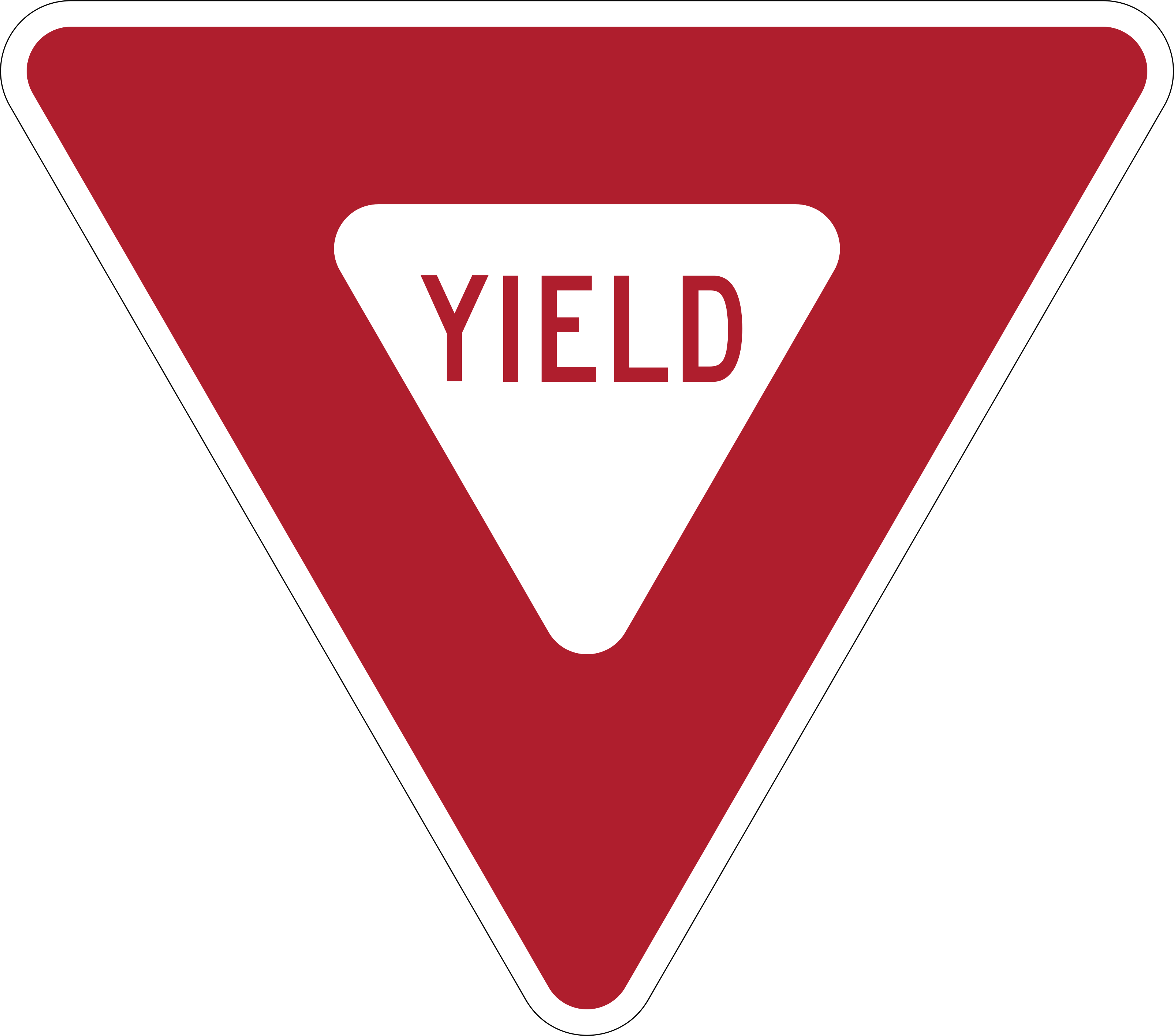
Show answer
A: Slow down and be prepared to stop and yield. Three-sided signs warn drivers to slow down and be ready to stop to yield to others. Indiana Driver's Manual: Chapter 6: Traffic Sign Shapes, page 33.
-
Question 16A flashing red light at an intersection is equivalent to what?
Show answer
A: A stop sign. A flashing red light is equivalent to a stop sign: stop completely, then proceed with caution. Indiana Driver's Manual: Chapter 6: Traffic Signals — Red Flashing Lights, page 39.
-
Question 17At an all-way stop, you arrive at the same time as a driver on your right. What should you do?
Show answer
A: Yield; the vehicle on the left yields. When two drivers arrive at the same time, the vehicle on the left yields the right-of-way. Indiana Driver's Manual: Chapter 7: All-Way Stops, page 44.
-
Question 18Should you back into an intersection to turn around?
Show answer
A: Never. Never back into an intersection in order to turn around. Indiana Driver's Manual: Chapter 7: Parking and Reversing — Reversing, page 59.
-
Question 19How do you measure your following distance?
Show answer
A: Watch the vehicle ahead pass a fixed object and count the seconds until you pass it. Watch for the vehicle ahead to pass a fixed object and estimate how much time passes before you pass the same object. Indiana Driver's Manual: Chapter 7: Braking and Following Distances, page 46.
-
Question 20What is "zipper merging" in a work zone?
Show answer
A: Merging late, toward the lane closure, to reduce the length of the backup, where signs direct it. At some locations signs encourage late or zipper merging at the lane closure to reduce backups. Indiana Driver's Manual: Chapter 7: Work Zones — Work Zone Safety Driving Tips, page 53.
-
Question 21You are following a tractor-trailer and cannot see the driver's side mirrors. What does that mean?
Show answer
A: The truck driver cannot see you. If you cannot see the driver's mirrors, the driver cannot see you. Indiana Driver's Manual: Chapter 7: Sharing the Road with Tractor-Trailers — Tips, page 55.
-
Question 22How much lower are Indiana work site speed limits than the normal maximum for the area?
Show answer
B: At least 10 mph lower. Work site speed limits are always at least 10 mph below the maximum established limit. Indiana Driver's Manual: Chapter 7: Speed Limits — Reduced Speed Limits in Highway Work Zones, page 46.
-
Question 23Which headlights should you use in fog?
Show answer
A: Low beams. Do not use high beams in fog; low beams better light the road. Also use flashing emergency signals. Indiana Driver's Manual: Chapter 7: Driving in Uncertain Weather Conditions — Fog, page 49.
-
Question 24You hit an unattended parked car and cannot find the owner. What should you do?
Show answer
A: Call a law enforcement agency to provide information. Take reasonable steps to notify the owner; if they can't be found, call law enforcement. Indiana Driver's Manual: Chapter 8: What to Do After an Accident — Provide Reasonable Assistance, page 63.
-
Question 25Which is a warning sign of drowsy driving?
Show answer
A: Difficulty remembering the last few miles driven. Signs include trouble remembering the last few miles, yawning, missing exits, drifting and hitting rumble strips. Indiana Driver's Manual: Chapter 7: Impaired and Dangerous Driving — Drowsy Driving, page 50.
Answer every question to see your score.
More Indiana practice tests
- Practice test 125 questions
- Practice test 225 questions
- Practice test 325 questions
- Practice test 425 questions
- Practice test 625 questions
- Practice test 725 questions
- Practice test 825 questions
- Practice test 925 questions
- Practice test 1025 questions
- Practice test 1125 questions
- Practice test 1225 questions
- Exam simulatorThe real format
How to use these tests
Read each explanation, even when you get the question right: it tells you the rule and the handbook section, so you can look it up. Your answers are saved in this browser only, so the weak spots mode can give you more questions on the topics you miss. When you're scoring well, take the exam simulator: it uses 25 questions at the BMV's pass mark, since it doesn't publish the number of questions.
Our own questions, written from the Indiana Driver's Manual and checked against it. Not affiliated with the Indiana Bureau of Motor Vehicles. Found a mistake? Tell us.