North Carolina NCDMV permit practice test 3
25 questions written from the North Carolina Driver Handbook, covering following and passing, turns and intersections, parking, hazards, weather and night driving, emergencies and more. Pick an answer to see straight away whether you're right and why.
-
Question 1How far to the left of the vehicle being passed must a passing driver be, by law?
Show answer
D: At least two feet. The law requires the passing driver to pass at least two feet to the left of the vehicle being passed. North Carolina Driver Handbook: Passing, page 57.
-
Question 2How do you give a left-turn hand signal?
Show answer
D: Left arm and hand held straight out, pointing. To signal a left turn, hold the left arm and hand straight out from the window and point. North Carolina Driver Handbook: Hand Signals, page 71.
-
Question 3Outside city limits, how close to a fire or fire truck may you park?
Show answer
B: No closer than 400 feet. Do not park within one block of a fire or fire truck in city limits, or within 400 feet outside the city. North Carolina Driver Handbook: Parking, page 58.
-
Question 4An oncoming driver at night does not dim their high beams. What should you do?
Show answer
C: Blink your high beams once, and if they still do not dim, keep yours on low. Remind the driver by blinking your high beams once; if they still do not dim, keep your lights on low and look slightly to the right. North Carolina Driver Handbook: Night Driving, page 73.
-
Question 5Your gas pedal sticks. Which action does the handbook recommend?
Show answer
A: Shift to neutral and apply firm brake pressure without locking the wheels. Tap or lift the pedal, shift to neutral and brake firmly without locking the wheels, then get completely off the road. North Carolina Driver Handbook: Emergencies: Gas Pedal Sticks, page 77.
-
Question 6On a long interstate trip, how often does the handbook suggest stopping at rest areas?
Show answer
C: At least once every 100 miles. Stop at rest areas frequently, preferably at least once every 100 miles. North Carolina Driver Handbook: Interstate Highways, page 66.
-
Question 7How long must you hold a Level One Limited Learner Permit before applying for a Limited Provisional License?
Show answer
B: 9 months. The Level One permit must be held for nine months before you can apply for the Level Two Limited Provisional License. North Carolina Driver Handbook: Graduated Licensing—Licensing for Drivers 15–18: Limited Learner Permit, page 14.
-
Question 8If your chemical test shows a BAC of 0.08 or more, your license is revoked immediately for a minimum of:
Show answer
C: 30 days. A BAC of 0.08 or more (0.04 in a CMV) results in an immediate revocation of at least 30 days. North Carolina Driver Handbook: Driving While Impaired, page 33.
-
Question 9At 55 mph, how long does it take a vehicle to travel the length of a football field?
Show answer
A: About 3.7 seconds. The handbook notes that at 55 mph a vehicle covers the length of a football field in 3.7 seconds, so even a brief 'mini' sleep is dangerous. North Carolina Driver Handbook: Drowsy Driving, page 42.
-
Question 10What does a green arrow signal mean?
Show answer
B: You have a protected movement in the direction of the arrow. A green arrow gives a 'protected' movement, allowing you to cautiously make the movement shown by the arrow. North Carolina Driver Handbook: Traffic Signals, page 82.
-
Question 11Rectangular and square signs that are black and white or red and white usually show:
Show answer
A: Speed limits and other regulations. Rectangular and square black-and-white or red-and-white signs show speed limits and other regulations like NO U-TURN. North Carolina Driver Handbook: Traffic Signs: Regulatory Signs, page 85.
-
Question 12Even when you have the right of way, what does North Carolina law require as you come to an intersection?
Show answer
C: Slow down. The law requires you to slow down when coming to an intersection even if you have the right of way. North Carolina Driver Handbook: Special Driving Situations: Intersections, page 59.
-
Question 13On a two-lane roadway with a center turning lane, a school bus stops for passengers. Who must stop?
Show answer
A: All traffic from both directions. On a two-lane road with a center turning lane, all traffic in both directions must stop. North Carolina Driver Handbook: School Buses, page 50.
-
Question 14Under ideal conditions, about how many feet does a vehicle traveling 55 mph need to stop completely?
Show answer
C: About 211 feet. Even in ideal conditions, a vehicle at 55 mph needs approximately 211 feet to stop completely. North Carolina Driver Handbook: Adjusting Your Speed to Driving Conditions, page 55.
-
Question 15Passing is unsafe and usually illegal on a hill or curve where you cannot see at least how far ahead?
Show answer
C: 500 feet. Do not pass on any curve or hill where you cannot see at least 500 feet ahead. North Carolina Driver Handbook: Passing, page 57.
-
Question 16Which hand signal means a right turn?
Show answer
C: Left arm out with forearm and hand straight up, palm forward. To signal a right turn, hold the left arm out with the forearm and hand straight up, palm facing forward. North Carolina Driver Handbook: Hand Signals, page 71.
-
Question 17Before pulling out of a parallel parking space on the right side of the road, what should you do?
Show answer
D: Check for approaching traffic and give a left-turn signal. Before pulling out of a parallel space, check for traffic and give a left-turn signal (unless parked on the left side of a one-way street). North Carolina Driver Handbook: Parking, page 58.
-
Question 18To avoid being blinded by oncoming headlights at night, where should you look?
Show answer
B: Slightly to the right, using the edge of the road as a guide. Watch the road ahead, looking slightly to the right so you are not looking directly into oncoming headlights. North Carolina Driver Handbook: Night Driving, page 73.
-
Question 19If a tire blows out, what should you do first?
Show answer
C: Hold the steering wheel tightly and keep the car straight. Hold the wheel tightly to keep the vehicle straight, ease off the accelerator, and do not brake until the engine has slowed you. North Carolina Driver Handbook: Emergencies: Blowouts, page 78.
-
Question 20You realize you have entered an interstate going the wrong direction. What should you do?
Show answer
A: Pull onto the right shoulder and stop, then turn around when it is clear. Pull over to the right shoulder and stop; when clear, turn around and head the proper way. Watch for DO NOT ENTER signs. North Carolina Driver Handbook: Entering and Exiting the Interstate, page 67.
-
Question 21How many hours of supervised driving must a Level One permit holder record in the driving log?
Show answer
A: At least 60 hours, with at least 10 at night. The driving log must show a minimum of 60 hours of driving, at least 10 of them at night, signed by the supervising driver. North Carolina Driver Handbook: Graduated Licensing—Licensing for Drivers 15–18: Limited Learner Permit, page 14.
-
Question 22What is the license revocation for a first DWI conviction in North Carolina?
Show answer
A: One year. A first DWI conviction brings a mandatory one-year license revocation. North Carolina Driver Handbook: Driving While Impaired: If you are convicted of DWI, page 34.
-
Question 23Under North Carolina's seat belt law, who must wear a seat belt when the vehicle is moving forward on a street or highway?
Show answer
B: The driver and all passengers. The driver and all passengers in a vehicle built with seat belts must have them properly fastened whenever the vehicle is in forward motion on a street or highway. North Carolina Driver Handbook: Protecting Yourself and Your Passengers: Seat Belts, page 45.
-
Question 24When both a U-turning driver and an opposing right-turning driver have green arrows at the same time, who must yield?
Show answer
A: The U-turning driver. U-turning traffic should yield to opposing right-turning traffic when both have their green arrows. North Carolina Driver Handbook: Traffic Signals, page 82.
-
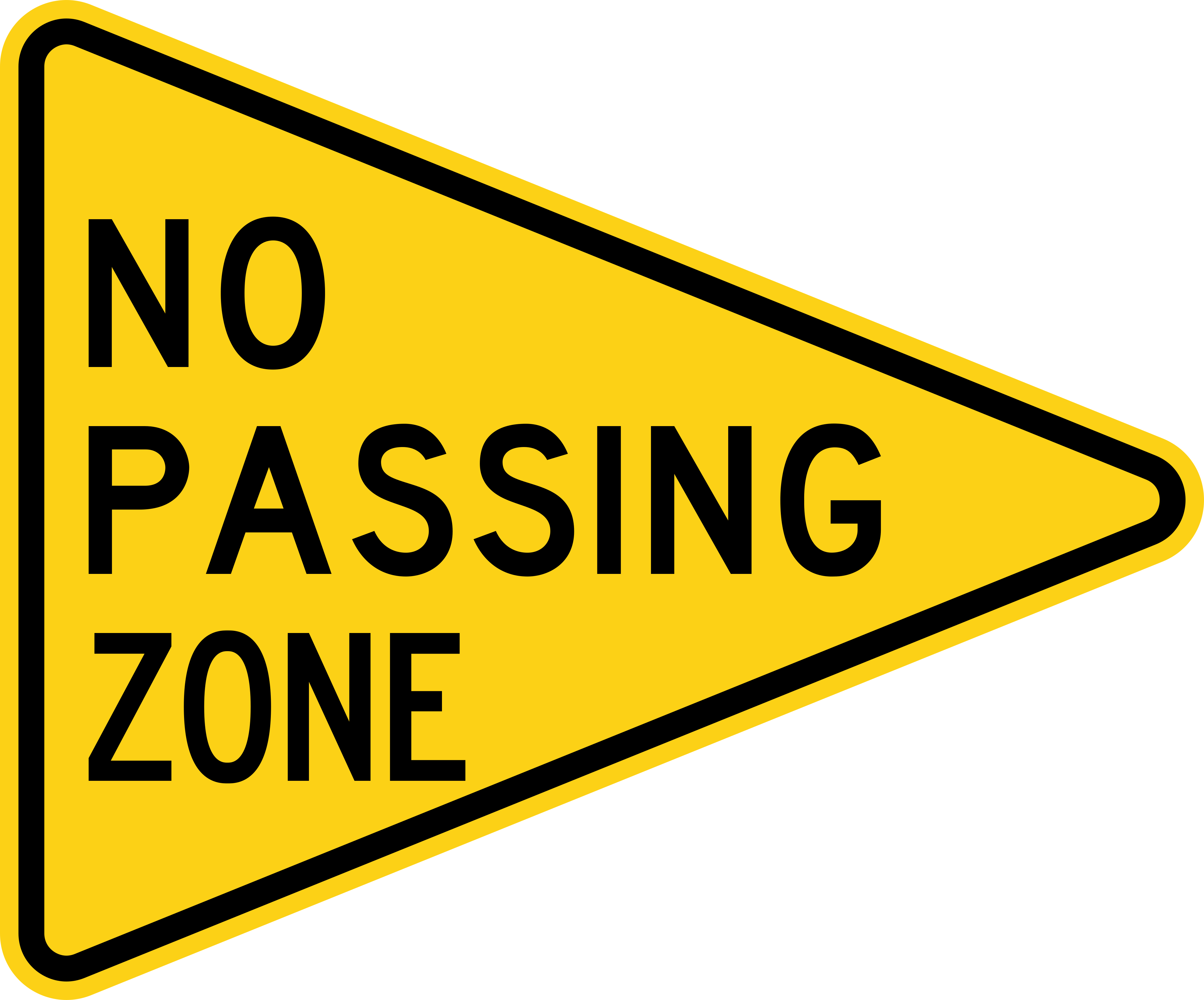
Question 25What does the yellow pennant-shaped sign on the left side of the road indicate?
Show answer
D: The beginning of a no-passing zone. The pennant-shaped sign is posted on the left side of the road and points to the start of a no-passing zone. North Carolina Driver Handbook: Traffic Signs: Warning Signs, page 86.
Answer every question to see your score.
More North Carolina practice tests
- Practice test 125 questions
- Practice test 225 questions
- Practice test 425 questions
- Practice test 525 questions
- Practice test 625 questions
- Practice test 725 questions
- Practice test 825 questions
- Practice test 925 questions
- Practice test 1025 questions
- Practice test 1125 questions
- Practice test 1225 questions
- Practice test 1325 questions
- Exam simulatorThe real format
How to use these tests
Read each explanation, even when you get the question right: it tells you the rule and the handbook section, so you can look it up. Your answers are saved in this browser only, so the weak spots mode can give you more questions on the topics you miss. When you're scoring well, take the exam simulator: it uses 25 questions at the NCDMV's pass mark, since it doesn't publish the number of questions.
Our own questions, written from the North Carolina Driver Handbook and checked against it. Not affiliated with the North Carolina Division of Motor Vehicles (N.C. Department of Transportation). Found a mistake? Tell us.