North Carolina NCDMV permit practice test 6
25 questions written from the North Carolina Driver Handbook, covering lanes, highways and freeways, licensing laws and penalties, alcohol and drugs, safe and defensive driving, signals and pavement markings and more. Pick an answer to see straight away whether you're right and why.
-
Question 1When changing lanes on a multi-lane highway, besides your target lane, what should you check?
Show answer
D: The lane beyond it, in case another driver is moving into the same space. Check the lane you are moving into and the lane beyond it to make sure another vehicle is not planning to move into the same space. North Carolina Driver Handbook: Changing Lanes, page 56.
-
Question 2Before moving from Level One to Level Two, you must have had no convictions for moving violations, seat belt or cell phone infractions within the preceding:
Show answer
D: 6 months. To graduate to the next level you must have no moving violation, seat belt or cell phone convictions within the preceding six months. North Carolina Driver Handbook: Graduated Licensing—Licensing for Drivers 15–18: Limited Learner Permit, page 14.
-
Question 3After a first DWI license restoration, what alcohol concentration restriction applies to the driver?
Show answer
A: 0.04. On the first restoration the alcohol concentration restriction is 0.04; on later restorations it is 0.00. North Carolina Driver Handbook: Blood Alcohol Concentration Restrictions, page 34.
-
Question 4Every driver transporting passengers younger than what age must make sure each one is properly secured in a child restraint or seat belt?
Show answer
B: 16. Drivers must ensure every passenger under 16 is properly secured in a child restraint system or seat belt. North Carolina Driver Handbook: Child Seats, page 46.
-
Question 5How should you treat an intersection where the traffic light is not working because of a power outage?
Show answer
D: As if there were a stop sign on all approaches. Approach a malfunctioning signal as though the intersection were controlled by stop signs on all approaches, unless an officer is directing traffic. North Carolina Driver Handbook: Traffic Signals, page 83.
-
Question 6A round yellow sign with a black X and the letters 'RR' means:

Show answer
B: A railroad crossing is ahead. The circular yellow RR sign gives advance warning of a railroad crossing; slow down and be ready to stop. North Carolina Driver Handbook: Traffic Signs: Warning Signs, page 86.
-
Question 7When a 'Walk' / 'Don't Walk' signal is operating, which signal must pedestrians obey?
Show answer
C: The pedestrian signal. Where special Walk/Don't Walk signals operate, pedestrians must obey them rather than the regular traffic signals. North Carolina Driver Handbook: The Driver and Pedestrian, page 49.
-
Question 8At night, North Carolina law requires a bicycle to have a front light visible for at least:
Show answer
A: 300 feet. A bicycle at night must have a front light visible for at least 300 feet and a red rear light or reflector visible for at least 200 feet. North Carolina Driver Handbook: Bicycles: Be Visible, page 92.
-
Question 9When you approach a curve while going downhill, what should you do?
Show answer
A: Shift to a lower gear before moving downhill and begin braking earlier. Consider gravity, shift to a lower gear before going downhill, and begin braking earlier than on level ground. North Carolina Driver Handbook: Rounding a Curve, page 56.
-
Question 10When have you NOT passed safely?
Show answer
D: When the vehicle you passed had to slow down to let you back in. You have not passed safely if the vehicle you passed must slow down to let you back into your lane. North Carolina Driver Handbook: Passing, page 57.
-
Question 11On a four-lane highway separated by a median wider than how many feet is each crossing a separate intersection?
Show answer
A: 30 feet. On four-lane highways separated by a median of more than 30 feet, each crossing is a separate intersection. North Carolina Driver Handbook: Special Driving Situations: Intersections, page 59.
-
Question 12Parking on the roadway side of another parked vehicle is called:
Show answer
B: Double parking, and it is not allowed. Do not park on the roadway side of another vehicle (double parking). North Carolina Driver Handbook: Parking, page 58.
-
Question 13If your vehicle begins to hydroplane, what should you do?
Show answer
A: Take your foot off the gas, avoid braking, and keep the wheel straight. Ease off the gas, resist braking, keep the steering wheel straight and let the car slow until the tires grip again. North Carolina Driver Handbook: Hydroplaning, page 74.
-
Question 14Your wheels drift off the pavement onto the shoulder. What should you do?
Show answer
D: Ease off the accelerator, steer straight, and return to the road gradually when safe. Don't brake or turn back right away; ease off the gas, steer straight, let the engine slow you, then gradually return when it's safe. North Carolina Driver Handbook: Emergencies: Unusual Emergencies, page 79.
-
Question 15Which step is part of a safe lane change?
Show answer
B: Look over your shoulder to make sure the blind spot is clear. Check your mirrors, look over your shoulder to check the blind spot, signal in advance, then change lanes. North Carolina Driver Handbook: Changing Lanes, page 56.
-
Question 16What is the minimum age for a Level Two Limited Provisional License?
Show answer
B: 16. Level Two Limited Provisional License holders must be at least 16 but under 18. North Carolina Driver Handbook: Level Two Limited Provisional License, page 15.
-
Question 17If a driver under 21 is convicted of driving with any amount of alcohol or drugs in their body, the license is revoked for:
Show answer
D: One year. A driver under 21 convicted of driving with any amount of alcohol or drugs in the body loses the license for one year. North Carolina Driver Handbook: Alcohol and the Young Driver, page 35.
-
Question 18How should a lap belt fit a child?
Show answer
D: Snugly across the hips, not across the stomach. The lap belt must fit snugly across the child's hips, not the stomach, and the shoulder belt must cross the shoulder and chest, not the face or throat. North Carolina Driver Handbook: Booster Seats and Seat Belts for Children, page 46.
-
Question 19A flashing red traffic signal has the same meaning as:
Show answer
C: A stop sign. A flashing red signal means stop and do not go until you can enter the intersection without interfering with approaching traffic, just like a stop sign. North Carolina Driver Handbook: Flashing Signals, page 83.
-
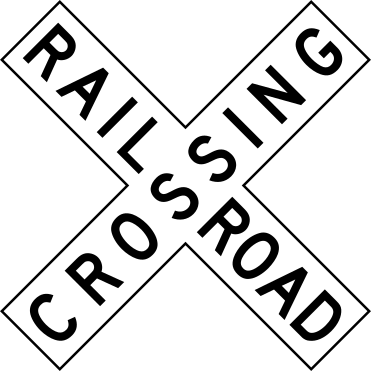
Question 20What is the X-shaped sign mounted at a railroad crossing called?
Show answer
B: A crossbuck. The X-shaped railroad crossing sign at the tracks is called a crossbuck. North Carolina Driver Handbook: Railroad Crossing Safety, page 63.
-
Question 21You are driving through on a green light and a pedestrian starts to cross in your path against the red. What should you do first?
Show answer
A: Give a warning with your horn. The handbook says to give a warning with your horn; if the pedestrian does not stop, you must stop. Saving a life is worth the lost right of way. North Carolina Driver Handbook: The Driver and Pedestrian, page 49.
-
Question 22Bicycle riders and passengers under what age must wear an approved bicycle helmet in North Carolina?
Show answer
C: 16. All bicycle riders and passengers under 16 must wear an approved protective bicycle helmet. North Carolina Driver Handbook: Bicycles: Be Visible, page 92.
-
Question 23Which statement about speed limits is correct?
Show answer
B: You must often drive slower than the posted limit, but you should not drive faster. To drive safely you must often drive slower than the posted limit, but never faster; never drive faster than is reasonable for conditions. North Carolina Driver Handbook: Adjusting Your Speed to Driving Conditions, page 55.
-
Question 24Which is a place where passing is always unsafe and usually illegal?
Show answer
B: At a crosswalk where a vehicle has stopped to let people cross. Passing is unsafe and usually illegal at intersections or crosswalks where a vehicle has stopped to let people cross. North Carolina Driver Handbook: Passing, page 57.
-
Question 25According to the handbook, more than what share of fatal traffic crashes occur at intersections?
Show answer
A: One-third. Intersections are the most dangerous places on the road; more than one-third of fatal crashes occur there. North Carolina Driver Handbook: Special Driving Situations: Intersections, page 59.
Answer every question to see your score.
More North Carolina practice tests
- Practice test 125 questions
- Practice test 225 questions
- Practice test 325 questions
- Practice test 425 questions
- Practice test 525 questions
- Practice test 725 questions
- Practice test 825 questions
- Practice test 925 questions
- Practice test 1025 questions
- Practice test 1125 questions
- Practice test 1225 questions
- Practice test 1325 questions
- Exam simulatorThe real format
How to use these tests
Read each explanation, even when you get the question right: it tells you the rule and the handbook section, so you can look it up. Your answers are saved in this browser only, so the weak spots mode can give you more questions on the topics you miss. When you're scoring well, take the exam simulator: it uses 25 questions at the NCDMV's pass mark, since it doesn't publish the number of questions.
Our own questions, written from the North Carolina Driver Handbook and checked against it. Not affiliated with the North Carolina Division of Motor Vehicles (N.C. Department of Transportation). Found a mistake? Tell us.