North Carolina NCDMV permit practice test 7
25 questions written from the North Carolina Driver Handbook, covering hazards, weather and night driving, emergencies, lanes, highways and freeways, licensing laws and penalties, alcohol and drugs and more. Pick an answer to see straight away whether you're right and why.
-
Question 1When should you avoid using cruise control?
Show answer
A: When it is raining or the road is still wet from rain. Never use cruise control when it is raining or after it has been raining, because it can cost you control if you hydroplane. North Carolina Driver Handbook: Hydroplaning, page 74.
-
Question 2If your car starts to skid, which way should you turn the steering wheel?
Show answer
A: In the direction the rear of the vehicle is skidding. Ease off the accelerator and turn the steering wheel in the direction the rear of the vehicle is skidding, then straighten as it recovers. North Carolina Driver Handbook: Emergencies: Skids, page 79.
-
Question 3On an interstate, which lane(s) should be used for passing?
Show answer
A: The left lane(s). Keep to the right on an interstate and use the left lane(s) for passing. North Carolina Driver Handbook: Interstate Highways, page 66.
-
Question 4With a Level Two Limited Provisional License, when may you drive without supervision?
Show answer
D: From 5 a.m. to 9 p.m., and any time driving directly to or from work. Level Two drivers may drive unsupervised from 5 a.m. until 9 p.m. and at any time when driving directly to or from work or volunteer fire, rescue or EMS service. North Carolina Driver Handbook: Level Two Limited Provisional License, page 15.
-
Question 5Which of these leads to a one-year license revocation under North Carolina's underage alcohol laws?
Show answer
D: Letting an underage person use your license to try to buy alcohol. Anyone who lets their license or ID be used by an underage person to buy or try to buy alcohol faces a one-year revocation. North Carolina Driver Handbook: Alcohol and the Young Driver, page 35.
-
Question 6How fast can an air bag come out of the dashboard in a crash?
Show answer
B: Up to 200 miles per hour. An air bag deploys at up to 200 mph, which is why children and people seated too close to it can be hurt. North Carolina Driver Handbook: Children and Air Bags, page 46.
-
Question 7What should you do at a flashing yellow signal?
Show answer
A: Slow down and proceed with caution. A flashing yellow signal has the same meaning as a warning sign: slow down and proceed with caution. North Carolina Driver Handbook: Flashing Signals, page 83.
-
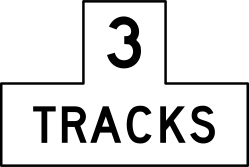
Question 8A smaller sign mounted below a railroad crossbuck tells you:
Show answer
A: That there is more than one track. A sign below the crossbuck indicates if there is more than one track at the crossing. North Carolina Driver Handbook: Railroad Crossing Safety, page 63.
-
Question 9A police car, ambulance or fire truck with flashing lights and siren approaches from behind. What must you do?
Show answer
D: Pull to the right-hand curb or edge of the road and stop. As an emergency vehicle approaches from either direction, drive to the right curb or edge of the road and stop completely until it passes. North Carolina Driver Handbook: Emergency and Law Enforcement Vehicles, page 50.
-
Question 10Which way should bicyclists ride on the road?
Show answer
A: On the right, with the flow of traffic. Bicyclists should ride on the right with the flow of traffic, not against it. North Carolina Driver Handbook: Bicycles: Go with the Flow, page 92.
-
Question 11Driving in a highway work zone faster than the posted work-zone limit:
Show answer
D: Is unlawful, and an extra penalty applies when the penalty is posted on a sign at the start of the zone. It is unlawful to exceed the posted work-zone limit, and an additional penalty applies if a sign at the beginning of the work zone lists it. North Carolina Driver Handbook: Work Zones, page 72.
-
Question 12If another vehicle is following you too closely, what does the handbook suggest?
Show answer
A: Move to another lane and signal for the driver to pass. If someone tailgates you, move to another lane and signal for the driver to pass. North Carolina Driver Handbook: Keeping a Margin of Safety, page 71.
-
Question 13In which direction does traffic travel in a North Carolina roundabout?
Show answer
C: Counterclockwise. All vehicles in a traffic circle or roundabout travel to the right, counterclockwise. North Carolina Driver Handbook: Roundabouts, page 60.
-
Question 14According to the handbook, how much fast-moving water can float a car or turn it over?
Show answer
A: 12 inches. Reports show 6 inches of fast-moving water can sweep a car off the road and 12 inches can float a car or turn it over. North Carolina Driver Handbook: Driving in Flood Conditions, page 75.
-
Question 15If you do NOT have anti-lock brakes and need to slow on a slippery road, what should you do?
Show answer
C: Pump the brakes gently. Without ABS, pump the brakes gently; with ABS, use firm, steady pressure and do not pump. North Carolina Driver Handbook: Emergencies: Skids, page 79.
-
Question 16Why are interstate highways generally safer than other roads?
Show answer
B: They separate opposing traffic and have fewer places to enter and exit. Interstates separate traffic moving in opposite directions, have fewer entry and exit points, and have no railroad crossings, sharp curves, stop signs or signals. North Carolina Driver Handbook: Interstate Highways, page 66.
-
Question 17When driving unsupervised with a Level Two license, how many passengers under 21 who are not household members are normally allowed?
Show answer
C: One. Unsupervised Level Two drivers may carry one passenger under 21 who is not a household member (one more is allowed only when that student is being driven directly to or from school). North Carolina Driver Handbook: Level Two Limited Provisional License, page 15.
-
Question 18What is the only thing that sobers up a person who has been drinking?
Show answer
B: Time. Only time sobers up a drinker; coffee, food and cold showers do not work. North Carolina Driver Handbook: Driver Safety: Alcohol, page 44.
-
Question 19According to the handbook's child safety points, children of what age and under should ride buckled up in a rear seat?
Show answer
B: 12 and under. Children age 12 and under should ride buckled up in a rear seat. North Carolina Driver Handbook: Children and Air Bags: Child Safety Points, page 47.
-
Question 20A ramp meter signal at a freeway entrance is dark. What should you do?
Show answer
D: Proceed without stopping and merge or yield as normal. When the ramp meter is dark you may proceed without stopping and merge onto the freeway as conditions allow. North Carolina Driver Handbook: Ramp Meter Traffic Signals, page 84.
-
Question 21What does a five-sided (pentagon) sign warn of?

Show answer
B: A school zone or school crossing. The pentagon-shaped sign warns of a school zone or school crossing; watch for children. North Carolina Driver Handbook: Traffic Signs: Warning Signs, page 87.
-
Question 22When are you not required to yield to an approaching emergency vehicle in North Carolina?
Show answer
B: When traveling in the opposite direction on a four-lane limited-access highway with a center median. All vehicles must yield to an emergency vehicle, except vehicles traveling the opposite direction on a four-lane limited-access highway with a center median. North Carolina Driver Handbook: Emergency and Law Enforcement Vehicles, page 50.
-
Question 23Why should you be especially careful when turning right where there is a bike lane?
Show answer
C: A bicyclist going straight on your right could be struck by your right turn. Because bicyclists ride to the right of motor vehicle traffic, a crash can occur between a bicyclist going straight and a motorist turning right. North Carolina Driver Handbook: Bicycle Lanes, page 64.
-
Question 24Where does a North Carolina highway work zone begin and end?
Show answer
D: From the first sign marking the start of the work zone to the last sign marking its end. A highway work zone is the area between the first sign indicating its beginning and the last sign indicating its end. North Carolina Driver Handbook: Work Zones, page 72.
-
Question 25In rain, how much following distance does the handbook recommend?
Show answer
A: At least twice the normal following distance. Because stopping distances increase on wet pavement, slow down and allow at least twice the normal following distance. North Carolina Driver Handbook: Rain, page 74.
Answer every question to see your score.
More North Carolina practice tests
- Practice test 125 questions
- Practice test 225 questions
- Practice test 325 questions
- Practice test 425 questions
- Practice test 525 questions
- Practice test 625 questions
- Practice test 825 questions
- Practice test 925 questions
- Practice test 1025 questions
- Practice test 1125 questions
- Practice test 1225 questions
- Practice test 1325 questions
- Exam simulatorThe real format
How to use these tests
Read each explanation, even when you get the question right: it tells you the rule and the handbook section, so you can look it up. Your answers are saved in this browser only, so the weak spots mode can give you more questions on the topics you miss. When you're scoring well, take the exam simulator: it uses 25 questions at the NCDMV's pass mark, since it doesn't publish the number of questions.
Our own questions, written from the North Carolina Driver Handbook and checked against it. Not affiliated with the North Carolina Division of Motor Vehicles (N.C. Department of Transportation). Found a mistake? Tell us.