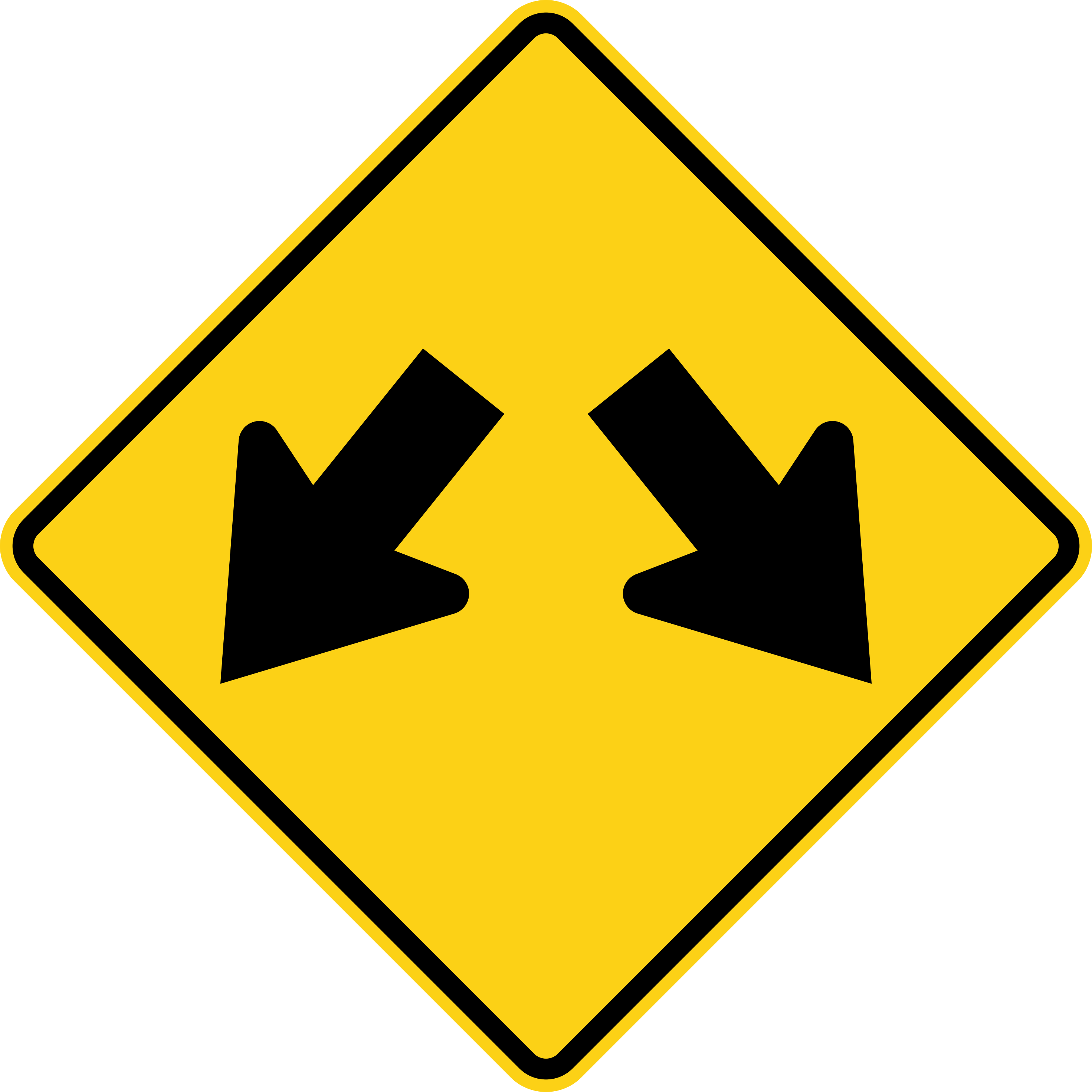
Double Arrow sign
Traffic may pass on either side of an island, obstruction or gore.
What to do
Go to the left or right of the object.
Choose the side that suits where you are going, decide early, and steer clear of the obstruction itself.
Where it's used
Section 2C.23 allows the Double Arrow (W12-1) sign to show that traffic may pass on either side of an island, obstruction or gore, after which the two streams may rejoin or go different ways. It is a black-on-yellow diamond with two arrows angled down to the left and right. On an island it should be mounted near the approach end, and in front of a pier it should be on or just in front of the face of the obstruction.
Don't confuse it with
- Two-Direction Large Arrow: The Two-Direction Large Arrow is a wide rectangle at the end of a T-intersection meaning you must turn, while the Double Arrow diamond means you may pass either side of an obstacle.
- Keep Right: The white Keep Right sign requires you to pass on the right only, while the Double Arrow allows either side.
- Two-Way Traffic: Two-Way Traffic has opposing up and down arrows meaning oncoming traffic, not a choice of sides.
- Type
- Warning signs
- Shape
- Diamond
- Colors
- yellow, black
- MUTCD code
- W12-1
- MUTCD section
- 2C.23
More warning signs
 Turn
 Curve
 Reverse Turn
 Reverse Curve
 Winding Road
 One-Direction Large Arrow
 Two-Direction Large Arrow
 Chevron Alignment
From the Manual on Uniform Traffic Control Devices (MUTCD), 11th edition, section 2C.23. Sign image: public domain, source.