Louisiana OMV permit practice test 2
25 questions written from the Class D & E Driver's Guide, covering lanes, highways and freeways, alcohol and drugs, emergencies, licensing laws and penalties, road signs and more. Pick an answer to see straight away whether you're right and why. The real Louisiana OMV test has 40 questions and you need 32 right.
-
Question 1What size gap do you need to merge onto an interstate?
Show answer
C: 4 seconds. A 4-second gap leaves about 2 seconds of following distance both for you and for the car you merge ahead of. Class D & E Driver's Guide: Space to Merge, page 106.
-
Question 2After an implied-consent refusal, what must you file before reinstatement?
Show answer
B: Proof of future financial responsibility (SR-22) or $30,000 cash or security, kept for 3 years. You must file an SR-22 (high-risk insurance) or $30,000 cash/security and maintain it for three years. Class D & E Driver's Guide: Administrative Per Se, page 131.
-
Question 3Your brakes fail. What should you avoid doing?
Show answer
A: Applying the parking brake suddenly. Don't put on the parking brake suddenly; let the car slow, downshift, then gradually apply the hand brake. Class D & E Driver's Guide: Brakes fail, page 122.
-
Question 4Which Louisiana license class covers a single motor vehicle under 10,001 pounds, such as a passenger car?
Show answer
D: Class E. Class E is the ordinary license for one vehicle under 10,001 pounds; it covers passenger cars, RVs and some farm vehicles. Class D & E Driver's Guide: Classes of License, page 7.
-
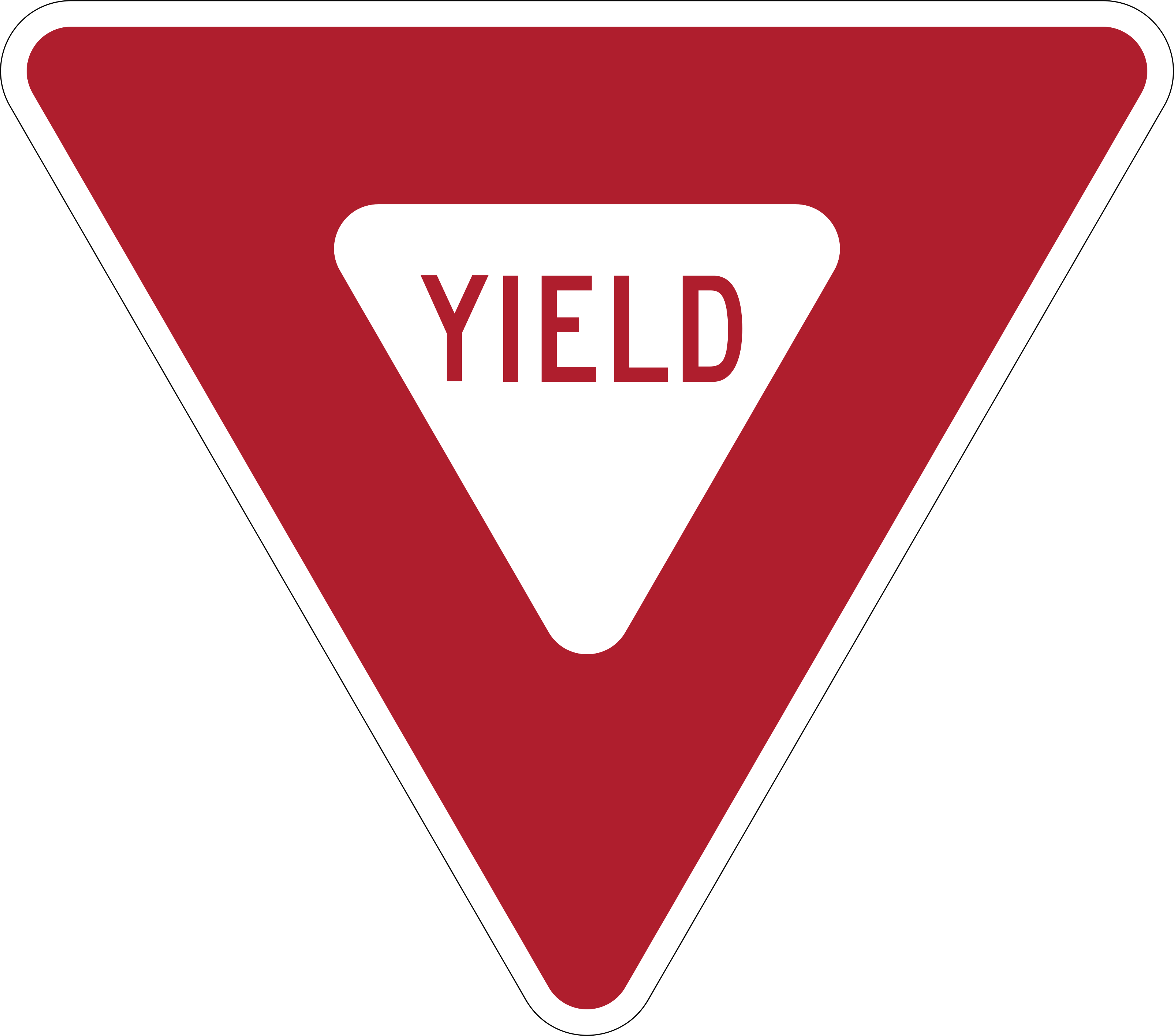
Question 5A triangle sign with the point down means:
Show answer
A: Yield. The downward-pointing triangle is used exclusively for yield signs. Class D & E Driver's Guide: Traffic Signs, page 28.
-
Question 6When facing a green arrow, what should you still watch for?
Show answer
B: Drivers turning right on red from the other side, and pedestrians. Oncoming and crossing traffic should yield, but be careful of others turning right on red and pedestrians. Class D & E Driver's Guide: Traffic Signals, page 38.
-
Question 7Before entering a roundabout, which way must you yield?
Show answer
A: To the left (to traffic already circulating). Look left before you enter: traffic already circulating has priority over entering vehicles. Class D & E Driver's Guide: Roundabouts, page 42.
-
Question 8A flashing DON'T WALK signal means pedestrians:
Show answer
B: May not start to cross, but those already crossing may continue. A flashing DON'T WALK tells pedestrians not to step off the curb; anyone already crossing may finish to the sidewalk, an island or a safety zone. Class D & E Driver's Guide: Pedestrian Safety, page 81.
-
Question 9How should a lap belt be worn?
Show answer
D: Snugly across the hips. Wear the lap belt snug and low across the hips; hip bones can take crash forces better than the abdomen can. Class D & E Driver's Guide: Use of Safety Belts, page 44.
-
Question 10How much following distance should you allow behind a motorcycle?
Show answer
A: At least 4 seconds. Stay at least four seconds behind a motorcycle, more on wet roads, so you have room if the rider falls or stops suddenly. Class D & E Driver's Guide: Sharing the Road with Motorcycles, page 87.
-
Question 11What is the average perception time for an alert driver?
Show answer
C: 3/4 second to 1 second. Average perception time for an alert driver is 3/4 second to 1 second. Class D & E Driver's Guide: Stopping Distances, page 69.
-
Question 12Parking on a hill with no curb, which way should your wheels point?
Show answer
C: Toward the edge of the road, whether uphill or downhill. Without a curb, point the wheels toward the road's edge on both uphill and downhill slopes so the car would roll off the road, not into traffic. Class D & E Driver's Guide: Parking on Hills, page 73.
-
Question 13When two vehicles reach a four-way stop at the same time, who must yield?
Show answer
C: The driver on the left must yield to the vehicle on the right. If two vehicles get to the intersection together, the one on the left gives way to the one on the right. Class D & E Driver's Guide: Right of Way, page 98.
-
Question 14According to the Louisiana guide, a frontal impact at 35 mph compared with 30 mph is:
Show answer
B: One-third more violent. Crash force grows faster than speed: the guide says a head-on impact at 35 mph is a third more violent than at 30 mph. Class D & E Driver's Guide: Speed, page 91.
-
Question 15On an interstate with three or more lanes in one direction, what is the far left lane for?
Show answer
A: Passing. On interstates with three or more lanes each way, the right lane serves entering and exiting traffic, the middle is usually for travel, and the leftmost is for passing. Class D & E Driver's Guide: Right-Hand Lane, page 106.
-
Question 16A driver 21 or older submits to a test showing a BAC of 0.08% to 0.149%. How long is the suspension?
Show answer
B: 180 days. A BAC of 0.08% to 0.149% for drivers 21+ brings a 180-day suspension. Class D & E Driver's Guide: Administrative Per Se, page 131.
-
Question 17Your gas pedal sticks. What should you do first, keeping your eyes on the road?
Show answer
B: Put the gear shift in neutral. Shift to neutral, try to free the pedal, turn off the ignition carefully (don't lock the steering), brake and pull off. Class D & E Driver's Guide: Gas pedal sticks, page 122.
-
Question 18What is the minimum age for a Louisiana Class D (chauffeur's) license?
Show answer
B: 17. Class D requires a minimum age of seventeen. Class D & E Driver's Guide: Age Requirement (R.S. 32:408), page 9.
-
Question 19What does a diamond-shaped orange sign indicate?
Show answer
C: A construction zone. Diamond signs are warning signs; orange diamonds are used in construction zones. Class D & E Driver's Guide: Traffic Signs, page 28.
-
Question 20What does a flashing yellow traffic light mean?
Show answer
C: Slow down, look for traffic entering the intersection and proceed with caution. A flashing yellow means slow down, look for entering traffic and proceed with caution; stop if traffic is in the intersection. Class D & E Driver's Guide: Traffic Signals, page 38.
-
Question 21Once inside a roundabout, you should:
Show answer
D: Never stop; continue to your exit. Don't stop once you are in the roundabout; circulating vehicles have priority, so keep moving to your exit. Class D & E Driver's Guide: Roundabouts, page 42.
-
Question 22A vehicle ahead in the next lane is stopped at a crosswalk. What should you do?
Show answer
D: Do not pass it; be prepared to stop for pedestrians. You should not pass a vehicle stopped at a crosswalk; it may be hiding a crossing pedestrian. Class D & E Driver's Guide: Pedestrian Safety, page 81.
-
Question 23Under Louisiana's child passenger law, children from birth to at least age 2 must ride in:
Show answer
A: A rear-facing car seat. Louisiana's child restraint law calls for a rear-facing, federally approved car seat from birth until at least age 2. Class D & E Driver's Guide: Use of Safety Belts, page 45.
-
Question 24In good conditions, how much following distance should you keep behind a large truck?
Show answer
C: 4-5 seconds. Leave a gap of at least four to five seconds behind a truck, even longer when conditions are poor. Class D & E Driver's Guide: Following trucks, page 89.
-
Question 25At 50 mph, what is the minimum total stopping distance in ideal conditions?
Show answer
C: 268 feet. Counting perception, reaction and braking, a car at 50 mph needs at least 268 feet to stop. Class D & E Driver's Guide: Stopping Distances, page 70.
Answer every question to see your score.
More Louisiana practice tests
- Practice test 125 questions
- Practice test 325 questions
- Practice test 425 questions
- Practice test 525 questions
- Practice test 625 questions
- Practice test 725 questions
- Practice test 825 questions
- Practice test 925 questions
- Practice test 1025 questions
- Practice test 1125 questions
- Practice test 1227 questions
- Exam simulatorThe real format, 40 questions
How to use these tests
Read each explanation, even when you get the question right: it tells you the rule and the handbook section, so you can look it up. Your answers are saved in this browser only, so the weak spots mode can give you more questions on the topics you miss. When you're scoring well, take the exam simulator: it uses the same number of questions and passing score as the real test.
Our own questions, written from the Class D & E Driver's Guide and checked against it. Not affiliated with the Louisiana Office of Motor Vehicles (Department of Public Safety & Corrections, Public Safety Services). Found a mistake? Tell us.