Louisiana OMV permit practice test
25 questions written from the Class D & E Driver's Guide, covering licensing laws and penalties, road signs, signals and pavement markings, turns and intersections, sharing the road and more. Pick an answer to see straight away whether you're right and why. The real Louisiana OMV test has 40 questions and you need 32 right.
-
Question 1How long do new Louisiana residents have to get a Louisiana driver's license?
Show answer
B: 30 days. A new Louisiana resident gets 30 days, counted from when residency begins, to switch to a Louisiana license. Class D & E Driver's Guide: Who Must Have a Driver's License?, page 6.
-
Question 2The octagon shape is used for which sign?

Show answer
B: Stop. The octagon shape is used exclusively for stop signs. Class D & E Driver's Guide: Traffic Signs, page 28.
-
Question 3On a horizontal traffic signal, where is the red light?
Show answer
B: On the left. In horizontal signals, red is on the left, yellow in the middle and green on the right. Class D & E Driver's Guide: Traffic Signals, page 38.
-
Question 4You discover you are in a turn-only lane but want to go straight. What should you do?
Show answer
D: Make the turn, then go around the block. Other drivers won't expect a sudden lane change or stop; make the turn and return by driving around the block. Class D & E Driver's Guide: Lane Markings, page 42.
-
Question 5What does the Louisiana guide say about large trucks and buses in a roundabout or traffic circle?
Show answer
B: Do not drive alongside them. The guide says not to drive next to trucks and buses in a roundabout or traffic circle; a warning sign may tell you to keep away from them. Class D & E Driver's Guide: Roundabouts and Traffic Circles, page 97.
-
Question 6Who must wear safety belts under Louisiana's mandatory belt law?
Show answer
B: All occupants in both front and back seats of cars, vans and pickups. Louisiana's belt law covers everyone riding in a car, van or pickup, in the front seat and in the back. Class D & E Driver's Guide: Use of Safety Belts, page 44.
-
Question 7What basic following-distance rule does the Louisiana guide teach for any speed?
Show answer
D: Three-second rule. The 3-second rule makes judging distance easier and can be used at any speed. Class D & E Driver's Guide: Following Distances, page 70.
-
Question 8At 60 mph, if you can't see at least how far ahead, you are driving too fast for your visibility?
Show answer
C: 400 feet. At 60 mph, if you can't see at least 400 feet ahead, you're driving too fast for your visibility. Class D & E Driver's Guide: Looking and Scanning Ahead, page 67.
-
Question 9Facing downhill next to a curb, how should you turn your wheels?
Show answer
D: Toward the curb. Downhill next to a curb, point the front wheels into the curb and shift to park (or reverse), so the car would roll into the curb if the brakes failed. Class D & E Driver's Guide: Parking on Hills, page 73.
-
Question 10Who must yield at a T intersection?
Show answer
D: Vehicles on the road that ends must yield to vehicles on the through road. At T intersections you must yield to vehicles on the through road. Class D & E Driver's Guide: Right of Way, page 98.
-
Question 11What is Louisiana's General Speed Law?
Show answer
C: Never drive faster than is reasonable for the area, road, traffic, light and weather. Under the General Speed Law, your speed may never be more than is reasonable for the area, road, traffic, light and weather. Class D & E Driver's Guide: Speed, page 92.
-
Question 12When entering an interstate, you should:
Show answer
A: Enter at or near the speed of traffic and merge into a gap. Enter at or near the speed of traffic; don't stop before merging unless absolutely necessary. Interstate traffic has the right of way. Class D & E Driver's Guide: Entering, page 105.
-
Question 13Under Louisiana's Implied Consent law, what happens on a first offense if you refuse a chemical test?
Show answer
B: Your driving privileges are suspended for 365 days. Refusing the test suspends your driving privileges for 365 days on a first offense (730 days for a second or subsequent). Class D & E Driver's Guide: Administrative Per Se, page 131.
-
Question 14One of your tires blows out while you are driving. What should you do?
Show answer
A: Hold the wheel firmly, stay in your lane, let the car slow to around 30 mph, then brake gently. Don't panic or slam on the brakes; hold the wheel, let the car slow to about 30 mph, then brake gently and pull off. Class D & E Driver's Guide: Tire blowout, page 122.
-
Question 15How long may a non-resident with a valid license from another state drive in Louisiana?
Show answer
A: 90 days. Non-residents with a valid license from another state may drive in Louisiana for 90 days. Class D & E Driver's Guide: Who Must Have a Driver's License?, page 6.
-
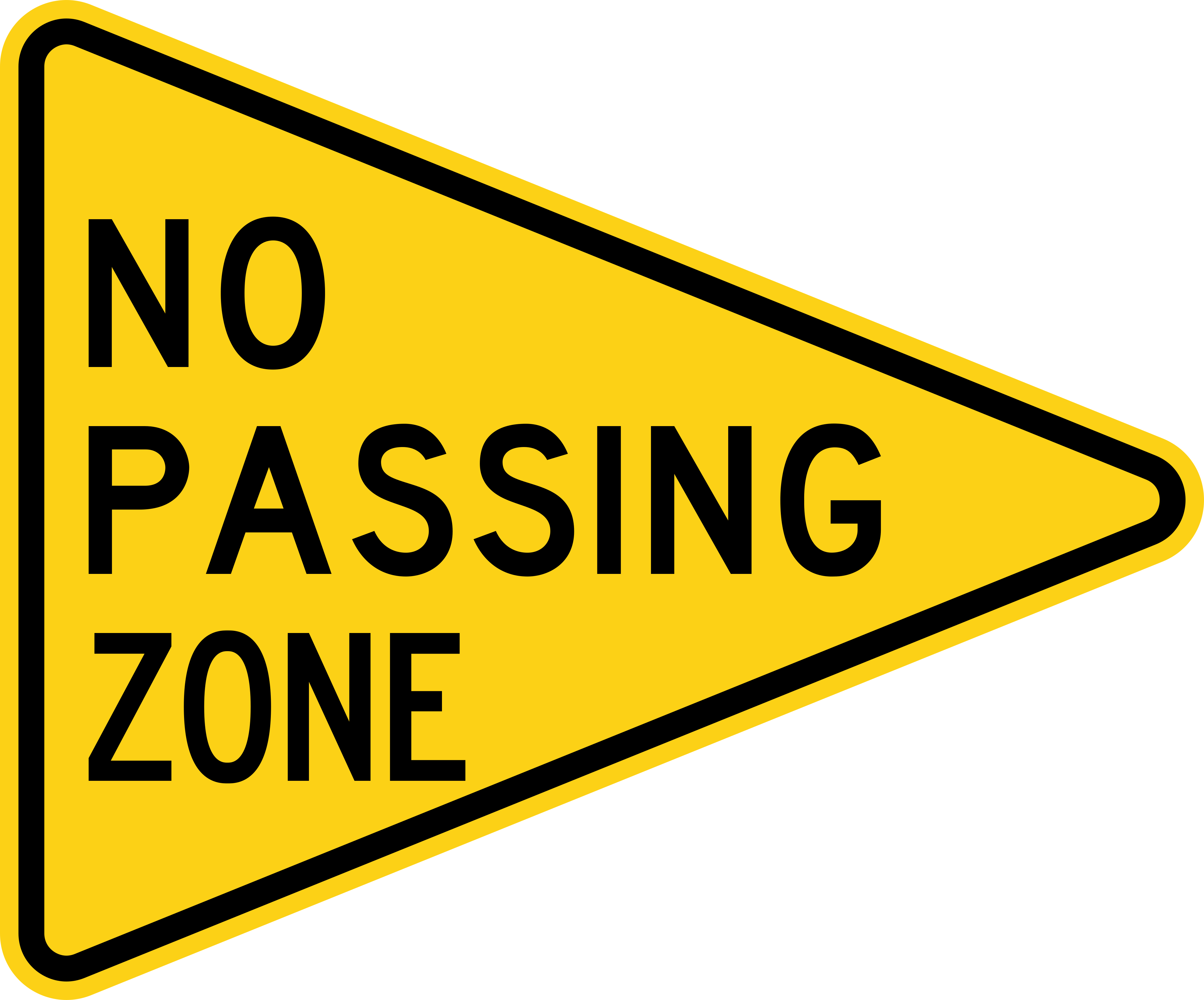
Question 16In Louisiana's guide, what does a triangle-shaped sign with the point sideways indicate?
Show answer
D: No passing zone. The triangle with the point sideways (pennant) indicates a no passing zone. Class D & E Driver's Guide: Traffic Signs, page 28.
-
Question 17You are stopped at a light and it turns green. What must you do before going?
Show answer
C: Allow crossing traffic to clear the intersection. If the light turns green while you are stopped, you must let crossing traffic clear the intersection before you go. Class D & E Driver's Guide: Traffic Signals, page 38.
-
Question 18According to the Louisiana guide's roundabout tips, what speed is adequate inside a roundabout?
Show answer
A: 15 mph or less. The guide says 15 mph or slower is fast enough inside a roundabout. Class D & E Driver's Guide: Roundabouts, page 42.
-
Question 19When must you yield to a pedestrian in Louisiana?
Show answer
B: At all times, even if the pedestrian is jaywalking. You must yield to pedestrians at all times; even if they are jaywalking, you must stop for them. Class D & E Driver's Guide: Pedestrian Safety, page 81.
-
Question 20By about how much do safety belts reduce the risk of serious injury and death?
Show answer
C: 50 percent. The guide says belts cut the risk of serious injury, and of death, by about half (50 percent). Class D & E Driver's Guide: Use of Safety Belts, page 44.
-
Question 21When should you increase your following distance to four seconds?
Show answer
C: In bad weather, on wet pavement, behind motorcycles, when pulling a trailer or in low visibility. Use four seconds on slippery roads, wet pavement, behind motorcycles, when towing, in low visibility, and similar situations. Class D & E Driver's Guide: Following Distances, page 71.
-
Question 22About how far does it take to react and stop from 60 mph on dry pavement?
Show answer
C: 359 feet. On dry pavement, reacting and braking from 60 mph takes roughly 4 to 5 seconds and about 359 feet. Class D & E Driver's Guide: Looking and Scanning Ahead, page 67.
-
Question 23Facing uphill next to a curb, how should you turn your wheels?
Show answer
C: Away from the curb. Uphill next to a curb, point the front wheels away from the curb and shift to park (or low gear), so the tires catch the curb if the car rolls back. Class D & E Driver's Guide: Parking on Hills, page 73.
-
Question 24When turning left at an intersection, whom must you yield to?
Show answer
C: Oncoming traffic, including bicyclists. A left-turning driver must let oncoming traffic, bicyclists included, go first. Class D & E Driver's Guide: Right of Way, page 98.
-
Question 25Can you be cited for driving too fast for conditions even when under the posted limit?
Show answer
A: Yes; speed limits are posted for ideal conditions. Speed limits are for ideal conditions; driving 55 mph in a snowstorm is not acceptable even if 55 is posted. Class D & E Driver's Guide: Speed, page 91.
Answer every question to see your score.
More Louisiana practice tests
- Practice test 225 questions
- Practice test 325 questions
- Practice test 425 questions
- Practice test 525 questions
- Practice test 625 questions
- Practice test 725 questions
- Practice test 825 questions
- Practice test 925 questions
- Practice test 1025 questions
- Practice test 1125 questions
- Practice test 1227 questions
- Exam simulatorThe real format, 40 questions
How to use these tests
Read each explanation, even when you get the question right: it tells you the rule and the handbook section, so you can look it up. Your answers are saved in this browser only, so the weak spots mode can give you more questions on the topics you miss. When you're scoring well, take the exam simulator: it uses the same number of questions and passing score as the real test.
Our own questions, written from the Class D & E Driver's Guide and checked against it. Not affiliated with the Louisiana Office of Motor Vehicles (Department of Public Safety & Corrections, Public Safety Services). Found a mistake? Tell us.