Louisiana OMV permit practice test 8
25 questions written from the Class D & E Driver's Guide, covering road signs, signals and pavement markings, sharing the road, safe and defensive driving, following and passing and more. Pick an answer to see straight away whether you're right and why. The real Louisiana OMV test has 40 questions and you need 32 right.
-
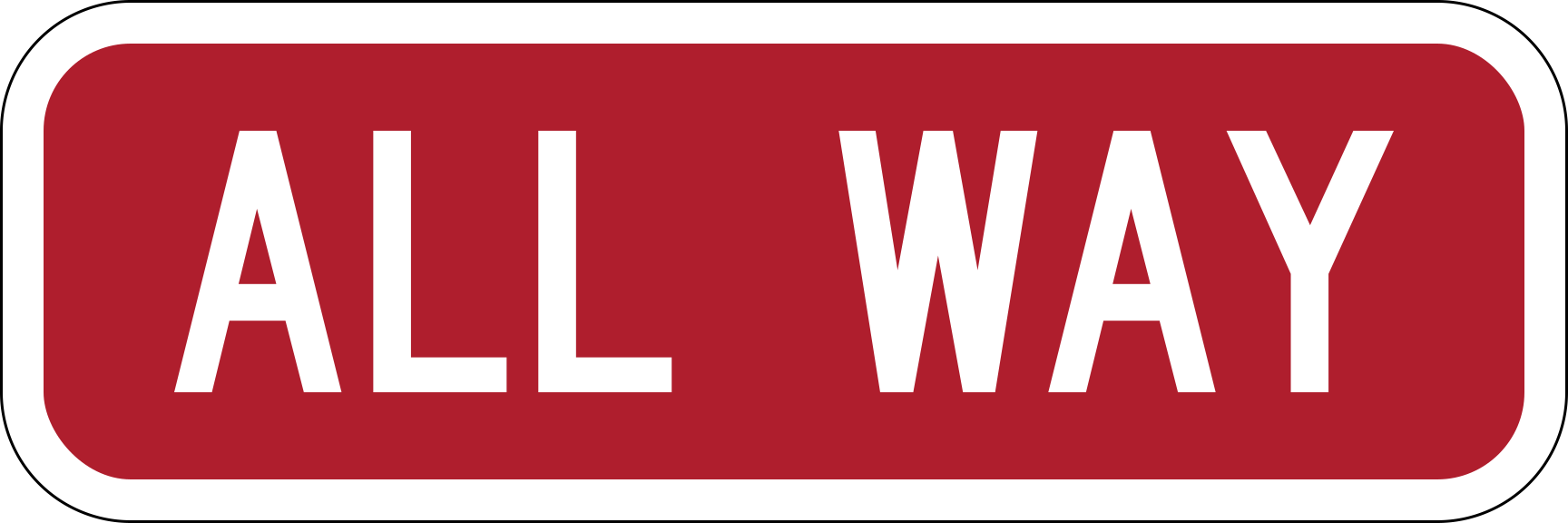
Question 1What does an 'ALL-WAY' (or '4-WAY') plaque under a stop sign mean?
Show answer
A: All approaching traffic at the intersection has a stop sign. The plaque tells you that every approach to the intersection has a stop sign; 3-WAY, 4-WAY and 5-WAY versions are also used. Class D & E Driver's Guide: Traffic Signs, page 32.
-
Question 2What do red raised pavement markers or reflectors facing you mean?
Show answer
B: You are going against the direction of travel; do not enter. Red raised markers indicate going against the direction of travel on a roadway that must not be entered. Class D & E Driver's Guide: Lane Markings, page 40.
-
Question 3Should you share a lane with a motorcycle?
Show answer
B: No; motorcycles are allowed the full width of a lane. Motorcycles are allowed the full lane width; sharing a lane restricts the rider's ability to avoid hazards. Class D & E Driver's Guide: Sharing the Road with Motorcycles, page 87.
-
Question 4When you stop behind another vehicle, how far back should you be?
Show answer
C: Far enough to see the bottom of its tires. Leave enough room when you stop that the bottom of the tires of the car ahead is still in view. Class D & E Driver's Guide: Starting and Stopping, page 51.
-
Question 5If you can't see at least how far ahead, you should not attempt to pass?
Show answer
C: A quarter mile. The guide says not to try a pass unless you can see at least a quarter mile ahead. Class D & E Driver's Guide: Lane Changing, page 93.
-
Question 6Fog is so dense you can't see. What does the guide advise?
Show answer
B: Don't drive; if you must, slow down and get off the highway at the nearest place. If fog impairs your vision, don't drive; creeping along at 10-20 mph on the highway risks your life. Class D & E Driver's Guide: Weather Changes, page 111.
-
Question 7When parallel parked, how close may your bumpers be to the other vehicles (unless otherwise marked)?
Show answer
D: No closer than two feet. Unless markings say otherwise, leave at least two feet between your bumpers and the cars in front and behind. Class D & E Driver's Guide: Parallel Parking, page 74.
-
Question 8A third DWI conviction in Louisiana is:
Show answer
D: A felony with 1-5 years in prison and loss of license for three years. A 3rd DWI is a felony with 1-5 years' prison (30 days mandatory), a $2,100 fine, 3-year license loss and possible vehicle seizure. Class D & E Driver's Guide: Penalty for Driving While Intoxicated (DWI), page 129.
-
Question 9When passing a parked emergency vehicle on a highway with two or more lanes in your direction, Louisiana law requires you to:
Show answer
C: Move into a lane not adjacent to it if safe; if not possible, slow to a reasonably safe speed. Change to a lane not adjacent to the parked emergency vehicle if possible; otherwise slow to a reasonably safe speed. Class D & E Driver's Guide: Approach of an Authorized Emergency Vehicle, page 126.
-
Question 10An applicant 18 or older who never entered the graduated program can get a full Class E license or permit after completing:
Show answer
A: A 38-hour driver's education course, or a 6-hour pre-licensing course plus 8 hours behind the wheel. Adults 18+ may apply after a 38-hour driver's education course or a 6-hour pre-licensing course and an 8-hour behind-the-wheel course. Class D & E Driver's Guide: Stage 3: Full License, page 12.
-
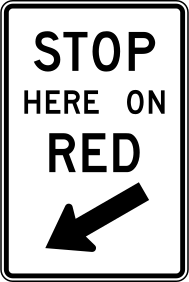
Question 11A 'Stop Here on Red' sign tells you:
Show answer
B: Where to stop when the light is red. It shows where you must stop when the light is red; without a NO TURN ON RED sign, you may then turn right after stopping and checking. Class D & E Driver's Guide: Traffic Signs, page 33.
-
Question 12How are railroad crossings marked on the pavement?
Show answer
B: With a large X and two R's. Railroad crossing markings are a large X and two R's, with a solid yellow center line to prevent passing and a white stop line. Class D & E Driver's Guide: Lane Markings, page 40.
-
Question 13Where are car-motorcycle collisions most likely to occur?
Show answer
C: At intersections. Most car-motorcycle crashes happen at intersections, usually because the driver fails to see the motorcycle and turns across its path. Class D & E Driver's Guide: Sharing the Road with Motorcycles, page 87.
-
Question 14When backing up, you should:
Show answer
B: Turn your head and look back. When you back up, turn your head and look back; don't just look into the rearview mirror. Class D & E Driver's Guide: Starting and Stopping, page 51.
-
Question 15What size gap should you look for when changing lanes?
Show answer
C: 4 to 5 seconds. Find a gap of 4 to 5 seconds, signal, check again, adjust your speed and steer smoothly into the new lane. Class D & E Driver's Guide: Looking and Scanning Ahead, page 68.
-
Question 16When are animals such as deer most active?
Show answer
A: Dusk and dawn, especially October through December. Wildlife is more active at dusk and dawn, and between October and December. Class D & E Driver's Guide: Animals, page 109.
-
Question 17When backing out of an angle parking space, which way does the front of your car swing?
Show answer
C: Opposite to the direction of your turn. Remember that the front of your car swings opposite to the direction of your turn. Class D & E Driver's Guide: Angle Parking, page 74.
-
Question 18After a DWI conviction, for how long must proof of future financial responsibility be maintained?
Show answer
C: Three years. After a DWI conviction you must file proof of future financial responsibility and keep it for three years from the conviction date. Class D & E Driver's Guide: Penalty for Driving While Intoxicated (DWI), page 130.
-
Question 19What must a Louisiana insurance card show to be acceptable to law enforcement?
Show answer
A: Company name, policy number, effective dates, vehicle description, insured's name and the NAIC number. Acceptable proof includes the company, policy number, effective dates, vehicle, insured party and NAIC number; the card must be in the vehicle at all times. Class D & E Driver's Guide: Proof of Insurance, page 12.
-
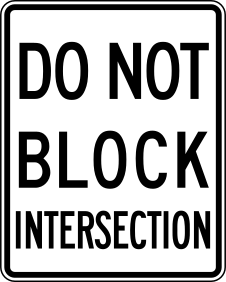
Question 20What does a 'Do Not Block Intersection' sign require?
Show answer
D: Don't stop, stand or park in the intersection and don't enter if you can't clear it. You must not enter an intersection if traffic conditions don't permit you to clear it completely. Class D & E Driver's Guide: Traffic Signs, page 33.
-
Question 21Under Louisiana law, which lane should vehicles generally travel in?
Show answer
A: The right-hand lane, except when preparing for a left turn, passing, or when right lanes are congested. Louisiana law expects you to keep right except to pass, to get ready for a left turn, or when the right lanes are congested; slower traffic belongs in the right lane. Class D & E Driver's Guide: Lane Markings, page 40.
-
Question 22About how far does a loaded tractor-trailer at 55 mph on a dry road need to stop, according to the Louisiana guide?
Show answer
D: At least 290 feet. A loaded tractor trailer at 55 mph on a clear, dry road requires a minimum of 290 feet to stop. Class D & E Driver's Guide: Sharing the Road with Big Trucks, page 88.
-
Question 23Above about what speed is hand-to-hand (push/pull) steering used during normal forward driving?
Show answer
B: 10-15 mph. Use hand-to-hand steering when turning the wheel during normal driving going forward above 10-15 mph. Class D & E Driver's Guide: Steering Methods, page 54.
-
Question 24A deer suddenly runs in front of you and you can't stop. What does the guide recommend?
Show answer
C: Don't swerve; keep control and stay on the roadway. Do not swerve into oncoming traffic or off the road; the safest choice may be hitting the animal while keeping control. Class D & E Driver's Guide: Animals, page 109.
-
Question 25You see a driver you believe is drunk. What should you do?
Show answer
C: Stay away, note the plate if safe, then pull over and call 911. Stay away, don't signal the driver to pull over, note details safely, then pull over and call 911. Class D & E Driver's Guide: Penalty for Driving While Intoxicated (DWI), page 130.
Answer every question to see your score.
More Louisiana practice tests
- Practice test 125 questions
- Practice test 225 questions
- Practice test 325 questions
- Practice test 425 questions
- Practice test 525 questions
- Practice test 625 questions
- Practice test 725 questions
- Practice test 925 questions
- Practice test 1025 questions
- Practice test 1125 questions
- Practice test 1227 questions
- Exam simulatorThe real format, 40 questions
How to use these tests
Read each explanation, even when you get the question right: it tells you the rule and the handbook section, so you can look it up. Your answers are saved in this browser only, so the weak spots mode can give you more questions on the topics you miss. When you're scoring well, take the exam simulator: it uses the same number of questions and passing score as the real test.
Our own questions, written from the Class D & E Driver's Guide and checked against it. Not affiliated with the Louisiana Office of Motor Vehicles (Department of Public Safety & Corrections, Public Safety Services). Found a mistake? Tell us.