Oregon DMV permit practice test 14
17 questions written from the Oregon Driver Manual, covering road signs, sharing the road. Pick an answer to see straight away whether you're right and why. The real Oregon DMV test has 35 questions and you need 28 right.
-
Question 1A black-and-white electronic sign reads SPEED LIMIT 45 because of low visibility. How is it enforced?
Show answer
C: Police may enforce it like any other speed limit sign. Variable speed limit signs are black and white and change the legal limit for conditions. Police enforce them like any other speed limit sign. Oregon Driver Manual: Variable Speed Signs, page 20.
-
Question 2How can you recognize the SLOW MOVING VEHICLE emblem on farm equipment?
Show answer
D: An emblem with a fluorescent orange center and a reflective red border. The slow moving vehicle emblem has a reflective red border and fluorescent orange center. Be prepared to slow down. Oregon Driver Manual: Other Vehicles: Slow Moving Vehicles, page 56.
-
Question 3A load extends 4 feet or more beyond the rear of a vehicle. What must be displayed in daylight?
Show answer
B: A red flag at least 12 inches square. A red flag at least 12 inches square must be shown at the end of loads extending 4 feet or more; a red light visible 500 feet is needed in limited visibility. Oregon Driver Manual: Over-Length and Over-Width Loads, page 56.
-
Question 4How far may a load extend beyond the right fenders of a passenger vehicle?
Show answer
C: No more than 6 inches. Loads may not extend beyond the left fenders at all and no more than 6 inches beyond the right fenders. Oregon Driver Manual: Over-Length and Over-Width Loads, page 56.
-
Question 5On a road with two or more lanes in your direction, you approach a vehicle stopped on the shoulder with its lights flashing. What does Oregon law require?
Show answer
C: Change lanes so you are not next to it, or slow to at least 5 mph under the posted limit. Change lanes away from any stopped vehicle with flashing lights; you may instead slow by at least 5 mph under the limit and give as much room as possible. Oregon Driver Manual: Approaching Stopped Vehicles, page 57.
-
Question 6Under Oregon's rule for stopped vehicles with flashing lights, which vehicles does it cover?
Show answer
B: Any motor vehicle stopped with lights flashing. The manual says the rule applies when you approach any motor vehicle that is stopped with lights flashing. Oregon Driver Manual: Approaching Stopped Vehicles, page 57.
-
Question 7At an emergency scene, may you drive over a fire hose?
Show answer
A: No, unless officials at the scene tell you to. Do not drive over fire hoses unless told to by officials at the scene. Oregon Driver Manual: Approaching Stopped Vehicles, page 57.
-
Question 8What color are the traffic control devices that define work zones?
Show answer
B: Orange. Work zones are defined by orange traffic control devices; orange signs warn you and orange cones guide you. Oregon Driver Manual: Work Zones, page 59.
-
Question 9An automated flagger device in a work zone shows a red light and its arm is down. What do you do?
Show answer
A: Stop. Stop when the red light is on and the arm is down; proceed when the yellow light flashes and the arm is up. Oregon Driver Manual: Work Zones, page 59.
-
Question 10A construction vehicle pulls into your lane ahead in a work zone. What does the manual say about following it?
Show answer
B: Do not follow construction vehicles in a work zone. Do not follow construction vehicles when in a work zone; they may enter the road and cause slowing. Oregon Driver Manual: Work Zones, page 60.
-
Question 11Which vehicles must stop at all railroad crossings, so you should be ready to stop behind them?
Show answer
D: School buses, hazmat vehicles and some school activity vehicles. All school buses, hazmat vehicles and some school activity vehicles must stop at railroad tracks. Oregon Driver Manual: Railroad Crossings, page 63.
-
Question 12If you must stop at a railroad crossing and there is no stop line, how far from the nearest rail must you stop?
Show answer
D: At least 15 feet. When required to stop at a crossing with no stop line, stop at least 15 feet from the nearest rail. Oregon Driver Manual: Railroad Crossings, page 64.
-
Question 13A railroad crossing has a STOP sign but no train is in sight. What must you do?
Show answer
A: Stop, even if you do not see a train coming. You must stop before railroad tracks when a stop sign is posted, even if no train is coming. Oregon Driver Manual: Railroad Crossings, page 64.
-
Question 14The crossing gate is rising after a train passes. May you drive around it?
Show answer
D: No, it is illegal to drive around or under a gate while it is down, rising or lowering. It is against the law to drive around or under a crossing gate while it is down or being raised or lowered. Oregon Driver Manual: Railroad Crossings, page 64.
-
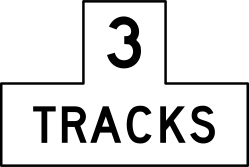
Question 15A railroad crossbuck with more than one track has what below it?
Show answer
B: A sign showing the number of tracks. If there is more than one track, a sign below the crossbuck shows the number of tracks. Oregon Driver Manual: Railroad Crossings, page 63.
-
Question 16A streetcar in the lane next to you is stopped. You want to turn right in front of it. What should you do?
Show answer
D: Never turn in front of a streetcar traveling your direction from an adjacent lane, even if stopped. Never turn in front of a streetcar or train traveling in your direction from an adjacent lane, even if it is stopped. Oregon Driver Manual: Travelling Around Streetcars & Light Rail Trains, page 66.
-
Question 17A person on horseback raises a hand as you approach. What does that mean?
Show answer
A: The animal is frightened; stop unless stopping would cause a collision. A raised hand means the animal is frightened. Stop unless that would cause a collision, and avoid using your horn. Oregon Driver Manual: Animals, page 75.
Answer every question to see your score.
More Oregon practice tests
- Practice test 125 questions
- Practice test 225 questions
- Practice test 325 questions
- Practice test 425 questions
- Practice test 525 questions
- Practice test 625 questions
- Practice test 725 questions
- Practice test 825 questions
- Practice test 925 questions
- Practice test 1025 questions
- Practice test 1125 questions
- Practice test 1225 questions
- Practice test 1325 questions
- Exam simulatorThe real format, 35 questions
How to use these tests
Read each explanation, even when you get the question right: it tells you the rule and the handbook section, so you can look it up. Your answers are saved in this browser only, so the weak spots mode can give you more questions on the topics you miss. When you're scoring well, take the exam simulator: it uses the same number of questions and passing score as the real test.
Our own questions, written from the Oregon Driver Manual and checked against it. Not affiliated with the Oregon Department of Transportation, Driver and Motor Vehicle Services (Oregon DMV). Found a mistake? Tell us.