Oregon DMV permit practice test
25 questions written from the Oregon Driver Manual, covering road signs, signals and pavement markings, speed limits, following and passing, lanes, highways and freeways and more. Pick an answer to see straight away whether you're right and why. The real Oregon DMV test has 35 questions and you need 28 right.
-
Question 1What must you do at a red octagonal STOP sign?

Show answer
C: Come to a complete stop, yield, and go when it is safe. The octagon means a complete stop. You then yield to other vehicles and pedestrians and enter only when it is safe. Oregon Driver Manual: Regulatory Signs—Prohibitive: Stop – Octagon, page 7.
-
Question 2A traffic signal is completely dark because of a power failure. What should you do?
Show answer
A: Stop as if there were stop signs in all directions. A dark signal is treated like stop signs in every direction: stop, then go when it is safe. Oregon Driver Manual: Traffic Signals, page 15.
-
Question 3Oregon's basic rule law says you must:
Show answer
B: Drive at a speed that is reasonable and cautious for existing conditions. The basic rule requires a reasonable and cautious speed for existing conditions, on all roads at all times. Oregon Driver Manual: The Basic Rule Law, page 20.
-
Question 4How does the Oregon Driver Manual define a safe following distance?
Show answer
A: 2-4 seconds, and 4 seconds or more above 30 mph. A safe following distance is 2-4 seconds; above 30 mph it should be 4 seconds or more. Oregon Driver Manual: Maintaining a Space Cushion: Following Distance, page 26.
-
Question 5When does Oregon allow you to drive to the left of the center of the road?
Show answer
C: When passing, avoiding an obstruction, on a one-way road, using a center passing lane on a three-lane road, or when directed. Drive on the right except in the listed cases such as passing, going around an obstruction, one-way roads, three-lane roads with a center passing lane, or when directed. Oregon Driver Manual: Lane Travel, page 18.
-
Question 6When moving in traffic, how far before a turn or lane change must you signal in Oregon?
Show answer
D: At least 100 feet. Use your turn signal at least 100 feet before turning or changing lanes when moving in traffic. Oregon Driver Manual: Turn Signals, page 38.
-
Question 7At a four-way stop, two drivers arrive at the same time. If in doubt, who should go first?
Show answer
B: The driver on the right. It's common courtesy to let the driver who stopped first go first; when in doubt, yield to the driver on your right. Oregon Driver Manual: Intersections, page 42.
-
Question 8In Oregon, who counts as a pedestrian?
Show answer
B: People walking, and people rolling with skateboards, scooters, wheelchairs and similar devices. The term pedestrian refers to people walking and rolling with skateboards, scooters, wheelchairs and similar devices. Oregon Driver Manual: Pedestrians, page 46.
-
Question 9Your car stalls on railroad tracks. What should you do first?
Show answer
C: Get out of the vehicle and away from the tracks. Get out of the vehicle and away from the tracks even if you do not see a train, then use the ENS sign to call the railroad if safe. Oregon Driver Manual: Railroad Crossings, page 64.
-
Question 10Where should you park on a street with streetcar tracks and no white line?
Show answer
C: As close to the curb as possible, away from the rails. Never park on tracks. Park behind the solid white line, or if there is none, as close to the curb as possible away from the rails. Oregon Driver Manual: Travelling Around Streetcars & Light Rail Trains, page 65.
-
Question 11Who must wear a safety belt in Oregon?
Show answer
A: All drivers and passengers in all available seating positions. Safety belt use is mandatory for all drivers and passengers in all seating positions. Oregon Driver Manual: Safety Belts, page 73.
-
Question 12When must headlights be on in Oregon?
Show answer
A: From sunset to sunrise and when you cannot see people or vehicles 1,000 feet ahead. Headlights must be on from sunset to sunrise and any time conditions make it hard to see people or vehicles 1,000 feet ahead. Oregon Driver Manual: Hazardous Conditions: Using Lights, page 76.
-
Question 13At what blood alcohol concentration does Oregon law presume a driver 21 or older is impaired?
Show answer
D: 0.08%. At a BAC of 0.08% or more Oregon law presumes impairment, but you can be arrested for DUII at a lower BAC. Oregon Driver Manual: Impaired Driving, page 82.
-
Question 14How many questions are on Oregon's Class C knowledge test, and how many must you answer correctly?
Show answer
D: 35 questions, 28 correct. The Class C knowledge test has 35 multiple-choice questions; you must answer 28 correctly to pass. Oregon Driver Manual: Knowledge Tests: Class C Knowledge Test, page 2.
-
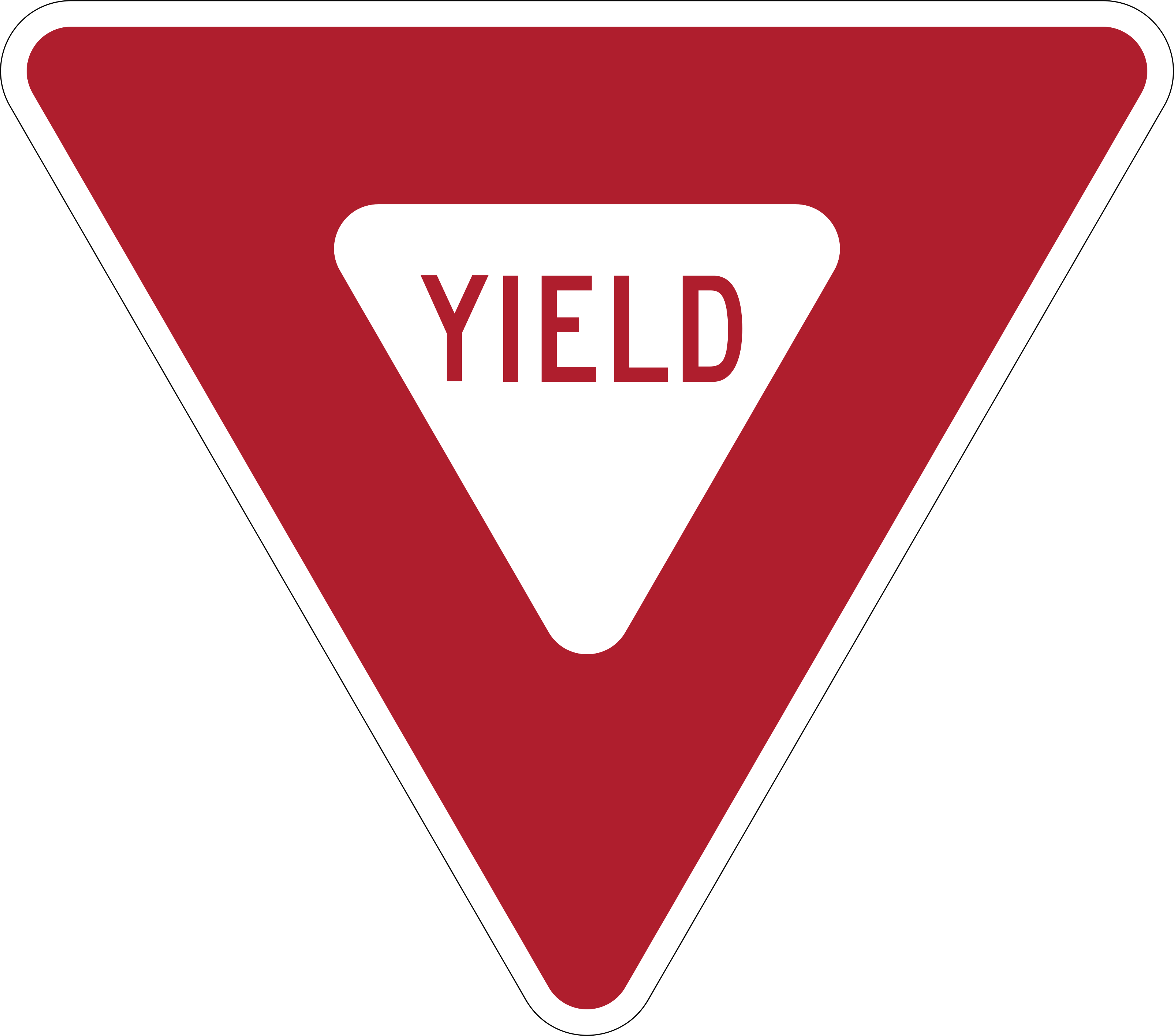
Question 15A triangular YIELD sign tells you to:
Show answer
C: Reduce speed and yield the right of way, stopping if needed. At a yield sign you slow down and give the right of way; if necessary you stop just as you would at a stop sign. Oregon Driver Manual: Regulatory Signs—Prohibitive: Yield – Triangle, page 7.
-
Question 16A flashing red traffic signal means:
Show answer
D: Treat it the same as a stop sign. A flashing red or dark signal is treated the same as a stop sign. Oregon Driver Manual: Traffic Signals: Flashing Red or Dark Signal, page 15.
-
Question 17You are driving 50 mph in a 55 mph zone in heavy fog. Could you be violating the basic rule?
Show answer
C: Yes, if 50 mph is unsafe for the conditions. Driving at a speed that is unsafe for conditions violates the basic rule even when it is below the speed limit. Oregon Driver Manual: The Basic Rule Law, page 21.
-
Question 18At speeds greater than 30 mph, what following distance does the Oregon manual recommend?
Show answer
B: 4 seconds or more. For speeds greater than 30 mph a safe following distance should be 4 seconds or more. Oregon Driver Manual: Maintaining a Space Cushion: Following Distance, page 26.
-
Question 19On a road with no center line and traffic in both directions, how much of the road must you give oncoming traffic?
Show answer
C: At least half. Drivers must give at least half the road to oncoming traffic. Oregon Driver Manual: Lane Travel, page 18.
-
Question 20When must you signal in Oregon?
Show answer
C: Before you turn, change lanes, exit a roundabout, or pull away from a curb. You must signal before turning, changing lanes, exiting a roundabout or pulling away from a curb. Oregon Driver Manual: Turn Signals, page 38.
-
Question 21At an intersection with two-way stop signs facing each other, you are turning left and the opposite driver is going straight. Who should yield?
Show answer
C: You, the driver turning left. The driver turning left should yield to approaching or oncoming traffic going straight. Oregon Driver Manual: Intersections, page 42.
-
Question 22When is a pedestrian considered to be crossing the road?
Show answer
D: When any part or extension of them (cane, wheelchair, bicycle) moves onto the road. A pedestrian is crossing when any part or extension, like a cane or wheelchair, moves onto the road. Oregon Driver Manual: Pedestrians, page 46.
-
Question 23Your vehicle is stuck on the tracks and a train is coming. Which way should you move?
Show answer
A: Move away from the tracks at a 45-degree angle, in the direction of the train. If a train approaches, move away at a 45-degree angle from the tracks in the direction of the train so you are not hit by flying debris. Oregon Driver Manual: Railroad Crossings, page 64.
-
Question 24When parallel parking, how close to the curb must your wheels be?
Show answer
C: No more than 12 inches. Park parallel to and no more than 12 inches from the curb. Oregon Driver Manual: Parallel Parking, page 68.
-
Question 25How long must a child ride in an approved child safety seat in Oregon?
Show answer
A: Until age 8 or 4 feet 9 inches tall and the adult belt fits correctly. Children must be restrained in child safety seats until age 8 or at least 4 feet 9 inches tall with a correctly fitting adult belt. Oregon Driver Manual: Safety Belts, page 74.
Answer every question to see your score.
More Oregon practice tests
- Practice test 225 questions
- Practice test 325 questions
- Practice test 425 questions
- Practice test 525 questions
- Practice test 625 questions
- Practice test 725 questions
- Practice test 825 questions
- Practice test 925 questions
- Practice test 1025 questions
- Practice test 1125 questions
- Practice test 1225 questions
- Practice test 1325 questions
- Practice test 1417 questions
- Exam simulatorThe real format, 35 questions
How to use these tests
Read each explanation, even when you get the question right: it tells you the rule and the handbook section, so you can look it up. Your answers are saved in this browser only, so the weak spots mode can give you more questions on the topics you miss. When you're scoring well, take the exam simulator: it uses the same number of questions and passing score as the real test.
Our own questions, written from the Oregon Driver Manual and checked against it. Not affiliated with the Oregon Department of Transportation, Driver and Motor Vehicle Services (Oregon DMV). Found a mistake? Tell us.