Parallel Track Crossing sign
Used on a road running parallel to the tracks to warn that a turn onto the side road leads quickly to a railroad crossing.
What to do
If you turn here, be ready to stop at the tracks soon after the turn.
If you turn here, slow down for the turn and be ready to stop almost immediately for the tracks.
W10-3 and W10-4 show other layouts.
Where it's used
Section 8B.06 requires a W10-2, W10-3 or W10-4 sign on each approach of a road that runs parallel to the tracks when the nearest rail is less than 100 feet from its edge, to warn drivers turning off that a crossing comes right after the turn. It is a black-on-yellow diamond showing the road, the side road and the track, and it is placed using the intersection warning distances for through traffic. If the tracks are 100 feet or more away, a normal W10-1 sign is used instead.
Don't confuse it with
- Railroad Crossing Ahead: The round W10-1 sign warns of a crossing on your own road ahead, while this diamond warns of a crossing just after a turn.
- Side Road: The plain Side Road sign shows a side road but no railroad track.

- Type
- Railroad crossing signs
- Shape
- Diamond
- Colors
- yellow, black
- MUTCD code
- W10-2
- MUTCD section
- 8B.06
On state permit tests
Our questions for 1 state ask about this sign, including Pennsylvania.
Test yourself
An Advanced Intersection/Railroad Crossing sign warns that: (Pennsylvania practice test)
- Trains have the right-of-way at all intersections
- The intersecting road has a railroad crossing very close to the intersection
- A train station is ahead
- Railroad crossing ahead has gates
Show answer
The intersecting road has a railroad crossing very close to the intersection. The intersecting road has a railroad crossing within a very short distance; be prepared to stop if you turn and a train approaches.
More railroad crossing signs
 Railroad Crossing (Crossbuck)
 Number of Tracks plaque
 Railroad Crossing Ahead
 Low Ground Clearance Crossing
 No Gates or Lights plaque
 No Train Horn
 Do Not Stop on Tracks
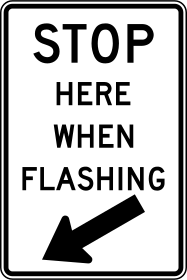 Stop Here When Flashing
From the Manual on Uniform Traffic Control Devices (MUTCD), 11th edition, section 8B.06. Sign image: public domain, source.