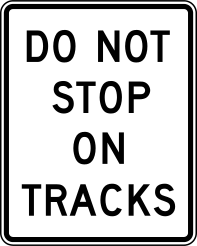
Do Not Stop on Tracks sign
Used where traffic queues could back up onto the tracks.
What to do
Never stop on the tracks. Wait before the crossing until there is room on the other side.
Before you start across, make sure there is room for your whole vehicle on the far side of the tracks.
Where it's used
Section 8B.07 says a DO NOT STOP ON TRACKS (R8-8) sign should be used where vehicle queues are likely to back up onto the tracks, such as where a STOP sign, signal or roundabout lies just beyond the crossing. It is a vertical black-on-white regulatory sign (24 x 30 inches), normally on the right on the near or far side of the crossing, whichever is more visible. It may be placed on both sides of the track and on the left side of divided or one-way roads.
Don't confuse it with
- Do Not Block Intersection: DO NOT BLOCK INTERSECTION applies to a road intersection, while this sign applies to railroad tracks.
- Stop Here When Flashing: STOP HERE WHEN FLASHING shows where to stop when the crossing lights flash; this sign forbids stopping on the tracks at any time.
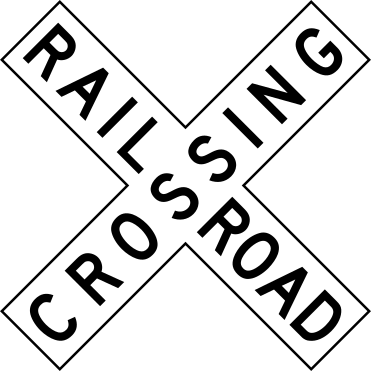
- Railroad Crossing (Crossbuck): The Crossbuck marks the crossing and requires yielding to trains.
- Type
- Railroad crossing signs
- Shape
- Vertical rectangle
- Colors
- white, black
- MUTCD code
- R8-8
- MUTCD section
- 8B.07
On state permit tests
Our questions for 1 state ask about this sign, including North Carolina.
Test yourself
What does the DO NOT STOP ON TRACKS sign remind drivers? (North Carolina practice test)
- Never stop on a railroad track for any reason
- Stop only on the first track
- Stop on the tracks only if a train is not visible
- Trains must stop for cars
Show answer
Never stop on a railroad track for any reason. The DO NOT STOP ON TRACKS sign reminds drivers not to stop on railroad tracks for any reason.
More railroad crossing signs
 Railroad Crossing (Crossbuck)
 Number of Tracks plaque
 Railroad Crossing Ahead
 Parallel Track Crossing
 Low Ground Clearance Crossing
 No Gates or Lights plaque
 No Train Horn
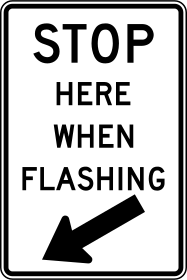 Stop Here When Flashing
From the Manual on Uniform Traffic Control Devices (MUTCD), 11th edition, section 8B.07. Sign image: public domain, source.