Low Ground Clearance Crossing sign
The crossing is humped enough that long or low vehicles and trailers could get stuck on the tracks. An educational plaque must accompany it for at least 3 years.
What to do
If your vehicle or trailer is low to the ground, use another route.
If you drive a low trailer, car carrier, long bus or motorhome, take another crossing rather than risk getting stuck on the tracks.
Where it's used
Section 8B.16 says the Low Ground Clearance Grade Crossing (W10-5) sign should be placed before a crossing whose hump is abrupt enough for long-wheelbase vehicles or low trailers to get stuck. It is a black-on-yellow diamond showing a vehicle caught on raised tracks, and because the symbol is not well known it must carry a LOW GROUND CLEARANCE (W10-5P) plaque for at least 3 years. Plaques such as USE NEXT CROSSING, an advisory speed, word signs and a signed detour for at-risk vehicles should also be considered.
Don't confuse it with
- Bump: BUMP warns of a sharp rise in the road, while this sign warns that vehicles can get stuck on a raised railroad crossing.
- Low Clearance: Low Clearance warns about overhead height, not ground clearance under the vehicle.

- Type
- Railroad crossing signs
- Shape
- Diamond
- Colors
- yellow, black
- MUTCD code
- W10-5
- MUTCD section
- 8B.16
On state permit tests
Our questions for 1 state ask about this sign, including Virginia.
Test yourself
What does a 'Low Ground Railroad Crossing' sign warn about? (Virginia practice test)
- A flooded crossing
- Trains crossing at low speed
- A crossing without gates
- A steep slope at the tracks that may catch the bottom of low vehicles
Show answer
A steep slope at the tracks that may catch the bottom of low vehicles. A steep slope where the tracks cross may cause low vehicles to get caught or drag on the tracks.
More railroad crossing signs
 Railroad Crossing (Crossbuck)
 Number of Tracks plaque
 Railroad Crossing Ahead
 Parallel Track Crossing
 No Gates or Lights plaque
 No Train Horn
 Do Not Stop on Tracks
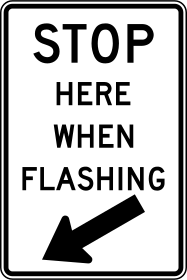 Stop Here When Flashing
From the Manual on Uniform Traffic Control Devices (MUTCD), 11th edition, section 8B.16. Sign image: public domain, source.