Pass With Care sign
Placed at the end of a no-passing zone that began with a Do Not Pass sign.
What to do
Passing is allowed again, but only when the way ahead is clear and it is safe.
Pass only if you can see far enough ahead to complete the move safely and the center line markings allow it on your side.
Where it's used
Section 2B.37 says a PASS WITH CARE sign should be installed at the downstream end of a no-passing zone wherever a Do Not Pass sign was installed at its start. It is a vertical black-on-white regulatory sign. It does not mean passing is safe, only that it is no longer prohibited by the zone.
Don't confuse it with
- Do Not Pass: DO NOT PASS marks the start of the zone where passing is prohibited; PASS WITH CARE marks its end.
- Broken Yellow Center Line: A broken yellow center line is the marking that allows passing, while the sign announces the end of a signed no-passing zone.
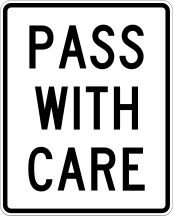
- Type
- Regulatory signs
- Shape
- Vertical rectangle
- Colors
- white, black
- MUTCD code
- R4-2
- MUTCD section
- 2B.37
On state permit tests
Our questions for 7 states ask about this sign, including Florida, Hawaii, Illinois, Kansas and Louisiana.
Test yourself
What does a PASS WITH CARE sign tell you? (Florida practice test)
- You may pass, but do so with caution
- The no-passing zone begins
- Passing is allowed only on the right
- Passing is allowed only for trucks
Show answer
You may pass, but do so with caution. Pass With Care means passing is allowed but must be done cautiously.
What does a PASS WITH CARE sign indicate? (Hawaii practice test)
- Passing is prohibited
- The end of a no-passing zone
- A passing lane begins
- Slow vehicles ahead
Show answer
The end of a no-passing zone. Pass With Care signs are rectangular black and white signs marking the end of a no-passing zone.
More regulatory signs
 Stop
 All-Way plaque
 Yield
 Yield Here to Pedestrians
 In-Street Pedestrian Crossing
 Speed Limit
 Night Speed Limit
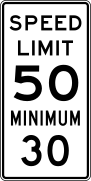 Combined Maximum and Minimum Speed Limits
From the Manual on Uniform Traffic Control Devices (MUTCD), 11th edition, section 2B.37. Sign image: public domain, source.