Washington DOL permit practice test
25 questions written from the Washington Driver Guide, covering licensing laws and penalties, alcohol and drugs, safe and defensive driving, hazards, weather and night driving, right of way and more. Pick an answer to see straight away whether you're right and why. The real Washington DOL test has 40 questions and you need 32 right.
-
Question 1If you enroll in an approved driver training course, what is the earliest age you can apply for a Washington instruction permit?
Show answer
B: 15. If you're enrolling in a driver training course, you can apply for a permit as early as 15, 1 to 10 days before the course starts. Washington Driver Guide: 1.8 Getting a personal driver license: Instruction permit, page 25.
-
Question 2For Washington drivers 21 and older, what BAC is considered DUI?
Show answer
C: .08% or higher. A BAC of .08% or higher is considered a DUI for drivers age 21 and older. Washington Driver Guide: 1.15 Driving under the influence (DUI), page 37.
-
Question 3According to the Washington guide, tire tread should not be less than:
Show answer
D: 2/32 of an inch. Worn tires can slip and slide, especially on wet roads; tread shouldn't be less than 2/32 of an inch. Washington Driver Guide: 2.5 Tires, page 48.
-
Question 4How do higher speeds affect your three types of vision?
Show answer
B: They reduce the quality of each type of vision. Higher speeds reduce the quality of central, fringe and peripheral vision. Washington Driver Guide: 5.5 Field of vision, page 164.
-
Question 5A pedestrian is crossing in front of you. How long must you wait before proceeding?
Show answer
D: Until the pedestrian has cleared your lane and one additional lane. Wait until a pedestrian has cleared your lane and one additional lane before proceeding. Washington Driver Guide: 4.1 Sharing with people, page 93.
-
Question 6Why should you avoid honking at a pedestrian with a service animal?
Show answer
C: It could confuse or frighten the animal or the pedestrian. Don't honk; it could confuse or frighten the animal or pedestrian. It's unlawful to interfere with a service animal. Washington Driver Guide: 4.1 Sharing with people, page 94.
-
Question 7A traffic signal is not working at all. How should you treat the intersection?
Show answer
A: Like a four-way stop: stop, yield to traffic on your right, and proceed carefully. If a traffic signal isn't working, treat the intersection like a four-way stop. Washington Driver Guide: 4.10 Broken lights or signals, page 109.
-
Question 8In Washington, what does a red sign color indicate?
Show answer
D: Prohibitive or restricted action. Red signs show prohibited or restricted actions. Washington Driver Guide: 4.12 Signs, page 113.
-
Question 9What is legally true of every intersection in Washington?
Show answer
D: It is legally a crosswalk, whether marked or unmarked. Every intersection is legally a crosswalk, whether it's marked or unmarked. Washington Driver Guide: 4.13 Common intersections, page 121.
-
Question 10How are HOV (carpool) lanes identified?
Show answer
D: By the diamond symbol on signs and pavement. HOV lanes are identified by the diamond symbol on signs and pavement and separated from other lanes by a solid white line. Washington Driver Guide: 4.16 HOV / carpool, page 134.
-
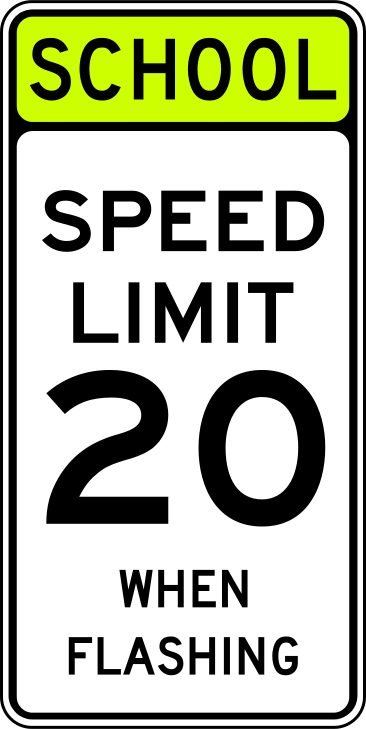
Question 11What is the school zone speed limit in Washington?
Show answer
B: 20 mph. The school zone speed limit is 20 mph because higher speeds increase the risk of fatal crashes. Washington Driver Guide: 4.17 School zone, page 140.
-
Question 12How far from the curb may your vehicle be when parallel parked in Washington?
Show answer
C: No more than 12 inches. Don't park more than 12 inches from the curb. Washington Driver Guide: 4.18 General parking rules, page 144.
-
Question 13How much space does the Washington guide say to leave between you and the vehicle ahead?
Show answer
A: At least twice the length of your vehicle. When driving near other vehicles, leave a distance at least twice the length of your vehicle between you and the vehicle ahead. Washington Driver Guide: 5.2 Space, page 159.
-
Question 14Your car starts to skid. What is the first thing to do?
Show answer
C: Take your foot off the accelerator. First take your foot off the accelerator, then brake appropriately and steer in the direction the vehicle is moving. Washington Driver Guide: 5.6 Skidding, page 171.
-
Question 15If you are NOT enrolling in a driver training course, at what age can you take the knowledge exam and get a Washington permit?
Show answer
B: 15½. Without a driver training course, you can take the knowledge exam after you turn 15½, but you must wait until 18 to take the skills exam. Washington Driver Guide: 1.8 Getting a personal driver license: Instruction permit, page 25.
-
Question 16Drivers under 21 in Washington face DUI consequences at what BAC?
Show answer
B: 0.02%. Drivers under 21 have the same potential consequences at a BAC of 0.02%. Washington Driver Guide: 1.15 Driving under the influence (DUI), page 37.
-
Question 17Where can you find the proper inflation pressure for your tires?
Show answer
C: On the Tire and Loading Information label on the driver's door edge or in the owner's manual. The proper pressure is on the Tire and Loading Information label on the driver's side door edge or in the owner's manual. Washington Driver Guide: 2.5 Tires, page 48.
-
Question 18At night, you should drive at a speed that lets you stop within the glow of your headlights, which is usually about:
Show answer
C: 400 feet. Drive at a speed that lets you stop within the glow of your headlights, usually 400 feet. Washington Driver Guide: 5.6 Night driving, page 166.
-
Question 19A pedestrian using a cane, wheelchair or guide dog is crossing. When may you continue?
Show answer
C: When they have completely crossed the street. If the pedestrian uses a wheelchair, cane, guide dog or other service animal, wait until they have completely crossed the street. Washington Driver Guide: 4.1 Sharing with people, page 93.
-
Question 20School bus lights are like traffic signals. What do flashing yellow lights on a school bus mean?
Show answer
C: Caution or slow down. Red means stop and yellow means caution or slow down. Washington Driver Guide: 4.2 Sharing with school buses, page 94.
-
Question 21Who can overrule traffic signals and must be obeyed?
Show answer
D: Law enforcement, construction workers, maintenance personnel and school crossing guards directing traffic. In special circumstances, these people can direct traffic and overrule signals, and their directions must be followed. Washington Driver Guide: 4.10 Traffic control devices, page 109.
-
Question 22What does an orange sign indicate?
Show answer
B: Construction and maintenance warning. Orange signs warn of construction and maintenance. Washington Driver Guide: 4.12 Signs, page 113.
-
Question 23You stopped at the stop line, but your view of the cross street is blocked. What should you do?
Show answer
A: Edge forward slowly until you can see. If your view is blocked, edge forward slowly until you can see; crossing drivers can then see your vehicle's front. Washington Driver Guide: 4.13 Common intersections, page 121.
-
Question 24Which vehicles may use Washington HOV lanes besides those meeting the posted occupancy?
Show answer
C: Motorcycles. To use an HOV lane you must meet the posted occupancy requirement; motorcycles are also allowed. Washington Driver Guide: 4.16 HOV / carpool, page 134.
-
Question 25When you see a roadside response vehicle with flashing lights, Washington law says you must either move to a farther lane or slow to at least:
Show answer
B: 10 mph below the posted limit. Move over into a farther lane or slow to at least 10 mph below the posted speed limit. Washington Driver Guide: 4.17 Emergency zone, page 143.
Answer every question to see your score.
More Washington practice tests
- Practice test 225 questions
- Practice test 325 questions
- Practice test 425 questions
- Practice test 525 questions
- Practice test 625 questions
- Practice test 725 questions
- Practice test 825 questions
- Practice test 925 questions
- Practice test 1025 questions
- Practice test 1125 questions
- Practice test 1227 questions
- Exam simulatorThe real format, 40 questions
How to use these tests
Read each explanation, even when you get the question right: it tells you the rule and the handbook section, so you can look it up. Your answers are saved in this browser only, so the weak spots mode can give you more questions on the topics you miss. When you're scoring well, take the exam simulator: it uses the same number of questions and passing score as the real test.
Our own questions, written from the Washington Driver Guide and checked against it. Not affiliated with the Washington State Department of Licensing. Found a mistake? Tell us.