Wisconsin DMV permit practice test 4
25 questions written from the Wisconsin Motorists' Handbook (BDS126), covering safe and defensive driving, turns and intersections, hazards, weather and night driving, parking, signals and pavement markings and more. Pick an answer to see straight away whether you're right and why. The real Wisconsin DMV test has 50 questions and you need 40 right.
-
Question 1How fast should you back up?
Show answer
A: No faster than a slow walk. Back up no faster than a slow walk. Wisconsin Motorists' Handbook (BDS126): Section 3: The Basics — I. Backing, page 22.
-
Question 2Why should you leave extra space for trucks and buses that are turning?
Show answer
A: They may cross the center line during a turn. Large vehicles such as trucks and buses may cross the center line during a turn. Wisconsin Motorists' Handbook (BDS126): Section 3: The Basics — G. Turning, page 18.
-
Question 3Lights are flashing at a railroad crossing. When may you proceed?
Show answer
A: When the lights stop flashing and the track is clear. Wait until the lights stop flashing and the track is clear to continue. Wisconsin Motorists' Handbook (BDS126): Section 4: Signs — H. Railroad Crossing, page 34.
-
Question 4How much longer than your vehicle should a parallel parking space be?
Show answer
B: About 3 to 6 feet. Find a parking space that is about 3 to 6 feet longer than your vehicle. Wisconsin Motorists' Handbook (BDS126): Section 3: The Basics — J. Parking, page 23.
-
Question 5May you turn right on a steady red light in Wisconsin?
Show answer
A: Yes, after a full stop, if safe and no sign prohibits it. You can turn right on red if it is safe and no sign prohibits it, after first stopping and yielding. Wisconsin Motorists' Handbook (BDS126): Section 5: Signals, Pavement Markings and Lane Controls — A. Traffic Signals, page 36.
-
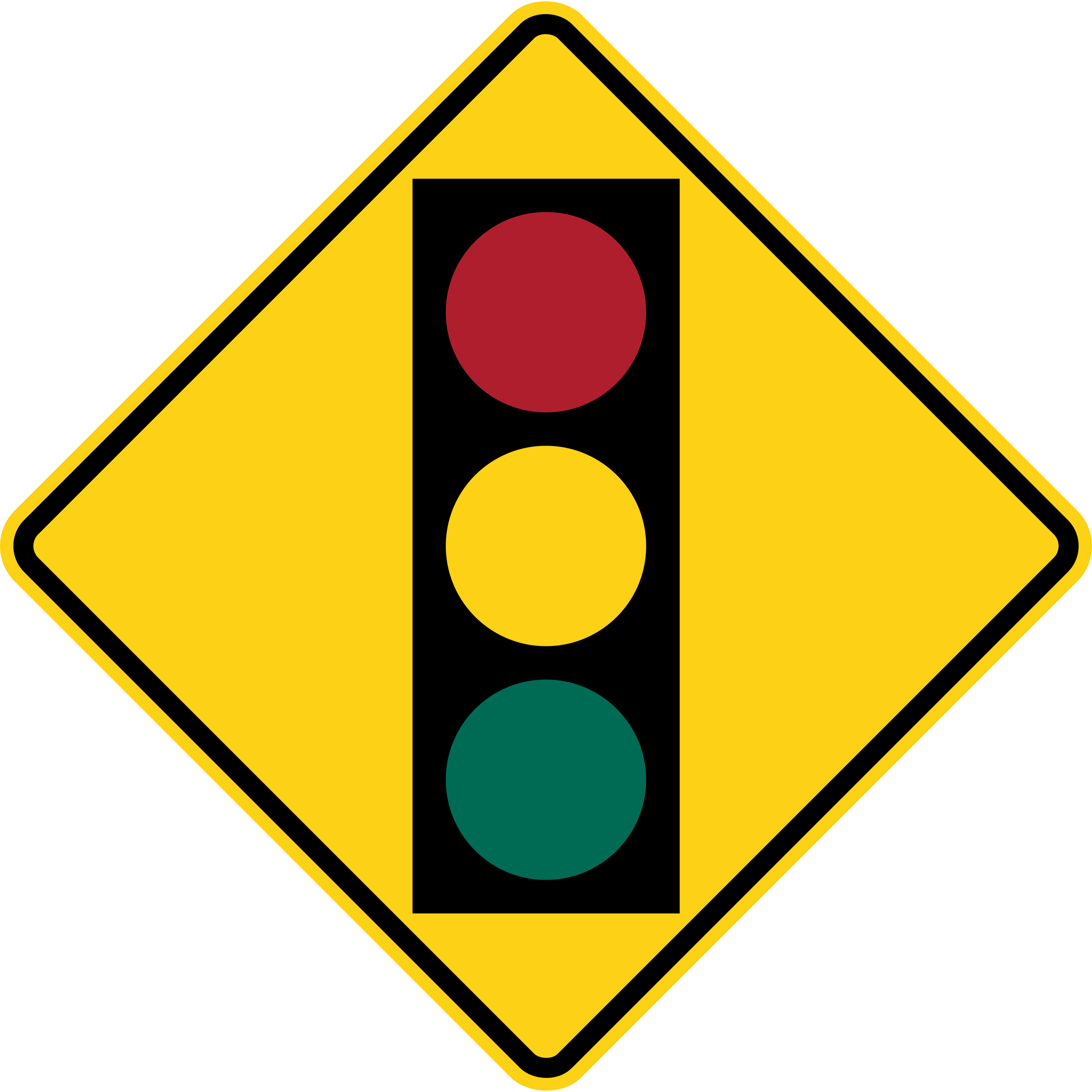
Question 6A yellow diamond sign shows a traffic signal symbol. What should you do?
Show answer
A: Be ready to slow down and stop for a signal ahead. The Signal Ahead sign means stop lights are ahead; be ready to slow down and stop. Wisconsin Motorists' Handbook (BDS126): Section 4: Signs — A. Warning, page 26.
-
Question 7When driving near livestock on or along a rural highway, what should you do?
Show answer
A: Yield the right-of-way, slow down and do not honk. Yield to livestock; do not honk because it may scare the animals; slow down and keep a safe distance. Wisconsin Motorists' Handbook (BDS126): Section 7: Driving Conditions — D. Farm Safety/Rural Driving, page 49.
-
Question 8When might speeding up be the best way to avoid a crash?
Show answer
A: When another vehicle is about to hit you from the side or behind. Speeding up may help when another vehicle is about to hit you from the side or from behind. Wisconsin Motorists' Handbook (BDS126): Section 8: Handling Emergencies — A. Avoiding Crashes, page 50.
-
Question 9A police officer asks you to take a prohibited alcohol concentration (PAC) test. What does Wisconsin's Implied Consent Law require?
Show answer
A: You must agree to take it. Under the Implied Consent Law, you must agree to take the test. Wisconsin Motorists' Handbook (BDS126): Section 9: Dangerous Driving Behaviors — A. Alcohol, Drugs and Driving, page 53.
-
Question 10About how long does the Wisconsin knowledge test take to complete at a DMV service center?
Show answer
C: 45 minutes. The handbook says the knowledge test takes about 45 minutes, so allow enough time before the service center closes. Wisconsin Motorists' Handbook (BDS126): Section 1: Driving Test Requirements — C. Knowledge Test, page 5.
-
Question 11A car is already traveling in a roundabout as you arrive. What should you do?
Show answer
A: Yield to the traffic already in the roundabout. You should yield to traffic that is already in a roundabout. Wisconsin Motorists' Handbook (BDS126): Section 3: The Basics — A. Right-Of-Way, page 13.
-
Question 12How often should you check your rearview mirror for tailgaters?
Show answer
B: Every 6 to 8 seconds. Check your rearview mirror every 6 to 8 seconds to see if someone is following too closely. Wisconsin Motorists' Handbook (BDS126): Section 3: The Basics — F. Space Between Vehicles, page 17.
-
Question 13Which situation calls for slowing down, according to the handbook?
Show answer
A: Curved roads or hills. Slow down for curved roads or hills, bad weather, parking lots, schools and heavy traffic. Wisconsin Motorists' Handbook (BDS126): Section 3: The Basics — B. Understanding Vehicle Speed, page 15.
-
Question 14Above a reversible lane you see a yellow X. What should you do?
Show answer
A: Move to a lane with a green arrow; the lane is changing. A yellow X means the lane is changing; move to a lane with a green arrow. Wisconsin Motorists' Handbook (BDS126): Section 5: Signals, Pavement Markings and Lane Controls — C. Special Lanes, page 40.
-
Question 15When backing up, which way should you look?
Show answer
A: Turn your body and look over your right shoulder through the rear window. Turn your body and look over your right shoulder through the rear window; do not depend only on mirrors and cameras. Wisconsin Motorists' Handbook (BDS126): Section 3: The Basics — I. Backing, page 22.
-
Question 16You are stopped in the intersection waiting to turn left across oncoming traffic. How should you hold your steering wheel?
Show answer
A: Straight. Keep the wheels straight; if you are hit from behind with the wheel turned left, you could be pushed into oncoming traffic. Wisconsin Motorists' Handbook (BDS126): Section 3: The Basics — G. Turning, page 18.
-
Question 17Which action is unsafe at a railroad crossing?
Show answer
A: Shifting gears while crossing the tracks. Do not shift gears while crossing railroad tracks. Wisconsin Motorists' Handbook (BDS126): Section 4: Signs — H. Railroad Crossing, page 34.
-
Question 18To begin parallel parking, how far from the vehicle ahead of the space should you stop alongside it?
Show answer
B: About 2 feet. Signal, then stop evenly with the vehicle ahead of the space, about 2 feet away from it. Wisconsin Motorists' Handbook (BDS126): Section 3: The Basics — J. Parking, page 23.
-
Question 19What does a flashing red light mean?
Show answer
A: Come to a full stop, then go when safe. At a flashing red light you must come to a full stop and may go when it is safe. Wisconsin Motorists' Handbook (BDS126): Section 5: Signals, Pavement Markings and Lane Controls — A. Traffic Signals, page 36.
-
Question 20What does a yellow diamond sign with a leaping deer mean?

Show answer
A: Deer are very likely to cross the road here; be alert. In Deer Crossing areas, deer are very likely to cross the road, so be alert. Wisconsin Motorists' Handbook (BDS126): Section 4: Signs — A. Warning, page 26.
-
Question 21May you drive on a sidewalk in Wisconsin?
Show answer
A: Only when crossing it. It is illegal to drive on a sidewalk unless you are crossing it. Wisconsin Motorists' Handbook (BDS126): Section 10: Sharing the Road — A. Pedestrians, page 55.
-
Question 22You were in a crash and someone is injured. What should you do?
Show answer
A: Call 911, stay at the scene and do not move the vehicles. Call 911, stay on the scene and do not move vehicles; leaving is a crime if someone is injured or killed. Wisconsin Motorists' Handbook (BDS126): Section 8: Handling Emergencies — B. Crashes, page 51.
-
Question 23If you refuse a requested alcohol test in Wisconsin, how long will you lose your driving privileges at minimum?
Show answer
C: One year. Refusing means arrest for violating the Implied Consent Law and losing your driving privileges for at least one year. Wisconsin Motorists' Handbook (BDS126): Section 9: Dangerous Driving Behaviors — A. Alcohol, Drugs and Driving, page 53.
-
Question 24What does it cost to take the knowledge test at a Wisconsin DMV customer service center?
Show answer
A: It is free. Tests taken in a DMV customer service center are free. Wisconsin Motorists' Handbook (BDS126): Section 1: Driving Test Requirements — C. Knowledge Test, page 5.
-
Question 25Another vehicle is passing you going the same direction. What should you do?
Show answer
A: Yield the right-of-way to the passing vehicle. You yield to a vehicle that is passing you on the left or right going the same direction. Wisconsin Motorists' Handbook (BDS126): Section 3: The Basics — A. Right-Of-Way, page 13.
Answer every question to see your score.
More Wisconsin practice tests
- Practice test 125 questions
- Practice test 225 questions
- Practice test 325 questions
- Practice test 525 questions
- Practice test 625 questions
- Practice test 725 questions
- Practice test 825 questions
- Practice test 925 questions
- Practice test 1025 questions
- Practice test 1125 questions
- Practice test 1220 questions
- Exam simulatorThe real format, 50 questions
How to use these tests
Read each explanation, even when you get the question right: it tells you the rule and the handbook section, so you can look it up. Your answers are saved in this browser only, so the weak spots mode can give you more questions on the topics you miss. When you're scoring well, take the exam simulator: it uses the same number of questions and passing score as the real test.
Our own questions, written from the Wisconsin Motorists' Handbook (BDS126) and checked against it. Not affiliated with the Wisconsin Department of Transportation, Division of Motor Vehicles (WisDOT DMV). Found a mistake? Tell us.