Connecticut DMV permit practice test 3
25 questions written from the Connecticut Driver's Manual, covering following and passing, turns and intersections, lanes, highways and freeways, parking, hazards, weather and night driving and more. Pick an answer to see straight away whether you're right and why. The real Connecticut DMV test has 25 questions and you need 20 right.
-
Question 1Which vehicles should you leave extra room for near railroad crossings?
Show answer
C: Transit buses, school buses and hazardous materials vehicles that must stop there. Buses and hazardous-materials vehicles often must stop at railroad tracks, so leave extra space behind them near a crossing. Connecticut Driver's Manual: Space Ahead, page 23.
-
Question 2Where signs or markings allow two turning lanes, what should you do during the turn?
Show answer
C: Stay in your lane. With two or more turning lanes, stay in your lane during the turn. Connecticut Driver's Manual: Turning: Multiple lanes turning, page 26.
-
Question 3How large a gap in traffic do you need to merge or change lanes?
Show answer
D: About 4 seconds. You need an opening of about four seconds to merge, so you and the vehicle behind each have about two seconds. Connecticut Driver's Manual: Space to Merge, page 22.
-
Question 4How close to a pedestrian safety zone may you park?
Show answer
D: No closer than 25 feet. Do not park within 25 feet of a pedestrian safety zone. Connecticut Driver's Manual: No-Parking Zones, page 39.
-
Question 5When is a road especially slippery after rain begins on a hot day?
Show answer
D: During the first few minutes, as oil rises to the surface. When it starts to rain on a hot day, pavement is more slippery for the first few minutes because oil in the asphalt rises to the surface. Connecticut Driver's Manual: Slippery Roads, page 27.
-
Question 6Your engine dies while driving. What should you expect?
Show answer
D: Steering may be hard but possible, and you may need to press very hard on the brake. Keep a strong grip; steering may be difficult but possible, and the brakes still work though you may have to push very hard. Connecticut Driver's Manual: Power Failure, page 42.
-
Question 7Who must take the 8-hour Safe Driving Practices course before getting a Connecticut license?
Show answer
C: Anyone who has not previously held a Connecticut license and does not hold a valid license from another state. Connecticut requires anyone, regardless of age, who has never held a Connecticut license and does not hold a valid out-of-state license to take the 8-hour Safe Driving Practices course. Connecticut Driver's Manual: First Time Drivers (All Ages), page 6.
-
Question 8Under Connecticut's zero tolerance law, what blood alcohol content triggers penalties for a driver under 21?
Show answer
D: 0.02% or more. Drivers under 21 face penalties for a BAC of two hundredths of one percent (.02%) or more, on public roads and private property. Connecticut Driver's Manual: Alcohol and the Law, page 35.
-
Question 9On the highway, how far is 12 seconds of driving, roughly?
Show answer
B: About a quarter of a mile. Twelve seconds of travel at highway speed covers roughly a quarter mile, or about four city blocks. Connecticut Driver's Manual: Scanning, page 16.
-
Question 10When may you drive in a designated bicycle lane?
Show answer
C: When entering or leaving an alley or driveway, or when directed by police. Do not stop, park or drive in a bike lane except to enter or leave an alley or driveway, for official duties, when directed by police, or in an emergency. You may turn across it but not drive in it approaching a turn. Connecticut Driver's Manual: Bicyclists: As a driver, page 19.
-
Question 11You are entering a traffic circle or rotary. Who has the right-of-way?
Show answer
D: Drivers already in the circle. Vehicles already circulating in a rotary or traffic circle have priority; entering drivers must wait for a gap. Connecticut Driver's Manual: Right-of-Way, page 38.
-
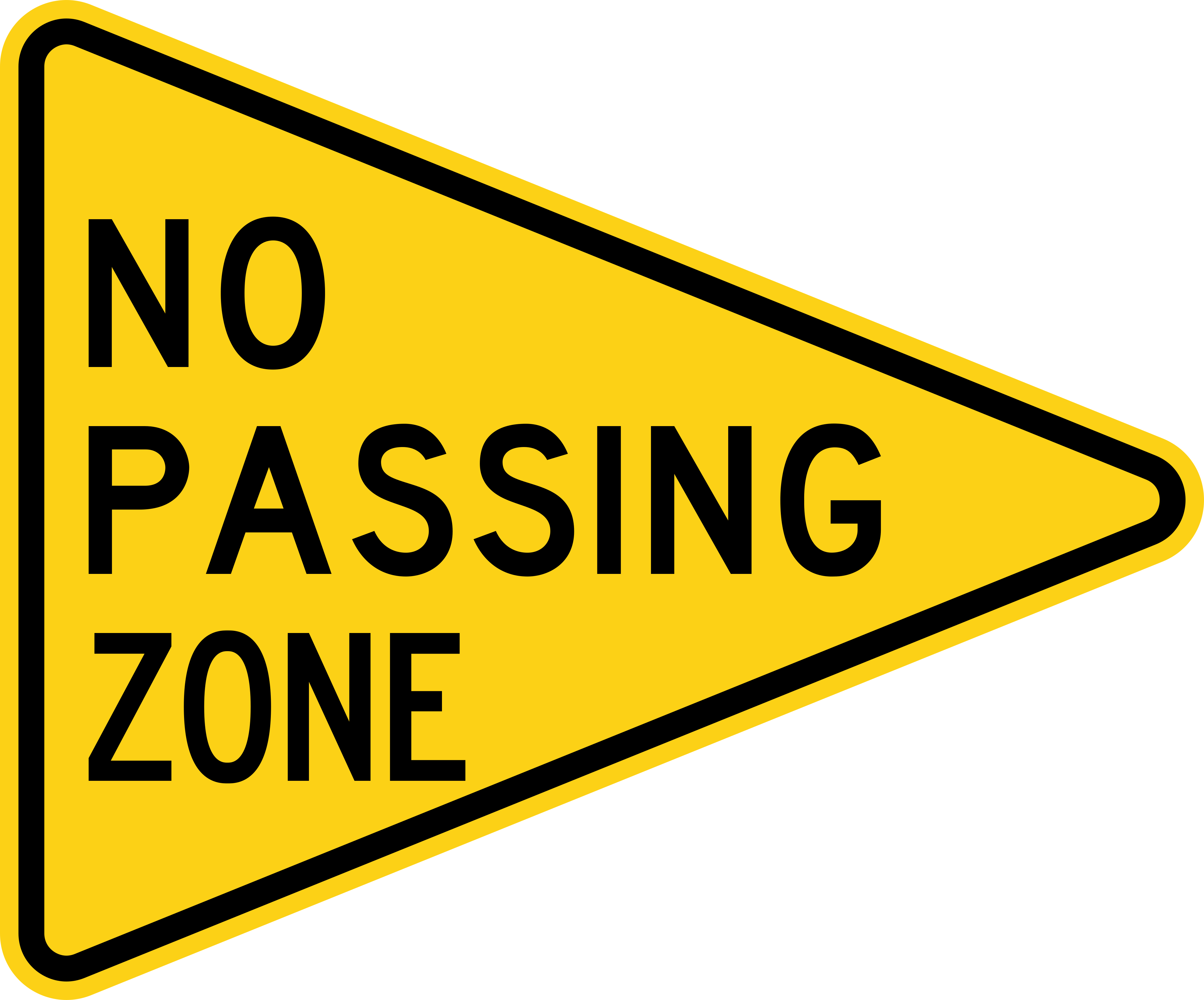
Question 12A pennant-shaped (three-sided, sideways) sign on the left side of the road means what?
Show answer
A: The beginning of a no-passing zone. The pennant-shaped sign is on the left side of a two-lane road at the beginning of a no-passing zone. Connecticut Driver's Manual: Traffic Signs: Shapes, page 48.
-
Question 13What does a red arrow signal mean?
Show answer
B: You must stop and may not go in the direction of the arrow. A red arrow means stop; you cannot go in the arrow's direction until it goes out and a green arrow or light comes on. Connecticut Driver's Manual: Arrows, page 47.
-
Question 14What should you do if vehicles are piling up behind you because you are driving slowly?
Show answer
D: Pull over when it is safe and let them pass. Driving much slower than others is dangerous; if vehicles pile up behind you, pull over when safe and let them pass. Connecticut Driver's Manual: Speed Limits: Driving Too Slow, page 38.
-
Question 15Another driver is tailgating you and there is no right lane. What should you do?
Show answer
C: When the road ahead is clear, slow down gradually to encourage them to pass. If there is no right lane, wait until the road ahead is clear, then reduce speed slowly; never slow down quickly to discourage a tailgater. Connecticut Driver's Manual: Space Behind: Being Tailgated, page 24.
-
Question 16What is the proper way to make a U-turn where one is allowed?
Show answer
C: Give a left signal, stop, check traffic, and turn into the right-hand lane going the other way. Give a left turn signal, stop, check for approaching traffic, and proceed into the outside or right-hand lane in the opposite direction. Connecticut Driver's Manual: U-Turns, page 39.
-
Question 17When leaving a highway on an exit ramp, when should you slow down?
Show answer
B: Not until you move onto the exit ramp. Keep up with traffic on the main road and do not slow down until you move onto the exit ramp. Connecticut Driver's Manual: Space to Leave, page 23.
-
Question 18Which of these is a legal place to park?
Show answer
B: Along a curb more than 25 feet from a stop sign, within a foot of the curb. You may not park on bridges, in bike lanes, or double-parked; parking within a foot of the curb away from restricted spots is allowed. Connecticut Driver's Manual: No-Parking Zones, page 39.
-
Question 19When are studded tires allowed in Connecticut?
Show answer
D: November 15 through April 30. Studded tires are permitted in Connecticut from November 15th through April 30th. Connecticut Driver's Manual: Slippery Roads, page 27.
-
Question 20Your gas pedal sticks and the engine keeps speeding up. What should you do?
Show answer
D: Shift to neutral, pull off the road when safe, and turn off the engine. Keep your eyes on the road, quickly shift to neutral, pull off when safe, then turn off the engine. Connecticut Driver's Manual: Gas Pedal Sticks, page 42.
-
Question 21Where must the person giving instruction to a learner's permit holder sit?
Show answer
C: In the front passenger seat next to the learner. The instructor must sit in the front passenger seat next to the learner and be ready to take control of the vehicle. Connecticut Driver's Manual: Learner's Permit – Qualified Trainer Requirement, page 7.
-
Question 22A 19-year-old driver's test shows a BAC of .03%. What happens to their license?
Show answer
B: Suspension of at least 45 days, plus an ignition interlock device for at least one year. Under zero tolerance, a result of .02% or higher leads to a suspension of at least 45 days and an IID for at least one year as a condition of reinstatement. Connecticut Driver's Manual: Alcohol and the Law, page 35.
-
Question 23Before starting a vehicle with an automatic transmission, where should the shift selector be?
Show answer
A: Park. For an automatic transmission, put the shift selector in park, with the parking brake on, before you start the vehicle. Connecticut Driver's Manual: Starting, page 16.
-
Question 24May you pass a slow bicyclist in a no-passing zone in Connecticut?
Show answer
B: Yes, if you can do it safely. Connecticut lets you pass slow traffic such as a bicycle in a no-passing zone, but only when you can see far enough ahead to do it safely. Connecticut Driver's Manual: Bicyclists: As a driver, page 19.
-
Question 25You are pulling out of a driveway onto a main road. Who has the right-of-way?
Show answer
C: Vehicles already on the main road. Coming out of a driveway, alley or the roadside, you must let traffic already on the road go first. Connecticut Driver's Manual: Right-of-Way, page 39.
Answer every question to see your score.
More Connecticut practice tests
- Practice test 125 questions
- Practice test 225 questions
- Practice test 425 questions
- Practice test 525 questions
- Practice test 625 questions
- Practice test 725 questions
- Practice test 825 questions
- Practice test 925 questions
- Practice test 1025 questions
- Practice test 1125 questions
- Practice test 1225 questions
- Exam simulatorThe real format, 25 questions
How to use these tests
Read each explanation, even when you get the question right: it tells you the rule and the handbook section, so you can look it up. Your answers are saved in this browser only, so the weak spots mode can give you more questions on the topics you miss. When you're scoring well, take the exam simulator: it uses the same number of questions and passing score as the real test.
Our own questions, written from the Connecticut Driver's Manual and checked against it. Not affiliated with the Connecticut Department of Motor Vehicles. Found a mistake? Tell us.