Connecticut DMV permit practice test 7
25 questions written from the Connecticut Driver's Manual, covering emergencies, licensing laws and penalties, alcohol and drugs, safe and defensive driving, sharing the road and more. Pick an answer to see straight away whether you're right and why. The real Connecticut DMV test has 25 questions and you need 20 right.
-
Question 1Which can you usually do more quickly to avoid a crash?
Show answer
A: Turn. Steering around a hazard is usually quicker than stopping for it, so turning is often your best way out. Connecticut Driver's Manual: Turning Quickly, page 42.
-
Question 2How much training must a parent or legal guardian of a 16- or 17-year-old permit holder complete?
Show answer
C: Two hours of instruction on teen driving laws and dangers. A parent or legal guardian must complete two hours of instruction about the laws for drivers under 18 and the dangers of teen driving. Connecticut Driver's Manual: Parent Training Requirements, page 8.
-
Question 3What can happen if you drink alcohol while taking other drugs?
Show answer
C: The effects of alcohol can be multiplied. Other drugs can multiply the effects of alcohol or add effects of their own, which can be dangerous and even deadly. Connecticut Driver's Manual: Drugs and Driving, page 35.
-
Question 4At an intersection, when is it especially important to look left and right even if cross traffic has a red light?
Show answer
A: Just after your light turns green. Just after the light turns green, drivers on the cross street are most likely to hurry through; look both ways even if they have a red light. Connecticut Driver's Manual: Intersections, page 17.
-
Question 5When do you NOT have to stop for a school bus with flashing red lights?
Show answer
B: When the bus is coming toward you on the other side of a median or physical barrier. You are not required to stop if the bus is traveling toward you and a median or other physical barrier separates the roadway. Connecticut Driver's Manual: Right-of-Way, page 39.
-
Question 6A traffic signal is not working at all. How must you treat the intersection?
Show answer
D: As if it were controlled by a stop sign. When a traffic light at an intersection is out, Connecticut law requires you to treat it like a stop sign and come to a full stop. Connecticut Driver's Manual: Stop Light Not Working, page 27.
-
Question 7What does a red circle with a slash over a symbol mean on a regulatory sign?
Show answer
B: The action shown is prohibited. Regulatory signs with a red circle and slash prohibit the action shown, such as no left turn or no U-turn. Connecticut Driver's Manual: Regulatory Signs, page 49.
-
Question 8Over a reversible lane, what does a flashing yellow X mean?
Show answer
D: Lane is only for turning. A flashing yellow X means the lane is only for turning; a green arrow means you may use it and a red X means you may not. Connecticut Driver's Manual: Reversible Lanes, page 46.
-
Question 9As a general rule, how many vehicles should you pass at one time?
Show answer
B: One. Do not count on time to pass several vehicles at once; as a general rule, only pass one vehicle at a time. Connecticut Driver's Manual: Passing, page 25.
-
Question 10How much farther do high beams let you see compared with low beams?
Show answer
C: About twice as far. High beams let you see twice as far as low beams; use them when there are no oncoming vehicles. Connecticut Driver's Manual: Lights, page 40.
-
Question 11Facing a choice between running off the road and a head-on crash, what does the manual say?
Show answer
C: It is generally better to run off the road. Leaving the road is generally a better outcome than a head-on collision with another vehicle. Connecticut Driver's Manual: Turning Quickly, page 42.
-
Question 12During the first six months after getting a license, which passenger may a 16-year-old driver carry?
Show answer
A: A parent or legal guardian. For the first six months, a newly licensed 16- or 17-year-old may carry only a licensed driving instructor, parents or legal guardian (at least one licensed), or one qualified person at least 20 years old. Connecticut Driver's Manual: Restrictions for 16- and 17-Year-Old Drivers: Passenger Restrictions, page 10.
-
Question 13Who is more affected by alcohol when driving?
Show answer
D: New drivers, because they are still learning. Alcohol hurts new drivers more because they are still building basic driving skills, so any impairment hits them harder than experienced drivers. Connecticut Driver's Manual: Drinking and Driving, page 35.
-
Question 14Your view of the cross street is blocked while stopped at an intersection. What should you do?
Show answer
D: Edge forward slowly until you can see. If your view is blocked, edge forward slowly until you can see; crossing drivers can see your front end and slow down. Connecticut Driver's Manual: Intersections, page 17.
-
Question 15How close may you stop to an ice cream truck that is displaying flashing lights and has its stop arm out?
Show answer
A: No closer than 10 feet from its front or back. State law requires drivers to stop at least 10 feet from the front or back of an ice cream truck displaying flashing lights with its stop and crossing arms extended. Connecticut Driver's Manual: Ice Cream Trucks, page 20.
-
Question 16Who must yield at a railroad crossing?
Show answer
D: Vehicles must yield to trains. You must yield the right-of-way to trains crossing the roadway. Connecticut Driver's Manual: Right-of-Way, page 39.
-
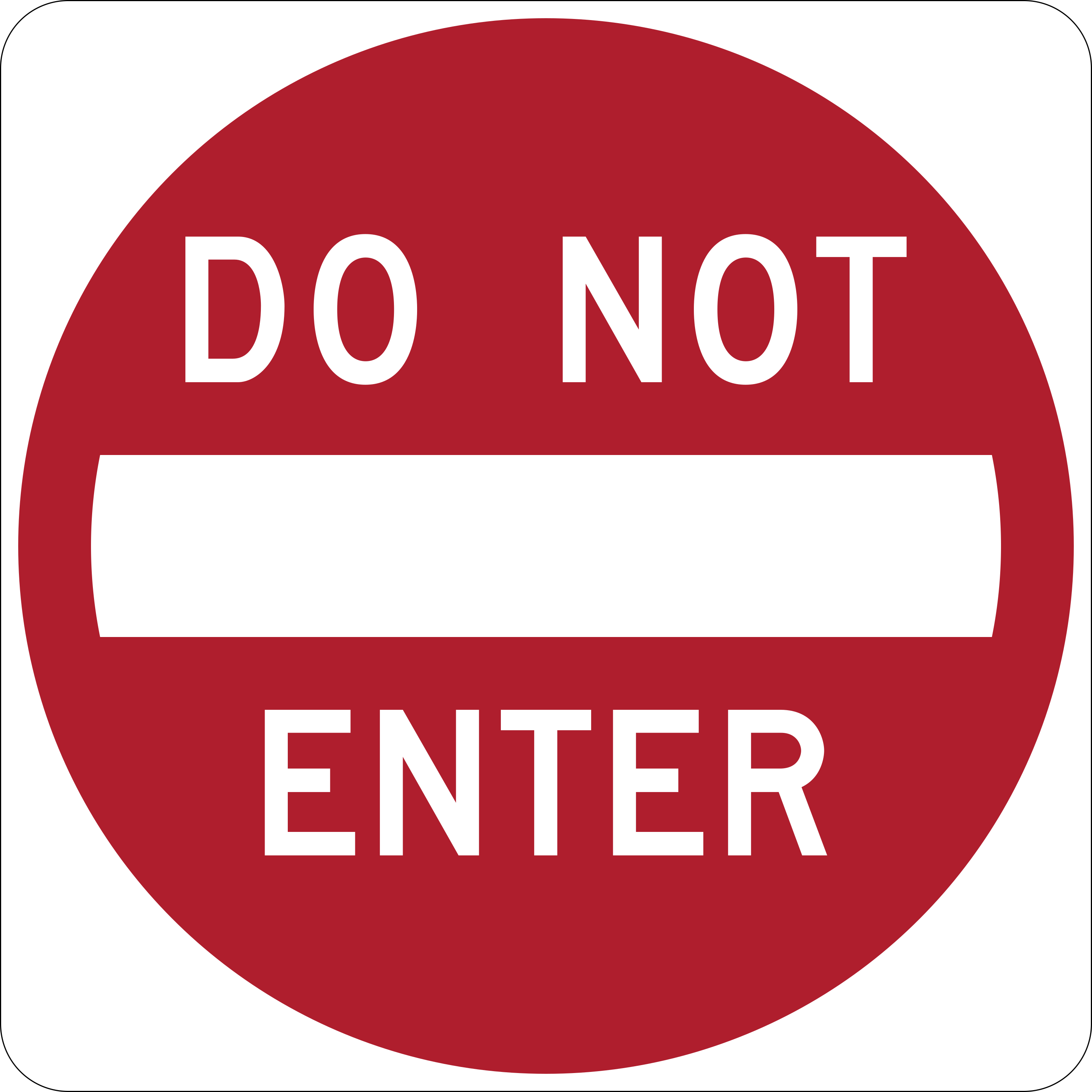
Question 17Where would you typically see a DO NOT ENTER sign?
Show answer
B: On exit ramps that would take you the wrong way and on one-way streets. Do Not Enter signs mark openings you should not enter, such as exit ramps in the wrong direction, crossovers and one-way streets. Connecticut Driver's Manual: Do Not Enter Sign, page 49.
-
Question 18How are reversible lanes usually marked?
Show answer
B: Double-dashed yellow lines. Reversible lanes are usually marked by double-dashed yellow lines. Connecticut Driver's Manual: Reversible Lanes, page 46.
-
Question 19Which can you legally pass in a no-passing zone in Connecticut, if it is safe?
Show answer
C: A slow-moving vehicle, bicycle, pedestrian, animal or parked vehicle. State law permits passing slow-moving traffic, pedestrians, parked vehicles, animals, bicycles, mopeds and scooters in no-passing zones if you can see far enough ahead to pass safely. Connecticut Driver's Manual: Slow Moving Vehicles, page 20.
-
Question 20In a very heavy downpour you can barely see. What should you do?
Show answer
C: Pull off the road in a safe place and wait. If you can't see well enough to drive in a heavy downpour, pull off the road in a safe place and wait until it clears. Connecticut Driver's Manual: Lights: Rain, Fog, or Snow, page 40.
-
Question 21Your vehicle starts to skid. What should you do?
Show answer
A: Stay off the brake and steer in the direction you want to go. Stay off the brake and steer where you want the vehicle to go; as it straightens, turn the wheel back and keep correcting. Connecticut Driver's Manual: Dealing with Skids, page 42.
-
Question 22During months seven through twelve of a 17-year-old's license, which additional passengers are allowed?
Show answer
D: Members of the driver's immediate family. In the second six months, the only additional passengers allowed are members of the driver's immediate family. Connecticut Driver's Manual: Restrictions for 16- and 17-Year-Old Drivers: Passenger Restrictions, page 10.
-
Question 23What is a good way to handle a social event where alcohol will be served?
Show answer
B: Agree ahead of time on a designated driver who will not drink. Arrange for one person in your group not to drink and be the designated driver, or use public transportation or a cab. Connecticut Driver's Manual: Alcohol and You, page 35.
-
Question 24Which of these is listed as a distraction inside a moving vehicle?
Show answer
D: Adjusting the radio or climate controls. Inside distractions include phones, adjusting radio or climate controls, GPS, grooming, passengers, children or pets, eating and reading. Connecticut Driver's Manual: Driver Distractions, page 29.
-
Question 25After stopping for an ice cream truck with flashing lights, how fast may you pass it?
Show answer
D: Up to 5 mph. After stopping, you may proceed past at a reasonable speed, up to 5 mph, yielding to pedestrians going to or from the truck. Connecticut Driver's Manual: Ice Cream Trucks, page 20.
Answer every question to see your score.
More Connecticut practice tests
- Practice test 125 questions
- Practice test 225 questions
- Practice test 325 questions
- Practice test 425 questions
- Practice test 525 questions
- Practice test 625 questions
- Practice test 825 questions
- Practice test 925 questions
- Practice test 1025 questions
- Practice test 1125 questions
- Practice test 1225 questions
- Exam simulatorThe real format, 25 questions
How to use these tests
Read each explanation, even when you get the question right: it tells you the rule and the handbook section, so you can look it up. Your answers are saved in this browser only, so the weak spots mode can give you more questions on the topics you miss. When you're scoring well, take the exam simulator: it uses the same number of questions and passing score as the real test.
Our own questions, written from the Connecticut Driver's Manual and checked against it. Not affiliated with the Connecticut Department of Motor Vehicles. Found a mistake? Tell us.