Connecticut DMV permit practice test 9
25 questions written from the Connecticut Driver's Manual, covering signals and pavement markings, hazards, weather and night driving, emergencies, licensing laws and penalties, safe and defensive driving and more. Pick an answer to see straight away whether you're right and why. The real Connecticut DMV test has 25 questions and you need 20 right.
-
Question 1When may you cross a double solid yellow center line?
Show answer
C: To make a left turn into or out of a driveway, alley, private road or street. A double solid yellow line means no ordinary passing, but you may cross it to turn left into or out of a driveway, alley, private road or street. Connecticut Driver's Manual: Center Lines, page 46.
-
Question 2Approaching a work zone, which lane change advice does the manual give?
Show answer
C: Merge as soon as possible. Merge as soon as possible: move to the appropriate lane at first notice of an approaching work zone. Connecticut Driver's Manual: Work Zones, page 18.
-
Question 3What should you give an injured person at a crash scene to drink?
Show answer
D: Nothing, not even water. Do not give injured persons anything to drink, not even water. Connecticut Driver's Manual: Traffic Crashes: If someone is injured, page 43.
-
Question 4How many passengers may a 16-year-old driver carry at most, in any case?
Show answer
C: No more than the number of seat belts in the vehicle. Learner's permit holders and 16- and 17-year-old drivers may not carry more passengers than the number of seat belts in the vehicle. Connecticut Driver's Manual: Other Restrictions, page 10.
-
Question 5How much sleep do most adults need to stay properly alert?
Show answer
C: 7 to 9 hours. Most adults need 7 to 9 hours of sleep to maintain proper alertness during the day. Connecticut Driver's Manual: Fatigue: Before a Trip, page 30.
-
Question 6Why should you not pass a motorcycle in the same lane?
Show answer
B: The motorcycle has the right to the full lane and needs space to react. Motorcyclists have the right to use a complete lane; do not pass a motorcycle in the same lane—it needs space to react. Connecticut Driver's Manual: Motorcycles, page 20.
-
Question 7What does a MERGE sign mean?

Show answer
A: Two lanes are about to become one; drivers in both lanes must merge smoothly. The merge sign means two lanes are about to become one, and drivers in both lanes share the job of merging smoothly. Connecticut Driver's Manual: Merge, page 51.
-
Question 8What does a solid yellow edge line on the left of the road mark?
Show answer
B: The left edge of a divided road. Solid yellow edge lines are used on the left edge of divided streets or roadways; solid white lines mark the right edge. Connecticut Driver's Manual: Edge Lines, page 45.
-
Question 9What color are temporary signs in work zones?
Show answer
A: Orange with black letters or symbols. All temporary work zone signs have an orange background with black letters or symbols. Connecticut Driver's Manual: Work Zones, page 17.
-
Question 10How can you help prevent an injured crash victim from going into shock?
Show answer
D: Cover them with a blanket or coat to keep warm. Cover them with a blanket or coat to keep them warm. Connecticut Driver's Manual: Traffic Crashes: If someone is injured, page 43.
-
Question 11How long after getting a motorcycle endorsement must a 16- or 17-year-old wait before carrying a passenger on the motorcycle?
Show answer
C: Six months. Teen drivers may not transport any passenger on a motorcycle for six months after the motorcycle endorsement is issued. Connecticut Driver's Manual: Other Restrictions, page 10.
-
Question 12Which of these is a warning sign of fatigue?
Show answer
A: Drifting from your lane or missing exits. Warning signs include drifting from your lane, tailgating, missing signs or exits, yawning, trouble keeping your eyes open, and daydreaming. Connecticut Driver's Manual: Fatigue: Warning Signs of Fatigue, page 30.
-
Question 13Nearly 40 percent of motorcycle crashes with other vehicles are caused by what?
Show answer
B: The other vehicle turning left in front of the motorcyclist. About four in ten motorcycle crashes with other vehicles happen when the other driver turns left across the motorcycle's path. Connecticut Driver's Manual: Motorcycles, page 20.
-
Question 14A warning sign shows the number of lanes reducing. What should you be ready to do?

Show answer
A: Change lanes or let other vehicles merge into your lane. The lane reduction sign warns of fewer lanes ahead; be prepared to change lanes or allow others to merge. Connecticut Driver's Manual: Reduction in Lanes, page 51.
-
Question 15What does a double solid white line between lanes mean?
Show answer
C: Lane changing is prohibited. A double solid white line prohibits lane changing. Connecticut Driver's Manual: Other Markings, page 46.
-
Question 16If no reduced speed limit is posted in a work zone, what speed should you obey?
Show answer
D: The normal posted speed limit. If there are no reduced speed limit signs in a work zone, obey the normal posted speed limit. Connecticut Driver's Manual: Work Zones, page 17.
-
Question 17You hit a parked car and can't find the owner. What must you do?
Show answer
A: Leave a note where it can be seen with the date, time and how to reach you. Try to find the owner; if you can't, leave a note in a visible place with the date and time and how the owner can reach you. Connecticut Driver's Manual: Traffic Crashes: Report the Accident, page 43.
-
Question 18How much must you pay for a Connecticut driver's license after passing the road test?
Show answer
D: $84. The manual lists a license fee of $84, paid after you pass the road test. Connecticut Driver's Manual: To Begin the Road Test You Will Need, page 9.
-
Question 19What is the best way to prevent fatigue while driving?
Show answer
B: Sleep. The manual says the best way to prevent fatigue is sleep; caffeine wears off and should not be relied on. Connecticut Driver's Manual: Fatigue: Ways to Prevent a Fatigue-Related Crash, page 30.
-
Question 20A motorcycle ahead has its turn signal on. What should you assume?
Show answer
A: It may not be turning; its signal may not self-cancel. Motorcycle turn signals may not self-cancel; do not pull out until you see the motorcycle actually beginning to turn. Connecticut Driver's Manual: Motorcycles, page 20.
-
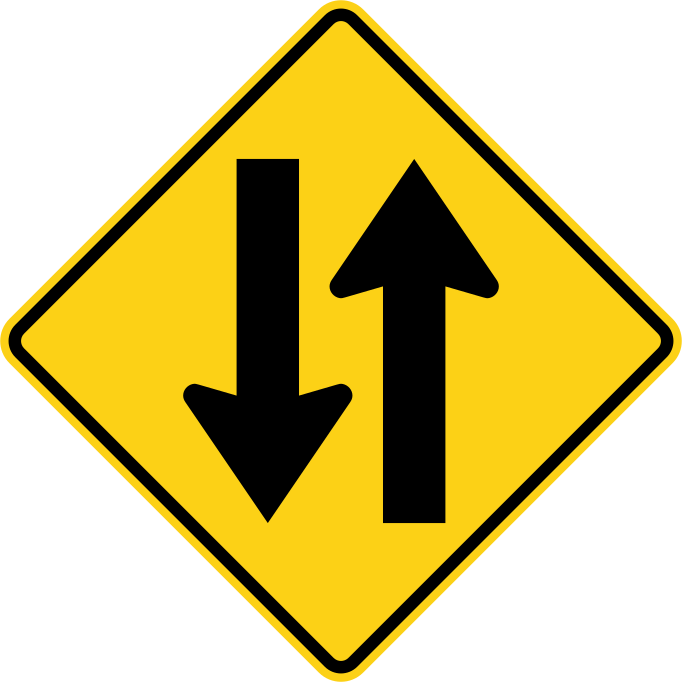
Question 21A TWO-WAY TRAFFIC warning sign means what?
Show answer
C: You are leaving a divided road and will drive on a two-way road. The two-way traffic sign warns that the divided highway is ending and oncoming traffic will soon share the road with you. Connecticut Driver's Manual: Two-Way Road Way, page 51.
-
Question 22How is a shared center left-turn lane marked?
Show answer
A: Solid yellow and dashed yellow lines on each side, with alternating left-turn arrows. Shared center lanes are marked on each side by solid and dashed yellow lines, with left-turn arrows for each direction alternating. Connecticut Driver's Manual: Shared Center Lane, page 46.
-
Question 23At a railroad crossing with more than one track, when should you start across after a train passes?
Show answer
D: When the train is well down the track and you can see no other train is coming. Wait until the passing train is well down the track; it may hide another train approaching on the other track. Connecticut Driver's Manual: Railroad Crossings, page 17.
-
Question 24When must you report a crash to police in Connecticut?
Show answer
D: If there is an injury, a death or property damage. Connecticut drivers must report a crash to police if anyone is hurt or killed or if there is property damage. Connecticut Driver's Manual: Traffic Crashes: Report the Accident, page 43.
-
Question 25What happens if the vehicle you bring for your road test is found to be unsafe?
Show answer
C: No driving evaluation is conducted and you reschedule for no fee. If the test vehicle is in unsafe operating condition, no behind-the-wheel evaluation is conducted and the applicant reschedules for no fee. Connecticut Driver's Manual: The Road Test, page 9.
Answer every question to see your score.
More Connecticut practice tests
- Practice test 125 questions
- Practice test 225 questions
- Practice test 325 questions
- Practice test 425 questions
- Practice test 525 questions
- Practice test 625 questions
- Practice test 725 questions
- Practice test 825 questions
- Practice test 1025 questions
- Practice test 1125 questions
- Practice test 1225 questions
- Exam simulatorThe real format, 25 questions
How to use these tests
Read each explanation, even when you get the question right: it tells you the rule and the handbook section, so you can look it up. Your answers are saved in this browser only, so the weak spots mode can give you more questions on the topics you miss. When you're scoring well, take the exam simulator: it uses the same number of questions and passing score as the real test.
Our own questions, written from the Connecticut Driver's Manual and checked against it. Not affiliated with the Connecticut Department of Motor Vehicles. Found a mistake? Tell us.