STOP/SLOW paddle sign
The flagger's preferred hand-signal device: an octagon on a rigid handle with STOP (red, the R1-1 design) on one side and SLOW (orange, W20-8) on the other.
What to do
STOP side toward you: stop and wait. SLOW side toward you: proceed slowly with caution as directed.
Treat the STOP side exactly like a STOP sign and wait until the flagger turns it to SLOW, then move ahead slowly and watch for workers.
Paddle procedures: Section 6D.05. No separate Commons file was located for the paddle; image null.
Where it's used
Section 6D.02 makes the STOP/SLOW paddle the preferred hand-signalling device for flaggers because it gives clearer guidance than a red flag. It must be an octagon on a rigid handle, normally 18 x 18 inches, with a red STOP face (R1-1) and an orange SLOW face (W20-8), retroreflective at night. White or red flashing lights may be added to the STOP face and white or yellow lights to the SLOW face, flashing 50 to 60 times a minute.
Don't confuse it with
- Stop: A permanent STOP sign is post-mounted at an intersection, while the paddle is held by a flagger and can switch to SLOW.
- Flagger: The Flagger diamond warns of the flagger ahead, while the paddle is the device they use.
- Pilot Car Follow Me: The PILOT CAR FOLLOW ME sign is mounted on a vehicle that leads traffic through the work zone.
- Type
- Work zone signs
- Shape
- Octagon
- Colors
- red, white, orange, black
- MUTCD code
- STOP/SLOW
- MUTCD section
- 6D.02
More work zone signs
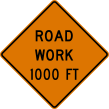 Road Work Ahead
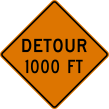 Detour Ahead
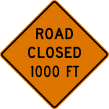 Road Closed Ahead
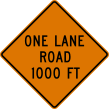 One Lane Road Ahead
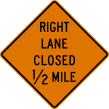 Right (Left) Lane Closed Ahead
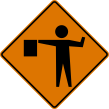 Flagger
 Workers
 Fresh Oil (Tar)
From the Manual on Uniform Traffic Control Devices (MUTCD), 11th edition, section 6D.02. Sign image: public domain.