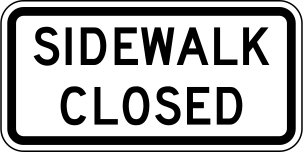
Sidewalk Closed sign
The sidewalk is closed to pedestrians ahead, typically because of work.
What to do
Drivers: watch for pedestrians who may be redirected into or across the street.
Expect pedestrians, including people using wheelchairs, to be crossing the street or walking at the road edge near the closure.
Where it's used
Section 6G.10 says SIDEWALK CLOSED (R9-9) signs should be used where pedestrian flow is restricted, at the start of the closed sidewalk, at the intersections before it and along it as needed. It is a horizontal black-on-white regulatory sign, usually mounted on a detectable barricade so that people with vision disabilities can tell the sidewalk is closed. Variants direct people to USE OTHER SIDE (R9-10) or CROSS HERE (R9-11, R9-11a), and pedestrian detour signs (M4-9a, M4-9b) mark a rerouted path.
Don't confuse it with
- No Pedestrian Crossing: NO PEDESTRIAN CROSSING bans crossing the street at that point, while SIDEWALK CLOSED means the sidewalk itself is shut.
- Road Closed: ROAD CLOSED shuts the roadway to vehicles, while SIDEWALK CLOSED is aimed at pedestrians.
- Pedestrian Warning: The yellow Pedestrian Warning sign warns drivers of people crossing.
- Type
- Work zone signs
- Shape
- Horizontal rectangle
- Colors
- white, black
- MUTCD code
- R9-9
- MUTCD section
- 6G.10
More work zone signs
 Road Work Ahead
 Detour Ahead
 Road Closed Ahead
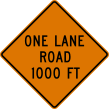 One Lane Road Ahead
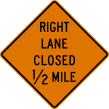 Right (Left) Lane Closed Ahead
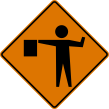 Flagger
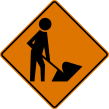 Workers
From the Manual on Uniform Traffic Control Devices (MUTCD), 11th edition, section 6G.10. Sign image: public domain, source.