Kansas KDOR Division of Vehicles permit practice test 11
25 questions written from the Kansas Driving Handbook (Non-Commercial Driver's Manual), covering alcohol and drugs, hazards, weather and night driving, licensing laws and penalties, sharing the road, signals and pavement markings and more. Pick an answer to see straight away whether you're right and why. The real Kansas KDOR Division of Vehicles test has 25 questions and you need 20 right.
-
Question 1Under 21 in Kansas, is it legal to possess alcoholic beverages?
Show answer
A: No, it is illegal to purchase, possess or drink alcohol. If you are under 21, it is illegal to purchase, possess or drink alcoholic beverages. Kansas Driving Handbook (Non-Commercial Driver's Manual): If you are under 21, page 22.
-
Question 2In a work zone, when should you merge if a lane will close?
Show answer
C: As soon as possible, at the first notice of the work zone. Merge as soon as possible by moving to the appropriate lane at first notice of an approaching work zone. Kansas Driving Handbook (Non-Commercial Driver's Manual): Work Zones, page 92.
-
Question 3What do approved private driver's education schools in Kansas provide?
Show answer
D: 8 hours of classroom and 6 hours of behind-the-wheel instruction. Approved private schools offer 8 hours of classroom and 6 hours of behind-the-wheel instruction; internet driver's ed courses are not accepted. Kansas Driving Handbook (Non-Commercial Driver's Manual): Driver's Education, page 9.
-
Question 4May two motorcycles share a single traffic lane in Kansas?
Show answer
A: Yes, two may share a lane, but cars may not pass a motorcycle in the same lane. Motorcyclists have the right to a complete lane, and two motorcycles may share a lane; do not pass a motorcycle in the same lane. Kansas Driving Handbook (Non-Commercial Driver's Manual): Motorcycles, Scooters and Mopeds, page 83.
-
Question 5Over a reversible lane, what does a flashing yellow X mean?
Show answer
C: The lane is for turning only. A flashing yellow X means the lane is for turning only; a steady yellow X means its use is changing; a red X means not available. Kansas Driving Handbook (Non-Commercial Driver's Manual): Reversible Lanes, page 45.
-
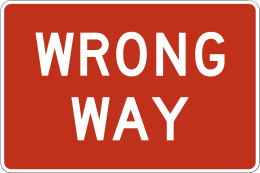
Question 6Where will you typically see a WRONG WAY sign on an expressway ramp?
Show answer
A: A short distance past the DO NOT ENTER sign. You'll see a Wrong Way sign on expressway ramps a short distance past the Do Not Enter sign. Kansas Driving Handbook (Non-Commercial Driver's Manual): Wrong Way, page 41.
-
Question 7When exiting a parallel parking space, when should you move fully into the lane?
Show answer
C: When your door post clears the rear bumper of the vehicle ahead. Move forward into the lane when the door post of your vehicle clears the rear bumper of the vehicle parked ahead. Kansas Driving Handbook (Non-Commercial Driver's Manual): Parallel Parking, page 54.
-
Question 8Even with a BAC under .08, can you be convicted of impaired driving in Kansas?
Show answer
D: Yes. Even under .08 you are still impaired, and under the law you can still be convicted of driving impaired. Kansas Driving Handbook (Non-Commercial Driver's Manual): Alcohol and the Law, page 23.
-
Question 9How long should you keep obeying work zone signs on a mobile work zone?
Show answer
C: Until you see the 'End Road Work' sign. Mobile work zones may not show workers right away; observe the signs until you see 'End Road Work'. Kansas Driving Handbook (Non-Commercial Driver's Manual): Work Zones, page 92.
-
Question 10Will Kansas accept a certificate from an internet driver education course for licensing?
Show answer
A: No. Internet courses do not meet Kansas requirements; their certificates will not be accepted. Kansas Driving Handbook (Non-Commercial Driver's Manual): Driver's Education, page 9.
-
Question 11What portion of motorcycle crashes with another vehicle are caused by the other vehicle turning left in front of the rider?
Show answer
C: Nearly 40 percent. About half of motorcycle crashes involve another vehicle; nearly 40 percent were caused by the other vehicle turning left in front of the rider. Kansas Driving Handbook (Non-Commercial Driver's Manual): Motorcycles, Scooters and Mopeds, page 83.
-
Question 12Over a reversible lane, what does a steady yellow X mean?
Show answer
A: The lane's use is changing; move out of it as soon as it is safe. A steady yellow X means the use of the lane is changing and you should move out of it as soon as it is safe. Kansas Driving Handbook (Non-Commercial Driver's Manual): Reversible Lanes, page 45.
-
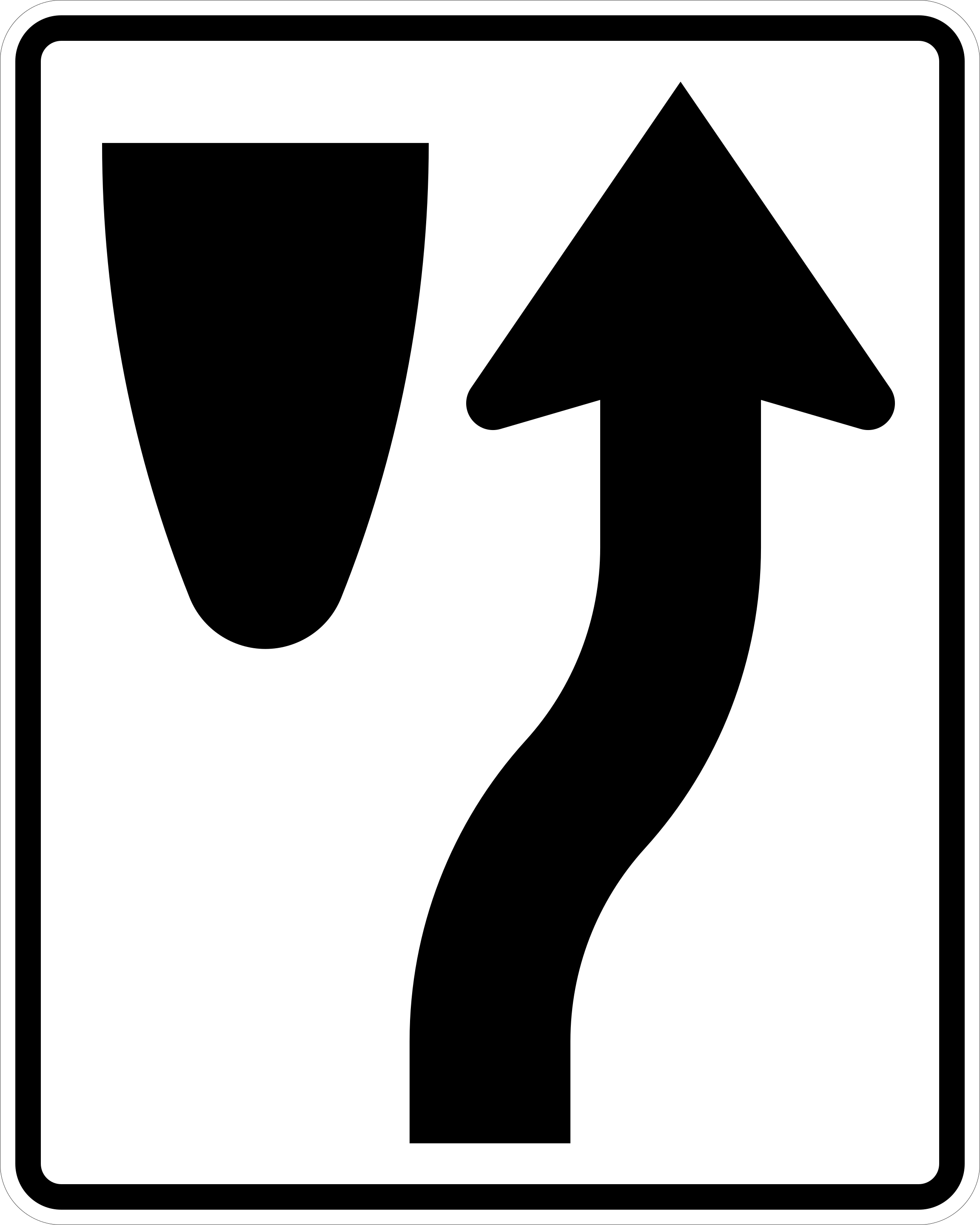
Question 13A KEEP RIGHT sign tells you to:
Show answer
A: Stay to the right of a median, island or lane divider ahead. Keep Right signs indicate traffic must stay to the right of a roadway feature or obstruction, such as a median or island. Kansas Driving Handbook (Non-Commercial Driver's Manual): Keep Right, page 41.
-
Question 14When entering a parallel space, how far back should you go before turning to center the car?
Show answer
C: Until your front bumper is in line with the rear bumper of the car you're parking behind. Continue backing until your front bumper is in line with the rear bumper of the vehicle you are parking behind, then turn to center. Kansas Driving Handbook (Non-Commercial Driver's Manual): Parallel Parking, page 54.
-
Question 15If you're stranded in a winter storm, what should you do?
Show answer
C: Stay with your vehicle unless you know exactly where help is. Stay with your vehicle; most deaths happen when people leave, get lost and suffer prolonged cold exposure. Kansas Driving Handbook (Non-Commercial Driver's Manual): Winter Driving, page 109.
-
Question 16How many questions are on the Kansas knowledge test?
Show answer
B: 25. The knowledge test consists of 25 multiple-choice questions on signs, markings, Kansas laws and driving practices. Kansas Driving Handbook (Non-Commercial Driver's Manual): Knowledge Test, page 94.
-
Question 17Under Kansas law, a moped's motor may have a cylinder capacity of no more than:
Show answer
C: 130 cubic centimeters. A motorized bicycle or moped has a motor of not more than 3.5 brake horsepower, a cylinder capacity of not more than 130 cc, an automatic transmission, and a maximum design speed of no more than 30 mph. Kansas Driving Handbook (Non-Commercial Driver's Manual): Motorcycles, Scooters and Mopeds, page 83.
-
Question 18An 'HOV 3' sign on a lane means:
Show answer
D: At least three people must be in the vehicle to use the lane. HOV lanes are for vehicles with two or more people; 'HOV 3' means at least three people must be in the vehicle. Kansas Driving Handbook (Non-Commercial Driver's Manual): Reserved Lanes, page 45.
-
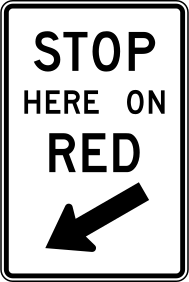
Question 19A STOP HERE ON RED sign shows:
Show answer
B: Where you must stop when the light is red. Stop Here on Red tells you where you must stop if the light is red. Kansas Driving Handbook (Non-Commercial Driver's Manual): Stop Here on Red, page 40.
-
Question 20In Kansas, what does a yellow painted curb indicate?
Show answer
C: A loading zone or other restriction. Yellow curbs indicate a loading zone or some other restriction. Kansas Driving Handbook (Non-Commercial Driver's Manual): Painted curbs, page 55.
-
Question 21When stranded in cold weather, how long does the handbook suggest running the engine each hour?
Show answer
C: About 10 minutes. Running the engine for about 10 minutes each hour is recommended, keeping the exhaust pipe clear and a window partly open. Kansas Driving Handbook (Non-Commercial Driver's Manual): Winter Driving, page 109.
-
Question 22What score must you get to pass the Kansas knowledge test?
Show answer
B: 80%. You must score 80% to pass the knowledge test. Kansas Driving Handbook (Non-Commercial Driver's Manual): Passing the Knowledge Test, page 94.
-
Question 23Why should you dim your headlights when approaching a motorcycle?
Show answer
B: The glare from high beams is far more dangerous to riders. Always dim your headlights when approaching a motorcycle; the blinding effect of high beams is far more dangerous for riders. Kansas Driving Handbook (Non-Commercial Driver's Manual): Motorcycles, Scooters and Mopeds, page 84.
-
Question 24What symbol often marks a reserved lane such as an HOV, transit or bicycle lane?
Show answer
D: A white diamond. Reserved lanes often have a white diamond posted at the side of the road or painted on the surface. Kansas Driving Handbook (Non-Commercial Driver's Manual): Reserved Lanes, page 45.
-
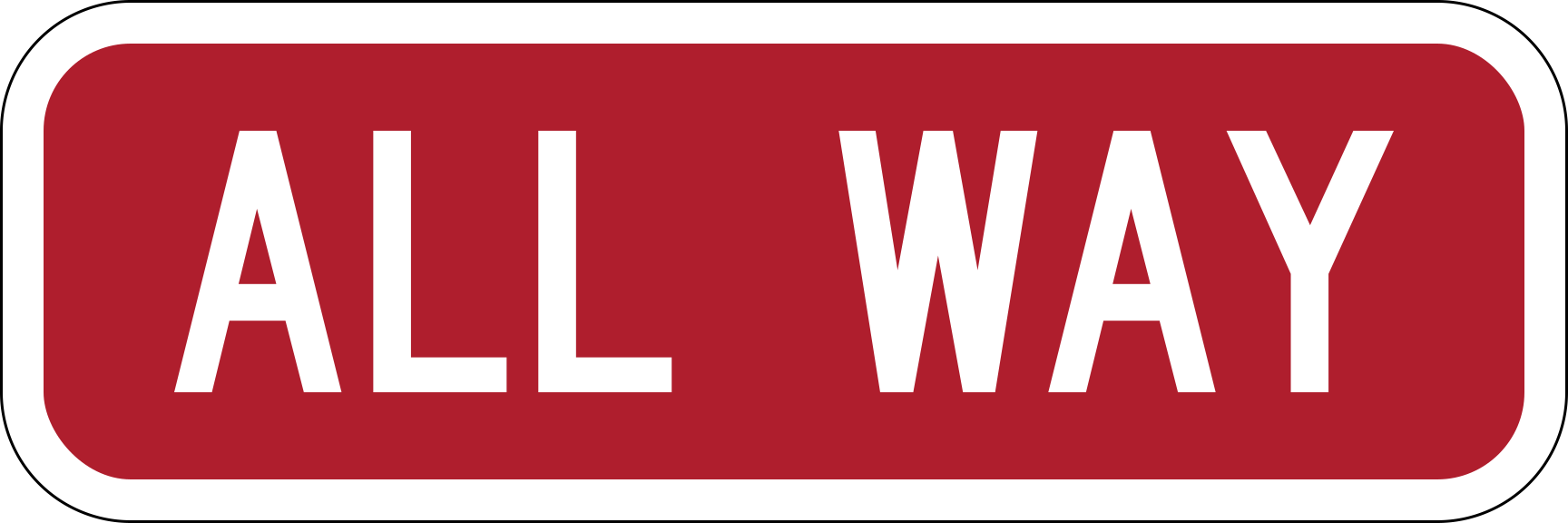
Question 25A plaque reading ALL WAY (or 4-WAY) is mounted under a stop sign. What does it mean?
Show answer
C: All approaching traffic has a stop sign. An ALL WAY or 4-WAY plaque under a stop sign tells you every approach to the intersection has a stop sign, so all drivers must stop. Kansas Driving Handbook (Non-Commercial Driver's Manual): Stop Sign, page 40.
Answer every question to see your score.
More Kansas practice tests
- Practice test 125 questions
- Practice test 225 questions
- Practice test 325 questions
- Practice test 425 questions
- Practice test 525 questions
- Practice test 625 questions
- Practice test 725 questions
- Practice test 825 questions
- Practice test 925 questions
- Practice test 1025 questions
- Practice test 1225 questions
- Practice test 1324 questions
- Exam simulatorThe real format, 25 questions
How to use these tests
Read each explanation, even when you get the question right: it tells you the rule and the handbook section, so you can look it up. Your answers are saved in this browser only, so the weak spots mode can give you more questions on the topics you miss. When you're scoring well, take the exam simulator: it uses the same number of questions and passing score as the real test.
Our own questions, written from the Kansas Driving Handbook (Non-Commercial Driver's Manual) and checked against it. Not affiliated with the Kansas Department of Revenue, Division of Vehicles. Found a mistake? Tell us.