Kansas KDOR Division of Vehicles permit practice test 2
25 questions written from the Kansas Driving Handbook (Non-Commercial Driver's Manual), covering emergencies, alcohol and drugs, hazards, weather and night driving, licensing laws and penalties, speed limits and more. Pick an answer to see straight away whether you're right and why. The real Kansas KDOR Division of Vehicles test has 25 questions and you need 20 right.
-
Question 1How far behind a broken-down vehicle should you place emergency flares?
Show answer
B: About 200 to 300 feet. Place emergency flares about 200 to 300 feet behind the vehicle. Kansas Driving Handbook (Non-Commercial Driver's Manual): Use emergency signals, page 69.
-
Question 2In Kansas, a driver under 21 can be arrested for alcohol impairment at what BAC?
Show answer
A: .02. If you are under 21, you can be arrested for alcohol impairment at .02%. Kansas Driving Handbook (Non-Commercial Driver's Manual): Alcohol and the Law, page 23.
-
Question 3Up to about what speed do modern tires keep stable traction on wet roads?
Show answer
A: About 30 mph. Modern tires have stable traction up to about 30 mph on wet roads; above 35 mph they start to ride up on pooled water. Kansas Driving Handbook (Non-Commercial Driver's Manual): Water on the roadway, page 60.
-
Question 4Who besides the supervising adult may sit in the front seat while a Kansas permit holder drives?
Show answer
B: No one. No person but the supervising adult may be in the front seat. Kansas Driving Handbook (Non-Commercial Driver's Manual): Instructional Permit Class C or M — K.S.A. 8-239, page 12.
-
Question 5Unless otherwise posted, what is the speed limit on Kansas state or federal highways?
Show answer
D: 65 mph. 65 mph on any state or federal highway outside of towns. Kansas Driving Handbook (Non-Commercial Driver's Manual): Speed Limits (K.S.A. 8-1558), page 16.
-
Question 6Who must wear seat belts in a Kansas passenger vehicle?
Show answer
A: All occupants. Kansas law requires all occupants to use safety restraints in passenger vehicles; it is a primary violation. Kansas Driving Handbook (Non-Commercial Driver's Manual): Seatbelts (K.S.A. 8-2501), page 16.
-
Question 7When turning left, whom must you yield to?
Show answer
D: Oncoming vehicles going straight or turning right. When turning left you must yield to oncoming vehicles going straight ahead or turning right. Kansas Driving Handbook (Non-Commercial Driver's Manual): Right-Of-Way (Section 6), page 33.
-
Question 8When must Kansas drivers stop for a school bus?
Show answer
A: When it is stopped with red lights flashing and/or stop arm extended. You must stop for a school bus stopped with red lights flashing and/or stop arm extended. Kansas Driving Handbook (Non-Commercial Driver's Manual): Rules for School Buses, page 50.
-
Question 9You are already in the intersection when the light turns yellow. What should you do?
Show answer
B: Continue safely through the intersection. If you are already in the intersection when the yellow light comes on, you may continue safely through. Kansas Driving Handbook (Non-Commercial Driver's Manual): Traffic Signals: Steady YELLOW Traffic Light, page 34.
-
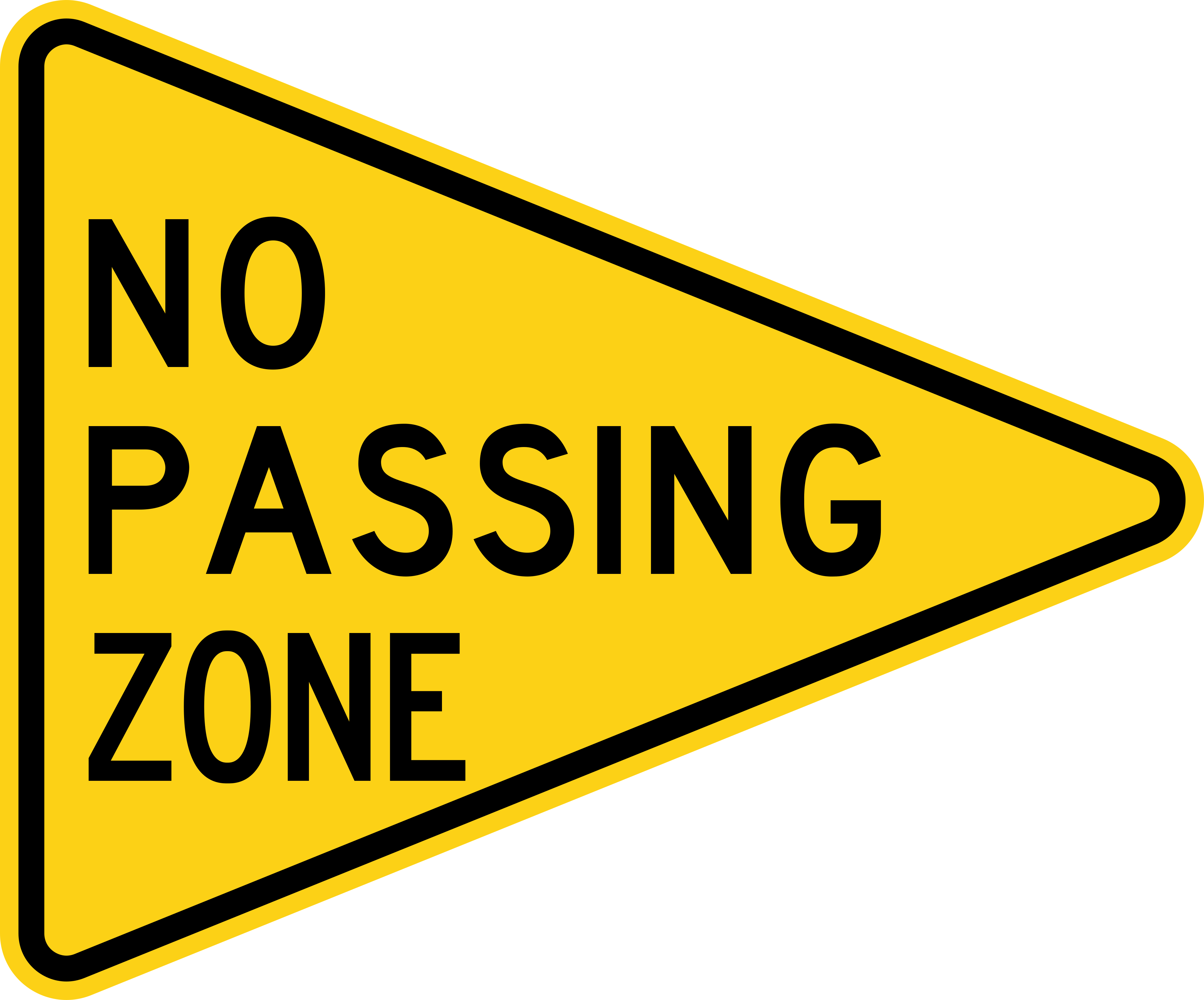
Question 10What is the only pennant-shaped warning sign, and where is it placed?
Show answer
B: No Passing Zone, on the left side of the road. The No Passing Zone sign is the only pennant-shaped warning sign; it marks the start of a no-passing zone on the left side of the road. Kansas Driving Handbook (Non-Commercial Driver's Manual): Passing (K.S.A. 8-1516, 8-1518, 8-1520), page 17.
-
Question 11In Kansas, what does a blue painted curb indicate?
Show answer
A: A handicap restriction. Blue curbs indicate a handicap restriction. Kansas Driving Handbook (Non-Commercial Driver's Manual): Painted curbs, page 55.
-
Question 12When turning right from a four-lane divided highway, how should you turn?
Show answer
A: Enter the right lane well in advance and make a tight turn into the right lane of the cross street. Enter the right lane well in advance and make a tight turn into the right lane of the cross street. Kansas Driving Handbook (Non-Commercial Driver's Manual): Turns on Multi-Lane Roads (K.S.A. 8-1545), page 17.
-
Question 13Within how many feet of a stopped emergency vehicle with emergency lights on is passing prohibited in Kansas?
Show answer
C: 100 feet. No passing within 100 feet of an emergency vehicle stopped on the side of the roadway with its emergency lights on. Kansas Driving Handbook (Non-Commercial Driver's Manual): Passing (K.S.A. 8-1516, 8-1518, 8-1520), page 17.
-
Question 14You miss your exit. Is it legal to back up in the travel lane?
Show answer
B: No, go on to where it is safe to turn around. It is illegal and unsafe to back a vehicle in any travel lane except to parallel park; go on to a safe place to turn around. Kansas Driving Handbook (Non-Commercial Driver's Manual): General Rules: General Driving, page 45.
-
Question 15With ABS, how do you stop quickly?
Show answer
D: Press the brake as hard as you can and keep pressing. With ABS, press on the brake pedal as hard as you can and keep pressing; don't let up even if it pushes back. Kansas Driving Handbook (Non-Commercial Driver's Manual): Braking Quickly, page 73.
-
Question 16With a BAC of .08 or more, how long may your Kansas driving privileges be suspended?
Show answer
C: 30 days. If you have a BAC of .08 or more, your license and privileges may be suspended for 30 days and you may face criminal penalties. Kansas Driving Handbook (Non-Commercial Driver's Manual): Alcohol and the Law, page 23.
-
Question 17In heavy rain, at what speed can your tires lose all traction with the road?
Show answer
D: 45-50 mph. In heavy rain, tires can lose all traction at 45-50 mph; badly worn tires lose traction at much lower speeds (25-30 mph). Kansas Driving Handbook (Non-Commercial Driver's Manual): Water on the roadway, page 60.
-
Question 18How long is a Kansas Class C instruction permit valid?
Show answer
A: One year. A Class C instructional permit expires in one year and may be renewed by retaking and passing the written exam. Kansas Driving Handbook (Non-Commercial Driver's Manual): Driver License Renewal: Permits, page 14.
-
Question 19Unless otherwise posted, what is the speed limit on Kansas county or township roads?
Show answer
D: 55 mph. 55 mph on any county or township road. Kansas Driving Handbook (Non-Commercial Driver's Manual): Speed Limits (K.S.A. 8-1558), page 16.
-
Question 20Kansas children under what age must be in a federally approved child safety seat?
Show answer
C: Under 4. All children under 4 must be in a federally approved child safety seat. Kansas Driving Handbook (Non-Commercial Driver's Manual): Child Restraints (K.S.A. 8-1344), page 16.
-
Question 21Must you yield to a pedestrian who is jaywalking?
Show answer
C: Yes, you must yield to pedestrians always. You must yield to pedestrians always, even if they are jaywalking or crossing where they should not. Kansas Driving Handbook (Non-Commercial Driver's Manual): Right-Of-Way (Section 6), page 33.
-
Question 22Must you stop for a school bus on the opposite side of a multi-lane highway without a median?
Show answer
C: Yes. You must stop on a multi-lane highway whether the bus is on your side of the road or the opposite side. Kansas Driving Handbook (Non-Commercial Driver's Manual): Rules for School Buses, page 51.
-
Question 23What does a yellow arrow mean?
Show answer
C: The green arrow is ending; prepare to stop and yield to oncoming traffic and pedestrians. A yellow arrow means the green arrow is ending; prepare to stop and yield to oncoming traffic or pedestrians. Kansas Driving Handbook (Non-Commercial Driver's Manual): Traffic Signals: YELLOW Arrow, page 34.
-
Question 24What color are Kansas incident signs used for crashes, spills or disasters?
Show answer
B: Fluorescent pink with black lettering. Incident signs are temporary and fluorescent pink with black lettering. Kansas Driving Handbook (Non-Commercial Driver's Manual): Incident Signs, page 43.
-
Question 25How close to a fire hydrant may you park in Kansas?
Show answer
B: No closer than 15 feet. Parking is not allowed within 15 feet of a fire hydrant. Kansas Driving Handbook (Non-Commercial Driver's Manual): Parking (K.S.A. 8-1571 8-1572), page 19.
Answer every question to see your score.
More Kansas practice tests
- Practice test 125 questions
- Practice test 325 questions
- Practice test 425 questions
- Practice test 525 questions
- Practice test 625 questions
- Practice test 725 questions
- Practice test 825 questions
- Practice test 925 questions
- Practice test 1025 questions
- Practice test 1125 questions
- Practice test 1225 questions
- Practice test 1324 questions
- Exam simulatorThe real format, 25 questions
How to use these tests
Read each explanation, even when you get the question right: it tells you the rule and the handbook section, so you can look it up. Your answers are saved in this browser only, so the weak spots mode can give you more questions on the topics you miss. When you're scoring well, take the exam simulator: it uses the same number of questions and passing score as the real test.
Our own questions, written from the Kansas Driving Handbook (Non-Commercial Driver's Manual) and checked against it. Not affiliated with the Kansas Department of Revenue, Division of Vehicles. Found a mistake? Tell us.