Kansas KDOR Division of Vehicles permit practice test
25 questions written from the Kansas Driving Handbook (Non-Commercial Driver's Manual), covering licensing laws and penalties, speed limits, safe and defensive driving, right of way, sharing the road and more. Pick an answer to see straight away whether you're right and why. The real Kansas KDOR Division of Vehicles test has 25 questions and you need 20 right.
-
Question 1What is the minimum age for a Kansas Class C instruction permit?
Show answer
D: 14. A Class C or M instruction permit is available at 14 years of age or older. Kansas Driving Handbook (Non-Commercial Driver's Manual): Age Requirements: Instruction Permits, page 9.
-
Question 2Unless otherwise posted, what is the maximum speed in a Kansas urban district?
Show answer
A: 30 mph. Unless otherwise posted, the maximum is 30 mph in any urban district. Kansas Driving Handbook (Non-Commercial Driver's Manual): Speed Limits (K.S.A. 8-1558), page 16.
-
Question 3Why are larger vehicles such as SUVs and pickups more prone to rollovers?
Show answer
D: They have a higher center of gravity. Larger vehicles with a higher center of gravity have special handling characteristics and are more prone to rollovers. Kansas Driving Handbook (Non-Commercial Driver's Manual): Special Handling Characteristics, page 62.
-
Question 4Two vehicles enter an intersection from different roads at about the same time. Who must yield?
Show answer
C: The driver on the left yields to the vehicle on the right. When two vehicles enter from different roadways at about the same time, the driver on the left yields to the vehicle on the right. Kansas Driving Handbook (Non-Commercial Driver's Manual): Right-of-Way (Section 2), page 18.
-
Question 5Do you have to stop for a transit bus picking up passengers when you are not behind it?
Show answer
C: No, unlike a school bus. Unlike a school bus, you do not have to stop for a transit bus picking up or dropping off people unless you are behind it. Kansas Driving Handbook (Non-Commercial Driver's Manual): Public Transportation: Transit Buses, page 87.
-
Question 6What does a steady green light require before you go if you were stopped?
Show answer
B: Let crossing traffic clear the intersection first. If you are stopped and the light turns green, you must allow crossing traffic to clear the intersection before going. Kansas Driving Handbook (Non-Commercial Driver's Manual): Traffic Signals: Steady GREEN Traffic Light, page 34.
-
Question 7What shape and color is a stop sign?

Show answer
B: Eight sides, red with white letters. A stop sign has eight sides and is red with white letters. Kansas Driving Handbook (Non-Commercial Driver's Manual): Stop Sign, page 40.
-
Question 8In Kansas, what does a white painted curb usually mean?
Show answer
A: Only short stops are permitted. Painted curbs: white = short stops only; yellow = loading zone or other restriction; blue = handicap; red = fire zone. Kansas Driving Handbook (Non-Commercial Driver's Manual): Painted curbs, page 55.
-
Question 9How far before a turn must you signal under Kansas law?
Show answer
B: At least 100 feet. All signals must be given at least 100 feet before making the actual move or turn. Kansas Driving Handbook (Non-Commercial Driver's Manual): Signaling for Stops and Turns (K.S.A. 8-1548), page 17.
-
Question 10When passing on a Kansas two-lane road, when may you return to the right lane?
Show answer
B: When you can see the entire front of the vehicle you passed in your rear-view mirror. Don't return too soon; wait until you can see the entire front of the vehicle you passed in your rear-view mirror. Kansas Driving Handbook (Non-Commercial Driver's Manual): Passing (K.S.A. 8-1516, 8-1518, 8-1520), page 17.
-
Question 11On a road with two or more lanes in your direction, which lane should you use?
Show answer
A: The right lane, except to pass. Stay in the right lane except to pass. Kansas Driving Handbook (Non-Commercial Driver's Manual): General Rules: General Driving, page 46.
-
Question 12Where should you stop if your vehicle breaks down on the highway?
Show answer
B: Off the road where others have a clear view, not just over a hill or around a curve. Get off the road and stop where others have a clear view; don't stop just over a hill or around a curve. Kansas Driving Handbook (Non-Commercial Driver's Manual): Use emergency signals, page 68.
-
Question 13At what BAC are you in violation of Kansas law?
Show answer
D: .08 or higher. If you are found to have .08 BAC or higher, you are in violation of the law. Kansas Driving Handbook (Non-Commercial Driver's Manual): Alcohol and the Law, page 23.
-
Question 14When are roads most slippery during rain, snow or sleet?
Show answer
C: When it first starts, as water mixes with dirt and oil. Roadways are more slippery when it first starts to rain, snow or sleet, as water mixes with dirt, oil and other substances. Kansas Driving Handbook (Non-Commercial Driver's Manual): Slippery roads, page 59.
-
Question 15Who may supervise a Kansas instruction permit holder?
Show answer
C: A licensed adult at least 21 with at least one year of driving experience, in the front seat. Permit holders may drive only with a licensed adult in the front seat who is at least 21 and has at least one year of driving experience. Kansas Driving Handbook (Non-Commercial Driver's Manual): Instructional Permit Class C or M — K.S.A. 8-239, page 12.
-
Question 16What is the maximum speed on separated, multilane Kansas highways designated and posted by the Secretary of Transportation?
Show answer
A: 75 mph. 75 mph on any separated, multilane highway as designated and posted by the Secretary of Transportation. Kansas Driving Handbook (Non-Commercial Driver's Manual): Speed Limits (K.S.A. 8-1558), page 16.
-
Question 17What does Kansas law prohibit regarding phones while driving?
Show answer
C: Using any electronic device to write, send or read a written communication, such as texting or email. Kansas prohibits using any electronic device to write, send or read written communications while driving; talking or dialing is not specifically illegal for licensed adults. Kansas Driving Handbook (Non-Commercial Driver's Manual): Cell Phones (K.S.A 8-1598), page 19.
-
Question 18At a four-way stop in Kansas, who goes first?
Show answer
D: The driver who reached the intersection first; if simultaneous, the vehicle on the right. The driver reaching the 4-way stop first goes first; if more than one arrive at the same time, the vehicle on the right goes first. Kansas Driving Handbook (Non-Commercial Driver's Manual): Right-Of-Way (Section 6), page 33.
-
Question 19At what speed may you pass a trolley or light rail safety zone?
Show answer
A: No faster than 10 mph. You may pass the safety zone as soon as it is safe and at no faster than 10 mph; never drive through or park in it. Kansas Driving Handbook (Non-Commercial Driver's Manual): Public Transportation: Transit Buses, page 87.
-
Question 20On horizontal traffic lights, which side is the red light on?
Show answer
C: The left. In horizontal signals, red is on the left, yellow in the middle and green on the right. Kansas Driving Handbook (Non-Commercial Driver's Manual): Traffic Signals, page 34.
-
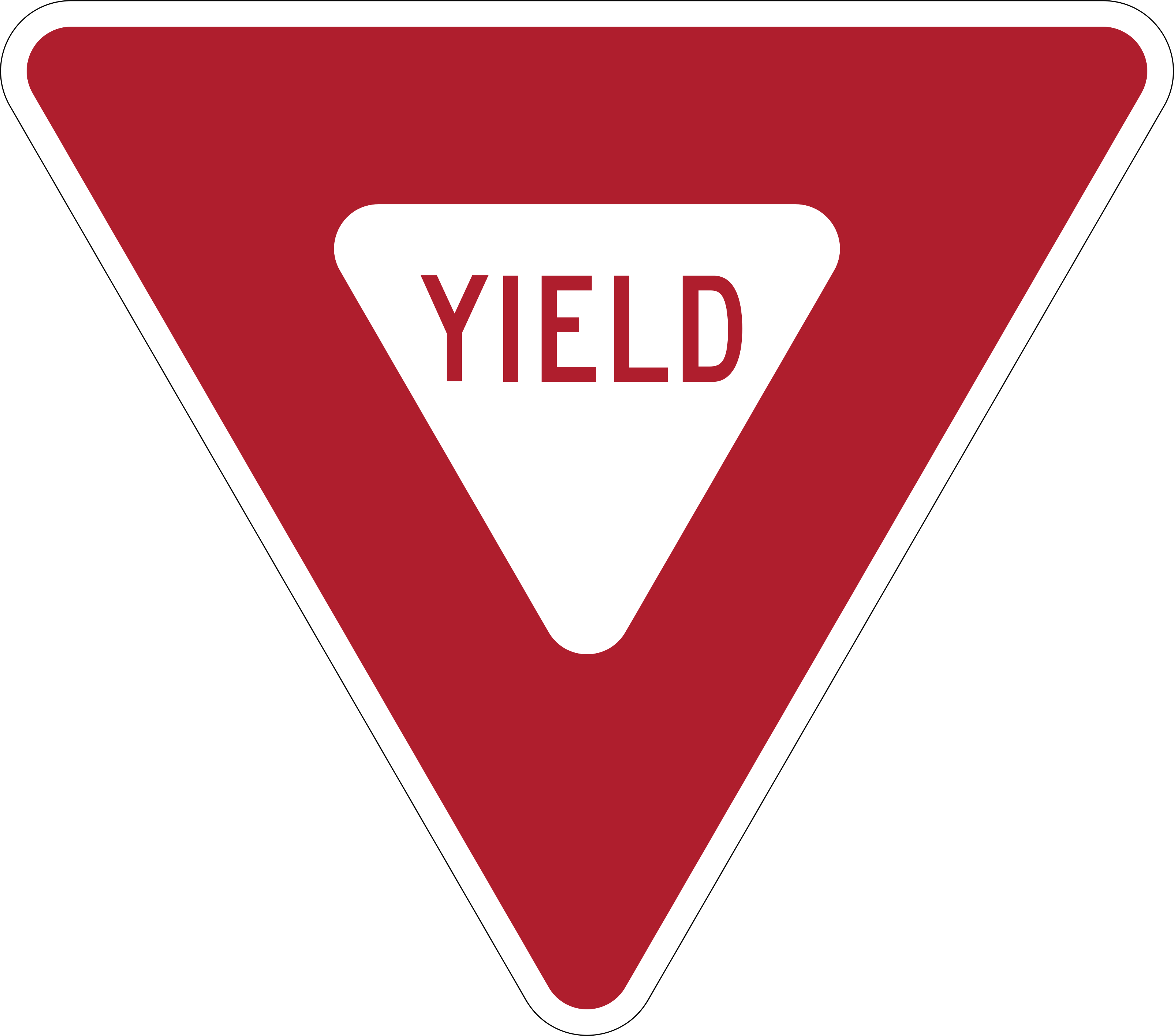
Question 21What shape is a yield sign?
Show answer
D: A red and white downward-pointing triangle. A yield sign is a red and white downward-pointing triangle with red letters. Kansas Driving Handbook (Non-Commercial Driver's Manual): Yield Sign, page 40.
-
Question 22In Kansas, what does a red painted curb indicate?
Show answer
A: Fire zone restrictions. Red curbs indicate fire zone restrictions. Kansas Driving Handbook (Non-Commercial Driver's Manual): Painted curbs, page 55.
-
Question 23At speeds above 40 mph, how far before a turn or lane change does the Kansas handbook advise signaling?
Show answer
B: 200 feet or 3 to 5 seconds. In urban areas signal 100 feet or 3 to 5 seconds before; above 40 mph signal 200 feet or 3 to 5 seconds before. Kansas Driving Handbook (Non-Commercial Driver's Manual): Signaling Your Movements, page 69.
-
Question 24You must not pass within how many feet of an intersection or railroad grade crossing in Kansas?
Show answer
B: 100 feet. No passing within 100 feet of crossing any intersection or railroad grade crossing. Kansas Driving Handbook (Non-Commercial Driver's Manual): Passing (K.S.A. 8-1516, 8-1518, 8-1520), page 17.
-
Question 25On a road with three or more lanes in the same direction, which lane does the Kansas handbook recommend?
Show answer
B: The center lane, especially with heavy entering and exiting traffic. With three or more lanes in the same direction, use the center lane, especially when a lot of traffic is entering or exiting. Kansas Driving Handbook (Non-Commercial Driver's Manual): General Rules: General Driving, page 46.
Answer every question to see your score.
More Kansas practice tests
- Practice test 225 questions
- Practice test 325 questions
- Practice test 425 questions
- Practice test 525 questions
- Practice test 625 questions
- Practice test 725 questions
- Practice test 825 questions
- Practice test 925 questions
- Practice test 1025 questions
- Practice test 1125 questions
- Practice test 1225 questions
- Practice test 1324 questions
- Exam simulatorThe real format, 25 questions
How to use these tests
Read each explanation, even when you get the question right: it tells you the rule and the handbook section, so you can look it up. Your answers are saved in this browser only, so the weak spots mode can give you more questions on the topics you miss. When you're scoring well, take the exam simulator: it uses the same number of questions and passing score as the real test.
Our own questions, written from the Kansas Driving Handbook (Non-Commercial Driver's Manual) and checked against it. Not affiliated with the Kansas Department of Revenue, Division of Vehicles. Found a mistake? Tell us.