Kansas KDOR Division of Vehicles permit practice test 9
25 questions written from the Kansas Driving Handbook (Non-Commercial Driver's Manual), covering road signs, parking, turns and intersections, following and passing, emergencies and more. Pick an answer to see straight away whether you're right and why. The real Kansas KDOR Division of Vehicles test has 25 questions and you need 20 right.
-
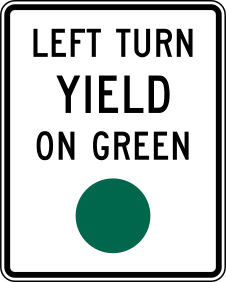
Question 1A sign reads LEFT TURN YIELD ON GREEN. What does it mean?
Show answer
A: Left turns are permitted on a green ball, but you must yield to oncoming traffic. It tells you a left turn is permitted but you must yield to oncoming traffic. Kansas Driving Handbook (Non-Commercial Driver's Manual): Left Turn Yield on Green, page 41.
-
Question 2When getting into your car parked on the street, how should you approach the driver's door?
Show answer
D: From the front of the vehicle with your key in hand, facing oncoming traffic. Approach the driver's door from the front of the vehicle with your key in hand to increase awareness of oncoming traffic. Kansas Driving Handbook (Non-Commercial Driver's Manual): Securing and Entering the Vehicle, page 52.
-
Question 3In a roundabout, if you plan to turn left, when should you signal right?
Show answer
C: After traveling three quarters of the way around, to take the exit. If you intend to turn left, signal right once you have traveled three quarters of the way around to take the exit. Kansas Driving Handbook (Non-Commercial Driver's Manual): Roundabouts and Traffic Circles, page 50.
-
Question 4Staying 500 feet behind emergency equipment means a following interval of at least about how many seconds at 30 mph?
Show answer
A: 12 seconds. The handbook says 500 feet behind emergency equipment is a minimum of about 12 seconds at 30 mph and about 6 seconds at 60 mph. Kansas Driving Handbook (Non-Commercial Driver's Manual): Space Ahead, page 63.
-
Question 5Your accelerator sticks. What should you do first?
Show answer
D: Shift to neutral and search for an escape path. Shift to neutral and search for an escape path, steer smoothly, brake gently, pull off, then turn off the vehicle. Kansas Driving Handbook (Non-Commercial Driver's Manual): Accelerator Failure, page 75.
-
Question 6How can 'pep pills' and diet pills affect driving?
Show answer
A: They can make you nervous, dizzy and unable to concentrate, and affect vision. Pep pills, uppers and diet pills can make you nervous, dizzy, unable to concentrate and can affect your vision. Kansas Driving Handbook (Non-Commercial Driver's Manual): Over-the-Counter Drugs, page 24.
-
Question 7How should you approach an uncontrolled rural intersection?
Show answer
D: Slow down and be prepared to stop for crossing or oncoming traffic. When approaching an uncontrolled rural intersection, slow down and be prepared to stop. Kansas Driving Handbook (Non-Commercial Driver's Manual): Rural Road Driving, page 90.
-
Question 8What is the minimum age for an unrestricted Kansas Class C license?
Show answer
B: 17. The unrestricted driver's license (K.S.A. 8-235d) requires a minimum age of 17. Kansas Driving Handbook (Non-Commercial Driver's Manual): Unrestricted Driver's License — K.S.A. 8-235d, page 13.
-
Question 9When you can see no farther than 100 feet ahead because of rain, snow, dust, smoke or fog, what is the fastest you can safely drive?
Show answer
A: 30 mph. When you cannot see farther than 100 feet ahead, you cannot safely drive faster than 30 mph. Kansas Driving Handbook (Non-Commercial Driver's Manual): Vision Limitations, page 77.
-
Question 10When pulled over by police in Kansas, what should you do?
Show answer
C: Pull right, turn off the engine, turn on hazards (and interior lights at night), keep your belt on and hands on the wheel. Move right, turn off the engine and devices, turn on hazards and interior lights at night, keep your seat belt on and hands on the wheel. Kansas Driving Handbook (Non-Commercial Driver's Manual): Police/Traffic Stops, page 85.
-
Question 11Do Kansas drivers have to move over for construction vehicles working on the road?
Show answer
C: Yes, move to a lane not next to them. You must yield to construction vehicles and workers engaged in work, and move into a lane not next to them. Kansas Driving Handbook (Non-Commercial Driver's Manual): Right-of-Way (Section 2), page 18.
-
Question 12You are about to turn right and a bicyclist is ahead on your right. What should you do?
Show answer
B: Don't pass the cyclist just before the turn; slow down and let them clear the intersection. If you are about to turn right, do not pass a bicyclist immediately before the turn; slow down and let the cyclist clear the intersection. Kansas Driving Handbook (Non-Commercial Driver's Manual): Bicyclists: As a driver, page 81.
-
Question 13If there are no crosswalk markings at an intersection, where must you stop?
Show answer
D: Before entering the intersection. If crosswalks are not apparent, you must stop prior to entering the intersection. Kansas Driving Handbook (Non-Commercial Driver's Manual): Crosswalks and Stop Lines, page 44.
-
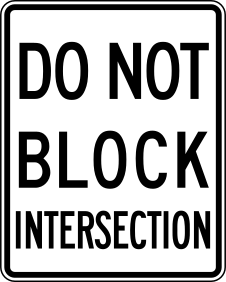
Question 14A DO NOT BLOCK INTERSECTION sign means:
Show answer
A: Don't stop, stand or park in the intersection, and don't enter if you can't clear it. Do not stop, stand or park in the intersection, and do not enter if you cannot clear it completely. Kansas Driving Handbook (Non-Commercial Driver's Manual): Do Not Block Intersection, page 41.
-
Question 15Is it legal to park on a bridge or in a tunnel in Kansas?
Show answer
B: No. Parking is not allowed on a bridge or other elevated structure or within a tunnel. Kansas Driving Handbook (Non-Commercial Driver's Manual): Parking (K.S.A. 8-1571 8-1572), page 19.
-
Question 16Why should you not drive alongside large vehicles in a roundabout?
Show answer
D: They need extra room and may cross into your path. The handbook warns not to drive alongside large trucks and buses in a roundabout; they need extra room to get around the tight circle and may use part of the next lane. Kansas Driving Handbook (Non-Commercial Driver's Manual): Roundabouts and Traffic Circles, page 50.
-
Question 17Why should you leave extra space when stopped behind a vehicle on a hill?
Show answer
A: It may roll back before moving forward. Leave extra space when stopped behind another vehicle on a hill; it may roll back before moving forward. Kansas Driving Handbook (Non-Commercial Driver's Manual): Space Ahead, page 63.
-
Question 18If you hit an animal, when must you report the crash to the police?
Show answer
C: If it involves a large animal such as a deer or farm animal. Report the crash to police if it involves a large animal such as a deer or farm animal. Kansas Driving Handbook (Non-Commercial Driver's Manual): Avoiding Collisions with Animals, page 93.
-
Question 19What did studies show about marijuana users as drivers?
Show answer
D: They make more mistakes, have more trouble with glare and get more traffic violations. Studies show people who use marijuana make more mistakes, have more trouble adjusting to glare and are arrested for traffic violations more than other drivers. Kansas Driving Handbook (Non-Commercial Driver's Manual): Illegal Drugs, page 24.
-
Question 20When are deer and other animals most active?
Show answer
C: At dawn and dusk, and from October through December. Use caution at dawn and dusk and between October and December, when animals are most active. Kansas Driving Handbook (Non-Commercial Driver's Manual): Avoiding Collisions with Animals, page 92.
-
Question 21What is the age range for a Kansas farm permit?
Show answer
B: 14 but less than 17. A farm permit has a minimum age of 14 but less than 17 and requires living or working on a farm. Kansas Driving Handbook (Non-Commercial Driver's Manual): Farm Permit --- K.S.A. 8-296, page 11.
-
Question 22With low beam headlights at night, about what speed allows you to stop within the distance you can see?
Show answer
D: About 45 mph. Low beams let you see about 150-200 feet ahead, so about 45 mph lets you stop within that distance; high beams (350-400 feet) allow about 65 mph. Kansas Driving Handbook (Non-Commercial Driver's Manual): Vision Limitations, page 77.
-
Question 23How should a lap belt be worn?
Show answer
B: Snug and low across your hips. The lap belt should be snug and lie low across your hips after fastening. Kansas Driving Handbook (Non-Commercial Driver's Manual): Using Safety Belts, page 27.
-
Question 24When leaving a driveway in a business district, where must you stop?
Show answer
A: Before driving onto the sidewalk or sidewalk area, then yield. A driver emerging from an alley, driveway or building must stop immediately before driving onto the sidewalk area, then yield. Kansas Driving Handbook (Non-Commercial Driver's Manual): Right-of-Way (Section 2), page 18.
-
Question 25When must a driver yield to a bicyclist on a bike path?
Show answer
C: When the bicycle path or bike lane intersects the road. You must yield the right-of-way to a bicyclist when a bicycle path or bike lane intersects a road. Kansas Driving Handbook (Non-Commercial Driver's Manual): Bicyclists: As a driver, page 81.
Answer every question to see your score.
More Kansas practice tests
- Practice test 125 questions
- Practice test 225 questions
- Practice test 325 questions
- Practice test 425 questions
- Practice test 525 questions
- Practice test 625 questions
- Practice test 725 questions
- Practice test 825 questions
- Practice test 1025 questions
- Practice test 1125 questions
- Practice test 1225 questions
- Practice test 1324 questions
- Exam simulatorThe real format, 25 questions
How to use these tests
Read each explanation, even when you get the question right: it tells you the rule and the handbook section, so you can look it up. Your answers are saved in this browser only, so the weak spots mode can give you more questions on the topics you miss. When you're scoring well, take the exam simulator: it uses the same number of questions and passing score as the real test.
Our own questions, written from the Kansas Driving Handbook (Non-Commercial Driver's Manual) and checked against it. Not affiliated with the Kansas Department of Revenue, Division of Vehicles. Found a mistake? Tell us.